
Receipt-to-Structured-Data Normalization Pipeline
A specialized, multi-agent pipeline that automates the extraction of raw, verifiable facts from unstructured receipts and time logs, outputting a perfectly structured JSON object ready for direct API ingestion into any existing accounting system.
Can AI turn receipt photos into structured data for my accounting software?
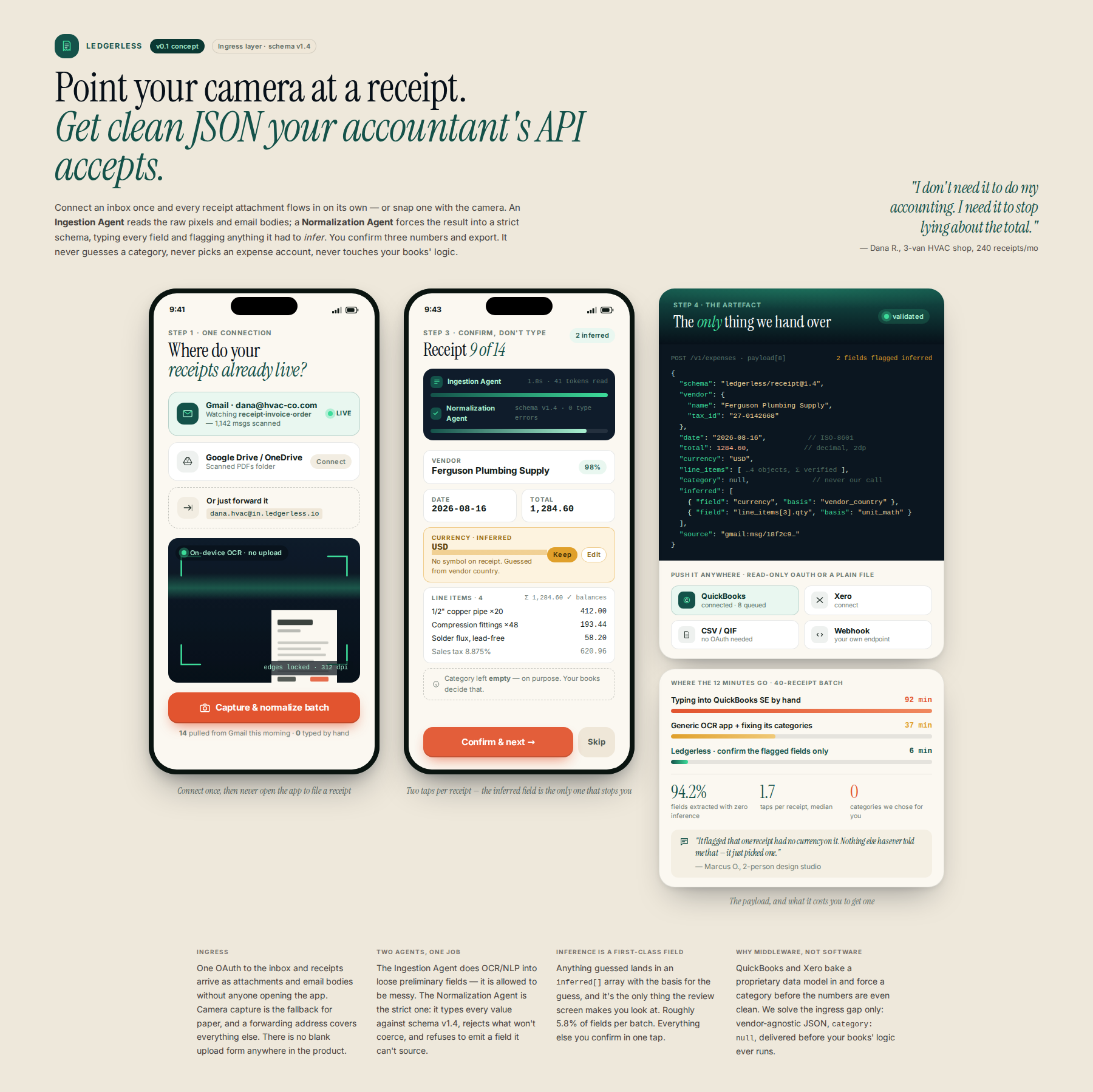
Yes: a multi-agent pipeline can OCR receipts and time logs, then normalize the results into a strict JSON schema (vendor, date, total, line items, currency) for direct API ingestion into accounting software. An ingestion agent extracts raw fields, a normalization agent validates data types and flags any inferred values, and the user confirms the structured draft before export. It targets small business owners and deliberately skips categorization, focusing only on clean, verifiable fact extraction.
Process flow
Who it's for
Small business owner
Why they need it
The primary friction point in modern bookkeeping is the manual, error-prone process of converting unstructured physical/digital inputs (receipt photos, handwritten logs) into structured, machine-readable data that accounting software can consume.
What it is
A focused agent workflow engine designed to consume raw inputs (OCR/NLP) and output a standardized, fact-based JSON payload containing only extracted entities (Vendor, Date, Total, Line Items, Currency), with zero attempt at categorization or financial reasoning.
How it works
- User uploads a batch of receipts/logs.
- The 'Ingestion Agent' extracts raw data (OCR/NLP) into preliminary fields.
- The 'Normalization Agent' validates and structures this data against a strict JSON schema, enforcing data types and required fields, and explicitly flagging any data points that required inference (e.g., assuming a missing currency).
- The system presents the final, structured JSON draft to the user for final, high-confidence validation before export/API call.
Differentiation
Unlike general tools (e.g., Google Docs) or existing specialized accounting software (e.g., QuickBooks Self-Employed) that often bake in their own, proprietary data models or force categorization prematurely, we solve the data ingress gap. We provide a universal, vendor-agnostic, structured JSON layer that acts as a reliable middleware, ensuring the raw data is clean and standardized before it touches the destination accounting system's logic.
Implementation sketch
- Prototype the core data pipeline using the agentcollective framework, focusing only on the Receipt OCR -> JSON Schema Output flow.
- Integrate a minimal MemoryEngine context solely to store and recall the target JSON schema structure and necessary field validation rules (e.g., date format, currency codes).
- Develop the front-end interface to display the agent's reasoning path (audit trail) showing what was extracted and how it was mapped to the target JSON structure, allowing user sign-off on the raw facts.
First step: Select a single, publicly available receipt template (e.g., a coffee shop receipt) and build a minimal agent workflow that successfully extracts Vendor, Date, and Total into a fixed JSON structure, achieving >95% accuracy on that single template.
Remaining risks
- The 'Ingestion Agent' fails to generalize beyond the single, controlled test template (e.g., coffee shop receipt) to handle the massive variability of real-world receipt formats (e.g., multi-page invoices, handwritten notes, receipts from international vendors). — Focus initial efforts on building a robust, modular OCR pre-processor layer that can identify document type (invoice vs. simple receipt vs. time log) before feeding data to the main agent, and prioritize integration with a commercial, specialized OCR service (e.g., Google Document AI) rather than relying solely on generalized LLM vision capabilities.
- The 'Normalization Agent' successfully outputs clean JSON, but the target accounting system's API schema is itself poorly documented, unstable, or requires complex, non-standard authentication/mapping logic, creating a new integration bottleneck. — Develop a 'Schema Abstraction Layer' MVP that doesn't connect to a live accounting API, but instead generates a standardized, human-readable JSON payload and a corresponding, editable YAML/JSON mapping file that explicitly details how the payload maps to the target system's expected fields. This decouples the core agent logic from external API volatility.
- The perceived value remains low because the user still has to manually review and confirm every extracted fact in the audit trail, leading to high cognitive load and diminishing returns compared to simply entering data manually. — Introduce a 'Confidence Scoring' mechanism visible to the user. Instead of just flagging inference, the system must assign a confidence score (e.g., 98% for Vendor Name, 75% for Line Item Description) to every extracted field. The UI must guide the user to only review fields below a certain threshold (e.g., 90% confidence), making the review process feel selective rather than exhaustive.
Watch for: If early user testing reveals that the primary friction point is not the extraction of data, but the context of the data (e.g., 'Why was this $50 receipt categorized as Travel vs. Supplies?'), it signals that the core value proposition is insufficient, and the project needs to re-evaluate the necessity of the 'fact-only' constraint. Kill criterion: If the system cannot reliably process and structure data from three fundamentally different, common receipt types (e.g., a gas station receipt, a restaurant bill, and a utility bill) into the required JSON schema with less than 80% accuracy across the board, the technical difficulty of the OCR/NLP layer exceeds the current scope and should trigger a pivot away from general receipt processing.
Sources the council used
Real-world evidence that grounded this idea — judge it for yourself.