
Expert-Driven Private Computation Platform for AI Auditing
A secure, platform-as-a-service (PaaS) environment enabling external auditors and specialized consultants to run proprietary, complex validation scripts against sensitive client data using Homomorphic Encryption or Secure Multi-Party Computation.
How can regulated companies get third-party auditors to validate sensitive data without exposing it to them?
A private computation platform lets external auditors run their proprietary validation scripts directly against encrypted client data using homomorphic encryption or secure multi-party computation, so the data is never decrypted or exposed. Clients upload encrypted data, auditors submit pre-vetted scripts that execute inside an isolated enclave against the ciphertext, and only raw computational results are returned for the auditor to interpret and sign off on. It's built for HealthTech and FinTech compliance teams, boutique cybersecurity firms, and AI audit consultancies that need demonstrable proof of rigorous data handling.
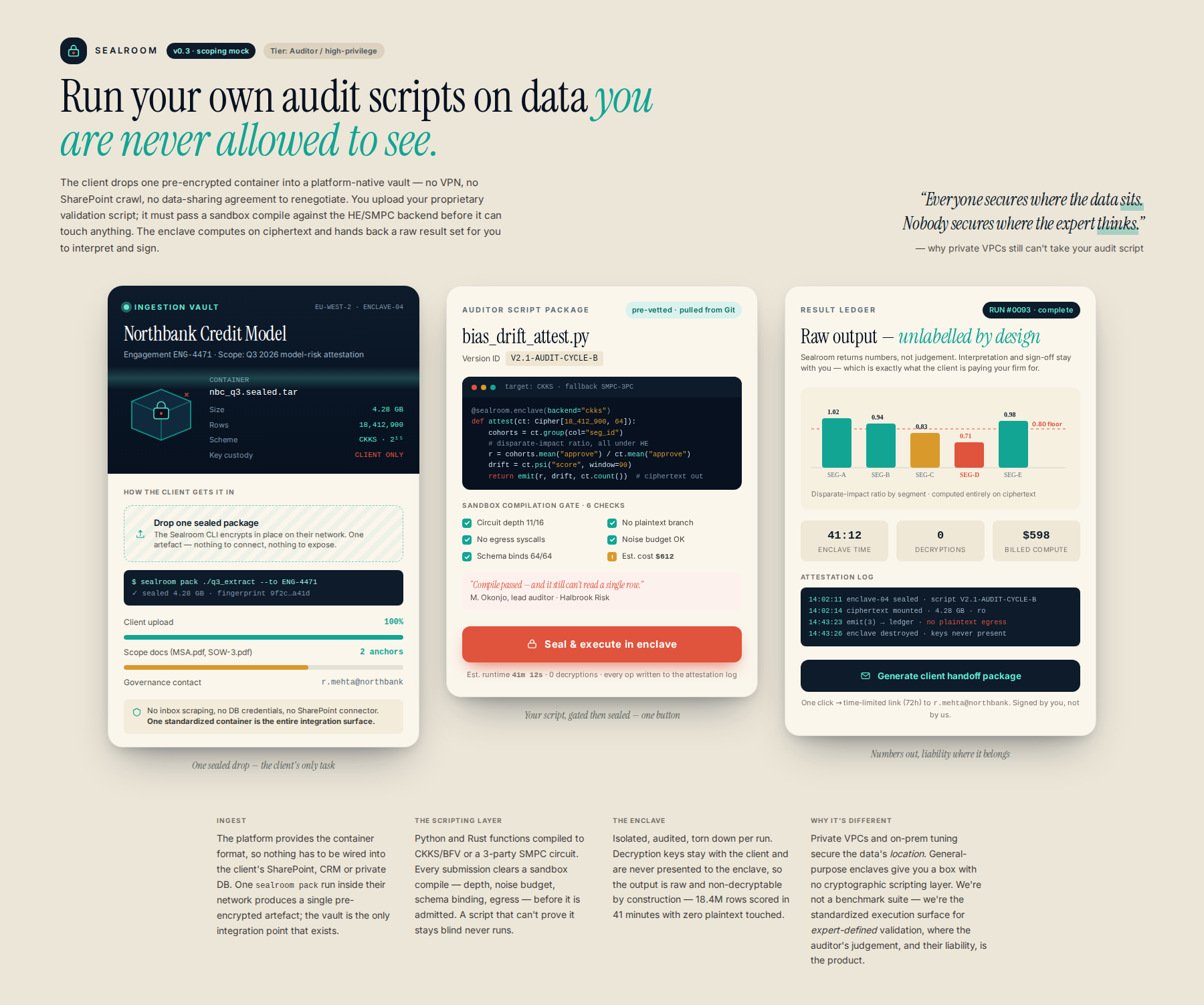
Process flow
Who it's for
Boutique cybersecurity firms, specialized AI audit consultancies, and large enterprise risk/compliance departments.
Why they need it
Regulated industries (HealthTech, FinTech) require demonstrable proof of data handling rigor for legal compliance, but internal teams lack the expertise or the platform to execute complex, multi-protocol cryptographic audits. This platform outsources the computational complexity to a secure execution environment, monetizing the platform access rather than the report. This directly addresses the gap between theoretical compliance needs and practical, expert-led auditing.
What it is
A managed, cloud-based execution environment that accepts encrypted data and allows authenticated, high-privilege users (auditors) to submit and execute custom, pre-vetted computational scripts (e.g., Python/Rust functions compiled for HE/SMPC execution) against that data, returning only the raw, non-decryptable results.
How it works
- The client uploads encrypted data and grants access to the platform.
- The auditor uploads their proprietary validation script, which must pass a sandbox compilation check against the target HE/SMPC backend.
- The platform executes the script within a highly isolated, audited enclave, performing the computation on the ciphertext.
- The platform returns the raw computational result set, which the auditor then interprets and signs off on, shifting the liability and expertise to the service provider.
Differentiation
Existing solutions (e.g., private VPCs, on-prem fine-tuning) secure the data location. Our gap is the secure, standardized execution environment for expert-defined, complex computational validation. We are not a benchmarking tool; we are a specialized, auditable execution platform for third-party experts, unlike general-purpose secure enclaves which lack the specific, high-level cryptographic scripting layer.
Implementation sketch
- Build a secure, multi-tenant backend capable of accepting and managing encrypted data payloads.
- Develop a sandboxed execution layer that compiles and runs user-provided scripts (e.g., Python/Rust) against specific, pre-loaded HE/SMPC computation kernels.
- Implement role-based access control (RBAC) strictly separating client data owners from the executing auditors, with mandatory audit logging for every script execution and data access attempt.
First step: Research and prototype the API/SDK wrapper required to execute a simple, known cryptographic function (e.g., basic XOR or addition) using a mature, open-source HE library (like Microsoft SEAL bindings or TFHE-rs) within a containerized, sandboxed environment (e.g., using gVisor or Firecracker). This proves the core 'execution' capability.
Remaining risks
- Cryptographic Implementation Complexity and Performance Ceiling: Even with a specialized platform, the performance overhead of HE/SMPC is immense. If the required computation (the audit script) pushes the HE/SMPC framework beyond its current practical limits (e.g., requiring operations that are computationally infeasible or too slow for any commercial SLA), the platform becomes unusable for real-world auditing. — Focus initial marketing and technical validation on 'Proof of Concept' audits that use the least computationally intensive, yet still highly valuable, cryptographic primitives (e.g., simple linear transformations or basic statistical checks) to build trust and establish a performance baseline before tackling complex, multi-step algorithms.
- Auditor/Consultant Adoption Friction: The platform requires the adoption of a highly specialized, niche technical workflow (writing scripts for a specific HE/SMPC backend). If the target expert audience (auditors) are accustomed to established, non-cryptographic audit tools (e.g., standard penetration testing suites, SQL queries), the learning curve and required integration effort for their existing workflows will create significant adoption friction. — Develop a 'script translator' or 'wrapper' layer that allows auditors to define their validation logic in a higher-level, familiar language (like Python pseudocode) and have the platform automatically generate the necessary, optimized HE/SMPC kernel calls, minimizing the need for them to become cryptographic engineers.
- Regulatory Scope Creep and Liability: While the platform shifts liability to the auditor, the platform itself becomes a critical piece of infrastructure handling the most sensitive data. Any perceived weakness in the platform's isolation, logging, or access control (even if technically sound) will immediately become a regulatory target, leading to immense liability risk. — Seek early, non-revenue-generating 'Advisory' partnerships with a single, reputable compliance firm or law firm. Use their established trust and existing compliance frameworks to validate the platform's security posture before selling it to the broader market, effectively outsourcing initial trust validation.
Watch for: A major, established cybersecurity vendor (e.g., IBM, Google Cloud) announces a significantly simplified, high-performance, and broadly usable SDK/API for running any custom ML workload within a verifiable confidential computing environment that doesn't require the full complexity of HE/SMPC. Kill criterion: If the initial 'first concrete step' (proving basic XOR/addition execution) fails to achieve a demonstrable, stable performance profile that can be reliably replicated across multiple, different open-source HE libraries, the fundamental technical premise of the platform is too brittle for commercialization.