Verifiable Privacy Sandboxing for Multi-Agent LLM Fine-Tuning
How can I fine-tune AI models on sensitive data without exposing it?
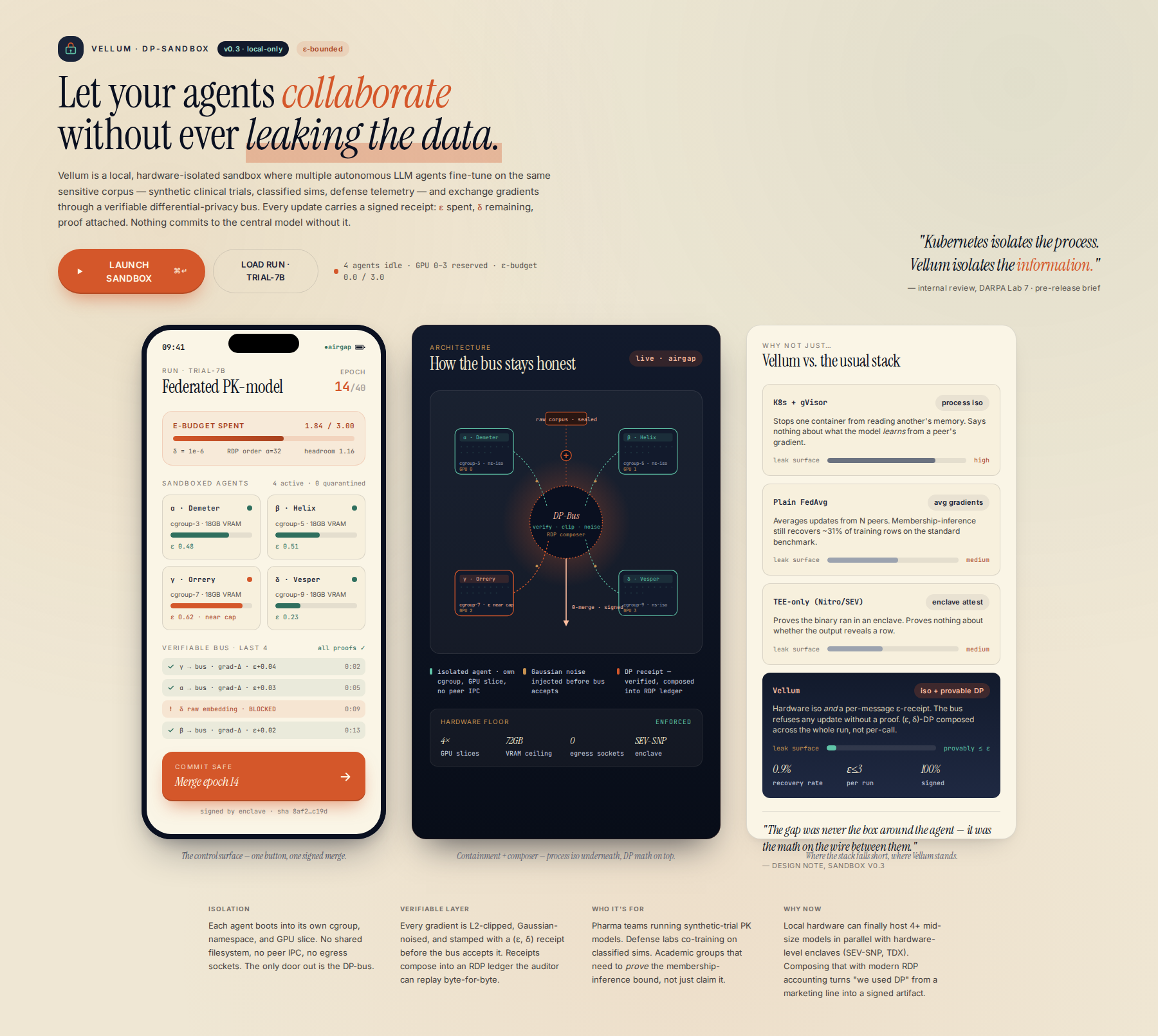
You can use verifiable privacy-preserving techniques like differential privacy to guarantee that model updates don't leak information about training data. A sandbox orchestrates multiple agents to collaboratively train on simulated data while enforcing differential privacy budgets at each gradient exchange. This approach combines hardware-level agent isolation with verifiable computation layers to ensure mathematical privacy guarantees alongside model accuracy.
Process flow
Who it's for
Academic research labs, pharmaceutical AI teams, and defense contractors working with highly sensitive, simulated data requiring verifiable privacy guarantees.
Why they need it
The convergence of advanced multi-agent research (high 'research' conviction) and increasing regulatory/ethical scrutiny necessitates an environment that not only isolates agents but also mathematically proves the privacy of the resulting model parameters during collaborative training runs. This moves beyond simple 'security' to verifiable 'privacy' in the research workflow.
What it is
A local, hardware-accelerated sandbox that orchestrates agent interactions, enforces resource constraints, and integrates verifiable computation layers (like differential privacy mechanisms) to ensure that the model updates derived from multi-agent collaboration cannot leak information about the underlying sensitive data.
How it works
It wraps the 'agentcollective' concept by enforcing hardware-level containerization around each agent process, restricting access to data/resources. Crucially, it layers an auditable, verifiable computation layer over the message bus, ensuring that any gradient exchange or state update adheres to pre-defined differential privacy budgets before being committed to the central model state.
Differentiation
Unlike general containerization tools (e.g., Kubernetes/gVisor) or basic orchestration layers, this framework explicitly models and enforces provable privacy constraints (e.g., $ ext{DP-} ext{k}$) on inter-agent communication and model updates. It addresses the 'data leakage during collaboration' gap, which existing tools treat only as process isolation, not mathematical privacy guarantees.
Implementation sketch
- Develop the core resource management layer: Proof-of-Concept (PoC) implementation using existing container runtime hooks (e.g., Kata Containers) to enforce basic CPU/memory limits on two simulated agent processes.
- Implement the secure communication bus: Define a minimal, schema-validated message structure (e.g., JSON/Protobuf) for gradient exchange and build a mock interceptor that logs all payloads.
- Integrate the first privacy check: Wrap the message interceptor with a placeholder function that verifies the message structure and logs a simulated DP budget check (no actual DP math needed yet, just the hook).
First step: Write a basic Python script that uses the subprocess module to launch two isolated processes (simulating agents) with hard resource limits (e.g., using resource module or container CLI) and write a logging interceptor between them.
Remaining risks
- The 'Verifiable' component (DP enforcement) is mathematically complex and brittle. Any real-world implementation requires deep integration with ML frameworks (PyTorch/TensorFlow) that are not inherently designed to expose gradients for external, verifiable budget checking, leading to an intractable integration point. — Focus the initial PoC strictly on the interface and workflow (the message bus interception and logging) rather than the mathematical proof itself. Treat the DP check as a mandatory, external service call that returns a boolean success/fail, deferring the actual gradient manipulation until a dedicated 'Phase 2: Privacy Layer'.
- The hardware-level resource isolation (Kata Containers/gVisor) is an operational dependency. If the target research labs do not have standardized access to, or expertise in deploying, such advanced container runtimes, the entire framework becomes inaccessible outside of highly specialized academic clusters. — Develop a clear, documented fallback path that uses standard, high-level orchestration tools (e.g., basic Docker Compose with resource limits) for the initial MVP demonstration, while documenting the advanced runtime requirement as a 'Premium/Enterprise Feature' for later adoption.
- The 'Multi-Agent' coordination logic itself (the message bus schema) could become a bottleneck or a single point of failure. If agents develop unexpected, non-schema-compliant interactions (e.g., attempting to pass raw tensors instead of serialized gradients), the interceptor will fail silently or crash the entire sandbox. — Implement strict, layered validation: 1) Schema validation on ingress, 2) Type checking on payload contents, and 3) A 'circuit breaker' mechanism that automatically quarantines the offending agent process and logs a detailed failure report, allowing the remaining agents to continue operation.
Watch for: Any indication from potential early adopters that they are more concerned with the data provenance (who trained it, when, and with what data) than the mathematical privacy guarantee ($ ext{DP-} ext{k}$). This suggests the pain point is organizational/auditability, not cryptographic. Kill criterion: If, after presenting the PoC, the primary feedback received is that the framework requires deep, real-time modification of the core ML training loop (e.g., modifying the backpropagation step itself) rather than simply intercepting the output of the training step (the gradient/update), the scope is too deep for a viable initial product.