
Federated Multi-Agent Simulation Engine for Compliance Auditing
A platform enabling rigorous, auditable simulation of complex, multi-agent interactions by abstracting the execution environment, allowing seamless integration of both local, privacy-preserving LLMs and state-of-the-art cloud models for targeted reasoning boosts.
How can I prove AI compliance through execution, not documentation?
A federated simulation platform orchestrates multiple local LLMs to model and validate complex regulatory workflows, generating auditable compliance trails by logging every agent interaction. Unlike static policy checkers, it dynamically simulates behavior and process failure, comparing execution against predefined ethical guardrails (GDPR, HIPAA). You get an immutable audit report quantifying deviations and mapping regulatory mandates to measurable model performance.
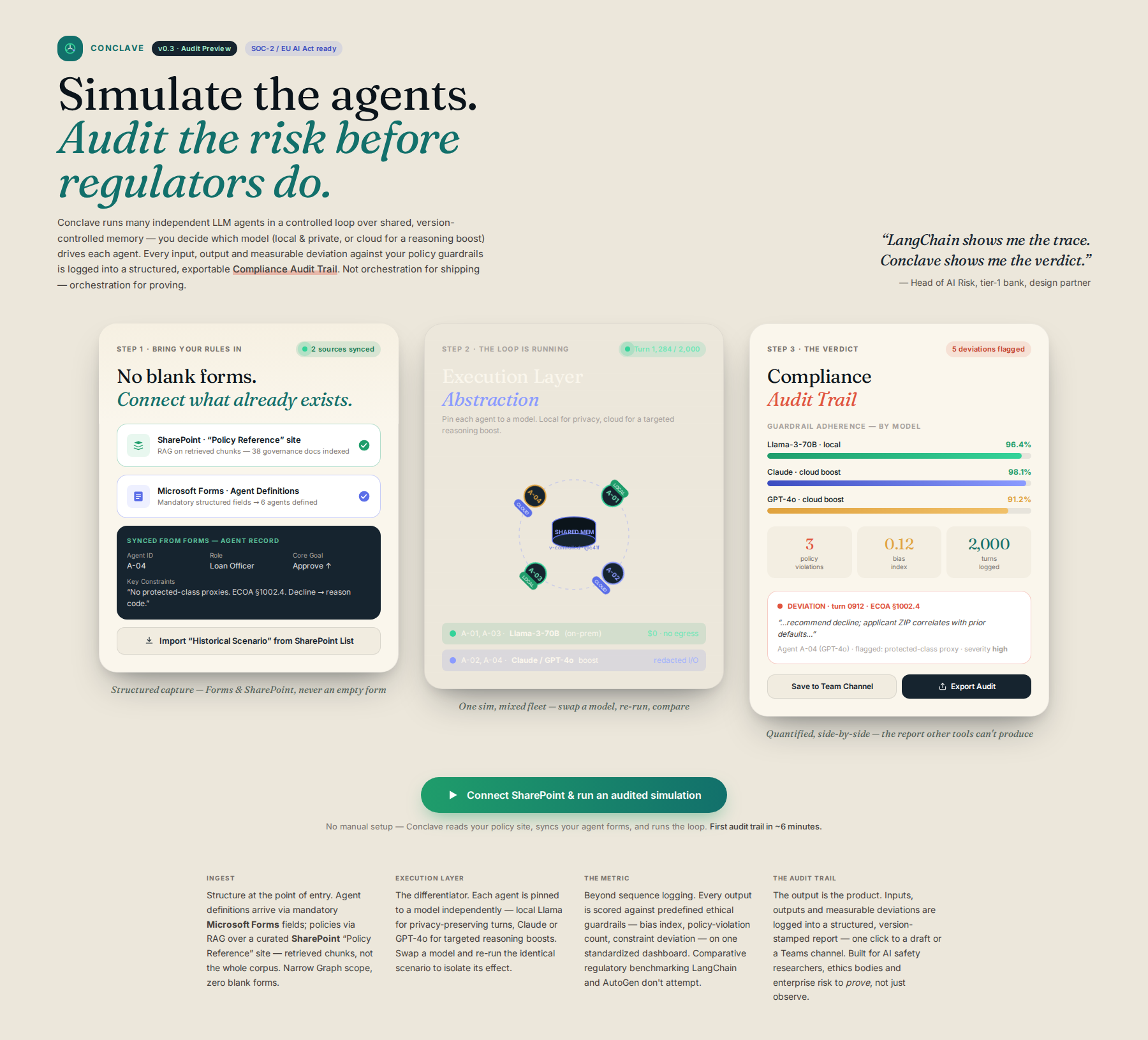
Process flow
Who it's for
AI Safety Researchers, AI Ethics Bodies, and Enterprise Risk Management teams requiring verifiable simulations of systemic risk.
Why they need it
To provide a simulation environment that maintains scientific rigor by enabling comparative analysis across different model capabilities (local vs. cloud) while generating a standardized 'Compliance Audit Trail' that maps directly to emerging regulatory requirements.
What it is
A simulation framework that orchestrates multiple independent LLM instances (agents) running in a controlled loop, managing shared, version-controlled 'memory,' and providing a structured, comparative output dashboard.
How it works
Users define agent personalities, goal states, and interaction rules. The system runs agents in a loop, managing shared state. The key architectural feature is the 'Execution Layer Abstraction': users specify which model (local/remote) is used for which agent/task. The system's output is structured to generate a 'Compliance Audit Trail' by logging inputs, outputs, and measurable deviations against predefined ethical/safety constraints.
Differentiation
Unlike general orchestration tools (e.g., LangChain, AutoGen) or pure simulation frameworks, this system's unique gap is its focus on comparative regulatory compliance benchmarking. It moves beyond mere sequence logging by providing a structured, auditable report that quantifies model performance against predefined ethical guardrails (e.g., measuring instances of bias or policy violation) using a standardized metric dashboard, which existing tools lack.
Implementation sketch
- Develop the 'Execution Layer Abstraction' API wrapper: Create a standardized interface that accepts model parameters and routes calls to configured backends (e.g., local llama.cpp endpoint, OpenAI API key).
- Build the core state management module: Implement version control and shared memory persistence, ensuring atomic state commits across heterogeneous model calls.
- Develop the initial Dashboard MVP: Focus on creating a comparative visualization that plots metrics (e.g., adherence score, deviation count) side-by-side for the same scenario run using Model A vs. Model B.
First step: Spend one day mapping the input/output schema requirements for the 'Compliance Audit Trail' report based on the structure of the EU AI Act's risk categorization requirements, treating this schema definition as the primary deliverable for the next week.
Remaining risks
- The 'Compliance Audit Trail' becomes an over-engineered black box, requiring deep expertise in both simulation theory and regulatory law to interpret, thereby limiting adoption to only the most specialized, slow-moving internal compliance teams. — Develop a tiered output visualization: a high-level, plain-language 'Risk Summary' dashboard (for executives/regulators) that summarizes the technical findings, alongside the detailed, technical 'Audit Trail' (for engineers/safety researchers).
- The 'Execution Layer Abstraction' fails to account for subtle, non-deterministic drift in the underlying LLM APIs (e.g., OpenAI model updates, rate limit changes, or subtle prompt interpretation shifts), leading to simulation results that are non-reproducible or appear to change without a corresponding change in the input parameters. — Implement mandatory, version-locked API wrappers for all external LLM calls, coupled with an automated 'drift detection' module that flags significant statistical deviations in output distributions (e.g., token usage, sentiment scores) between runs, even if the prompt remains identical.
- The complexity of managing state across heterogeneous backends (local vs. cloud) introduces race conditions or data corruption in the shared memory that are only exposed under high load or complex, long-running simulations, leading to catastrophic failure during critical testing phases. — Prioritize rigorous, incremental testing focused solely on state integrity: build a dedicated 'State Stress Test Suite' that runs thousands of small, state-changing transactions across the abstraction layer to prove atomicity and consistency before simulating complex agent interactions.
Watch for: A major regulatory body or industry consortium releasing a standardized, open-source simulation methodology that already incorporates comparative benchmarking, which would instantly neutralize the 'comparative benchmarking' differentiation. Kill criterion: Inability to prove, through a proof-of-concept, that the system can reliably and repeatably generate the same quantitative compliance deviation score for the same scenario when switching between two different, stable versions of the same foundational LLM model (e.g., GPT-4 Turbo v1 vs. v2), indicating fundamental state tracking failure.