
Autonomous LLM Compliance Auditing Engine
A local, multi-agent simulation environment that continuously models and validates complex regulatory compliance workflows against specific, immediate regulatory mandates, providing auditable proof of adherence.
How do I continuously verify AI compliance against regulations?
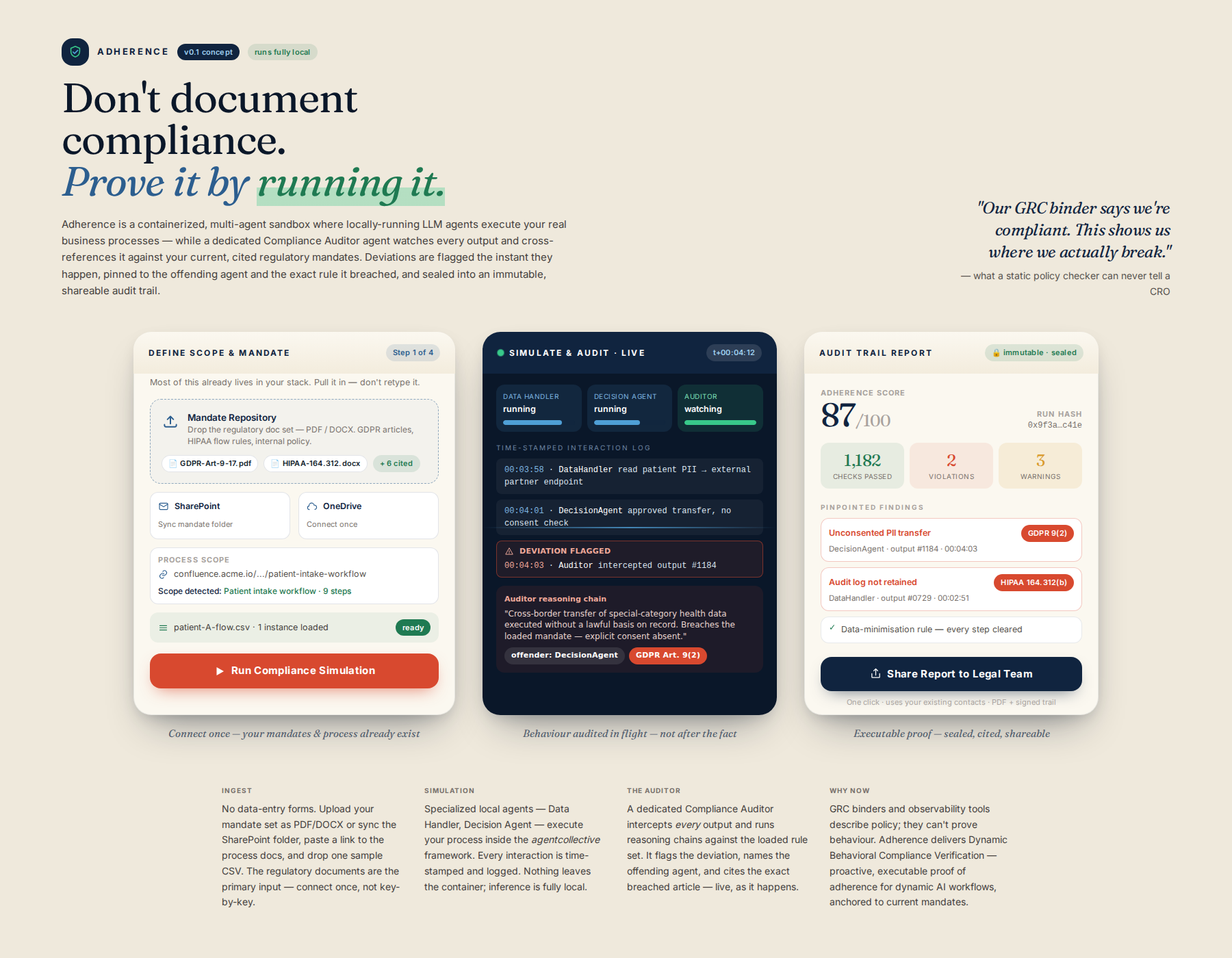
A local multi-agent simulation environment models and validates regulatory workflows, providing auditable proof through executable simulations. Specialized agents run within your infrastructure, intercepting outputs and checking them against loaded regulatory rule sets. The system generates an immutable audit trail pinpointing violations and the breached rule, proving compliance through execution rather than documentation.
Process flow
Who it's for
AI governance officers, Chief Risk Officers (CROs), and regulated industries (e.g., Finance, Healthcare) responsible for quarterly/annual compliance reporting.
Why they need it
Regulators are increasingly demanding demonstrable, proactive proof of compliance regarding AI model behavior, moving beyond static documentation. For instance, recent mandates require verifiable data lineage tracing during any AI decision process, creating immediate, acute pain points when systems are complex and opaque.
What it is
A containerized simulation platform where specialized, locally-running LLM agents execute simulated business processes. These actions are simultaneously monitored by a dedicated 'Compliance Auditor' agent that cross-references every output against a loaded, current regulatory rule set (e.g., specific GDPR articles, HIPAA data flow rules).
How it works
- Define Scope & Mandate: Input specific, current regulatory documents and the scope of the process under audit (e.g., 'Patient intake workflow'). 2. Load Environment: Initialize specialized agents (Data Handler, Decision Agent) within the 'agentcollective' framework. 3. Simulate & Log: Run the simulation, generating comprehensive, time-stamped logs of all agent interactions and outputs. 4. Audit & Report: The Compliance Auditor agent intercepts all logs, executes advanced reasoning chains against the loaded rule set, flags deviations, and generates an immutable audit trail report pinpointing the violation, the offending agent, and the breached rule.
Differentiation
Unlike static policy checkers or simple monitoring tools (e.g., GRC platforms, observability tools), we simulate behavior and process failure in a controlled, live-like environment. Our key differentiator is Dynamic Behavioral Compliance Verification anchored to current, cited regulatory mandates. We solve the problem of 'proving compliance through execution,' not just documentation. The gap is the inability to provide proactive, executable proof of compliance for complex, dynamic AI workflows.
Implementation sketch
- Refine 'agentcollective' to integrate an immutable, dedicated 'Auditor Agent' module.
- Develop a standardized, machine-readable input format for compliance rules, requiring direct citation mapping (e.g., 'GDPR Article 17: Right to Erasure').
- Implement robust cross-referencing logic in the Auditor Agent, designed to ingest sequential, stateful output streams for real-time failure detection against specific regulatory clauses. Initial focus: Build a proof-of-concept for state tracking using a constrained, known data structure (e.g., a specific HIPAA data flow path) rather than arbitrary regulatory text.
First step: Tomorrow, define the minimal viable state tracking mechanism. Select one specific, constrained data flow (e.g., 'PII handling for patient intake') and build a JSON/YAML structure that dictates the required state transitions. The goal is to prove the Auditor Agent can deterministically check if the simulated agent output violates this pre-defined state graph, ignoring the complexity of natural language reasoning for the first iteration.
Remaining risks
- The 'Auditor Agent' fails to maintain perfect, deterministic state tracking across complex, multi-step simulations. If the underlying LLM reasoning falters on state transitions, the entire audit result becomes untrustworthy, leading to a 'false sense of security' for the user. — Scope the initial MVP strictly to verifying against a small, highly constrained, and machine-readable state graph (as proposed in the first concrete step). Success must be defined by deterministic checking against this graph, not by generalized natural language reasoning over the entire workflow.
- Regulatory ambiguity or conflict. Real-world compliance mandates are often vague, contradictory, or subject to rapid interpretation changes. The system cannot audit against 'spirit' of the law, only against written rules. — Position the tool as a 'Compliance Gap Identification Engine' rather than a 'Compliance Guarantee.' The output must explicitly flag 'Ambiguity Detected' or 'Rule Conflict Found' when the input mandate set is incomplete or contradictory.
- Integration overhead with legacy systems. Regulated industries rarely use clean, modern APIs. Integrating a local simulation environment with existing, siloed, proprietary data pipelines will introduce massive, unpredictable technical debt and integration costs. — Focus the initial sales/proof-of-concept on the output (the report) rather than the input (the simulation). Develop a standardized, high-fidelity report format that can be ingested by existing GRC/Audit systems, minimizing the need for deep, real-time integration initially.
Watch for: Any external signal suggesting that existing GRC platforms or specialized observability tools (e.g., tracing/logging platforms) are rapidly developing or acquiring multi-agent simulation capabilities. This would invalidate the 'Dynamic Behavioral' differentiation. Kill criterion: If the required state tracking mechanism proves mathematically impossible to verify deterministically using current LLM inference techniques, regardless of prompt engineering, the core technical premise fails and the project must pivot to a non-simulation, document-review focus.