
Local Multi-Source Data Correlation Engine with Automated Contract Generation
A specialized framework coordinating local AI agents to execute complex, multi-protocol data correlation tasks (e.g., correlating artifacts from different forensic sources) without cloud reliance. It automates the creation of necessary data contracts, significantly lowering the barrier to entry for proprietary local data sources.
How can I automatically correlate data from multiple forensic sources?
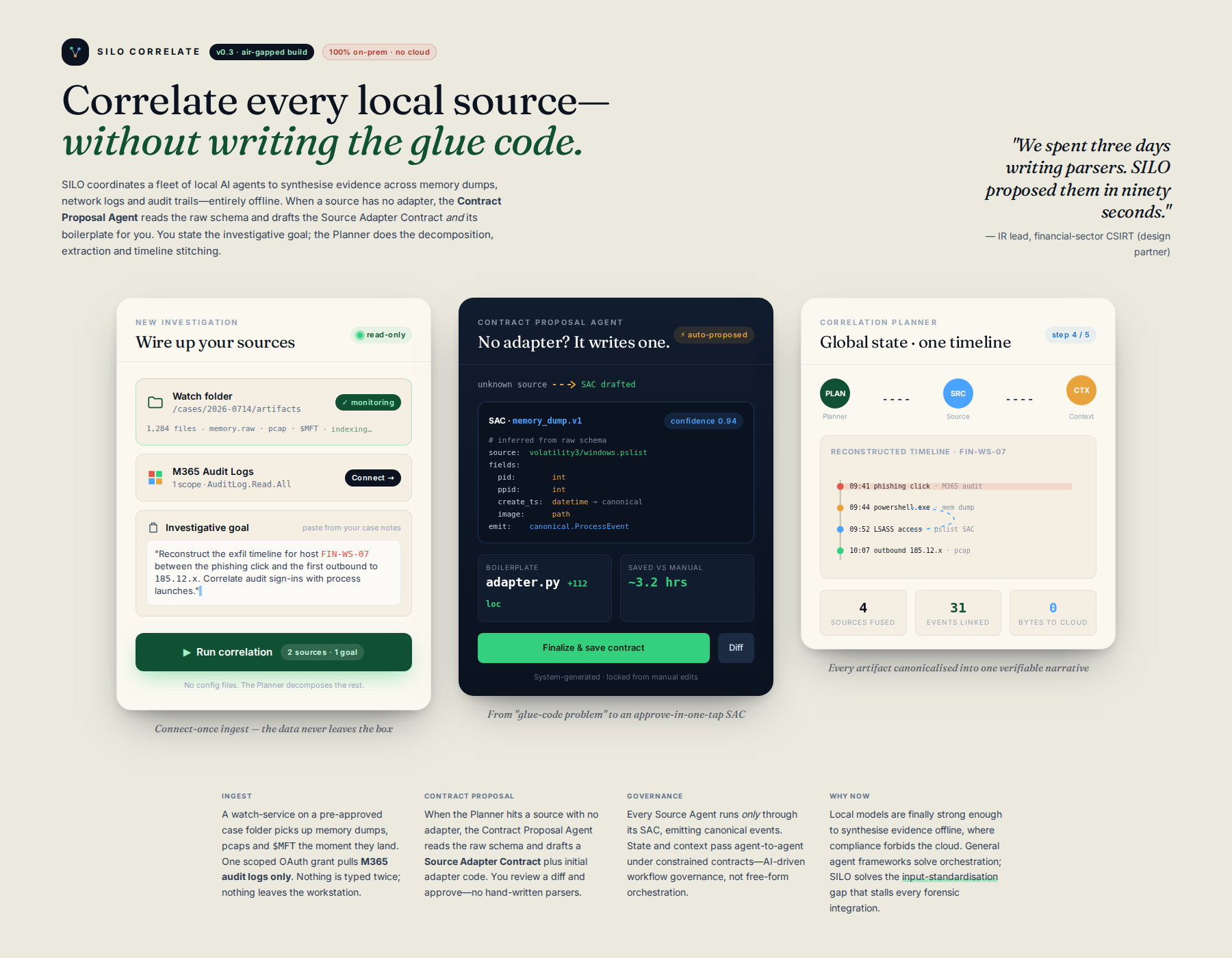
A specialized framework orchestrates agents to execute multi-protocol data correlation tasks without cloud reliance. When a data source lacks a defined ingestion contract, a 'Contract Proposal Agent' analyzes the raw schema and auto-generates the necessary adapter specification and boilerplate code. This dramatically lowers integration friction, allowing forensics and incident response teams to operationalize new evidence sources in days instead of weeks of manual glue-code development.
Process flow
Who it's for
Digital forensics teams, cybersecurity incident response units, or specialized R&D labs needing verifiable, offline data synthesis.
Why they need it
Existing workflows are manual and brittle, requiring extensive custom glue code to integrate disparate, proprietary, or low-level local data sources. The current bottleneck is not orchestration logic, but the laborious, upfront engineering required to standardize the data inputs themselves.
What it is
A modular orchestration layer that manages state and context passing between specialized agents. Crucially, it incorporates a 'Contract Proposal Agent' that can analyze raw data schemas and propose the necessary Source Adapter Contracts (SACs) and boilerplate integration code.
How it works
- The 'Correlation Planner Agent' receives the high-level investigative goal.
- It decomposes the goal into data extraction steps targeting specific local sources.
- If no SAC exists for a source, the Planner invokes the 'Contract Proposal Agent,' which analyzes the raw data dump/schema and generates a proposed SAC schema and initial adapter boilerplate.
- The Source Agent executes using the SAC, returning canonicalized output.
- The Planner Agent incorporates this structured output, updates the global state/timeline, and passes the refined context to the next required agent until the correlation goal is met.
Differentiation
Unlike general-purpose agent frameworks (e.g., agentcollective) or traditional ETL pipelines, this system focuses on AI-driven workflow governance over constrained data contracts. The gap filled is the automated generation of the integration layer itself—moving from the manual 'glue code' problem to an AI-assisted contract proposal mechanism. This is superior to pure orchestration because it actively solves the input standardization problem.
Implementation sketch
- Develop a proof-of-concept for the 'Contract Proposal Agent' that takes a sample JSON/Schema dump and outputs a basic Python class structure adhering to the SAC pattern.
- Prototype the Planner Agent to manage the state transition, specifically handling the 'Contract Missing' state and initiating the proposal step.
- Build a constrained task router that prioritizes using existing SACs but gracefully falls back to the proposal mechanism when necessary.
First step: Tomorrow, create a minimal Python function that accepts a sample raw data file (e.g., a sample registry hive dump) and uses a prompt to generate the corresponding SAC structure and a basic adapter stub, demonstrating the contract generation capability.
Remaining risks
- The 'Contract Proposal Agent' hallucinating incorrect or incomplete SAC schemas/boilerplate code for complex, non-standard data structures (e.g., binary logs, proprietary file formats). — Implement a multi-stage validation pipeline: 1. Schema generation $\rightarrow$ 2. Human review/validation loop $\rightarrow$ 3. Small, targeted execution sandbox testing against known edge cases before full integration.
- The complexity of the state graph grows exponentially with the number of sources and correlation steps, leading to unmanageable context bloat or deadlocks in the Planner Agent. — Enforce strict, bounded context windows by implementing mandatory context summarization checkpoints after every N steps, forcing the Planner Agent to pass only the delta or key findings rather than the entire corpus of intermediate results.
- The system's performance becomes bottlenecked by the latency of the AI model performing the contract generation and validation, making real-time forensic triage impossible. — Decouple the contract generation process entirely. Treat it as an offline, high-overhead pre-processing step, and focus initial productization on scenarios where the SACs are pre-vetted, reserving the automated generation for non-time-critical research phases.
Watch for: A lack of immediate, demonstrable interest from a niche, highly technical user group (e.g., a specific digital forensics lab) who can immediately validate the automated contract proposal feature on a source they currently struggle with. Kill criterion: If the initial proof-of-concept for contract generation requires more than 3-5 distinct, complex, proprietary data types to generate viable stubs, indicating the underlying LLM/schema mapping is fundamentally brittle or requires specialized, non-generalizable domain knowledge injection.