
Targeted Agent-Driven State-Space Probing for Constrained IoT Protocols
An autonomous, multi-agent system that rigorously tests the finite state space of a *narrow, defined* IoT or embedded protocol to uncover deep, emergent vulnerabilities.
How can AI systematically find security flaws in IoT protocol specifications?
A multi-agent simulation platform systematically probes the finite state space of constrained protocols (e.g., Bluetooth LE handshakes) to uncover emergent vulnerabilities. Specialized agents—State Explorer, Fuzzing Agent, Adversary Agent—model complex interaction flaws within the protocol lifecycle, monitoring for state violations, deadlocks, and unexpected data handling. Output includes specific message sequences that trigger violations and the exact protocol rules that break—directly actionable for embedded systems developers.
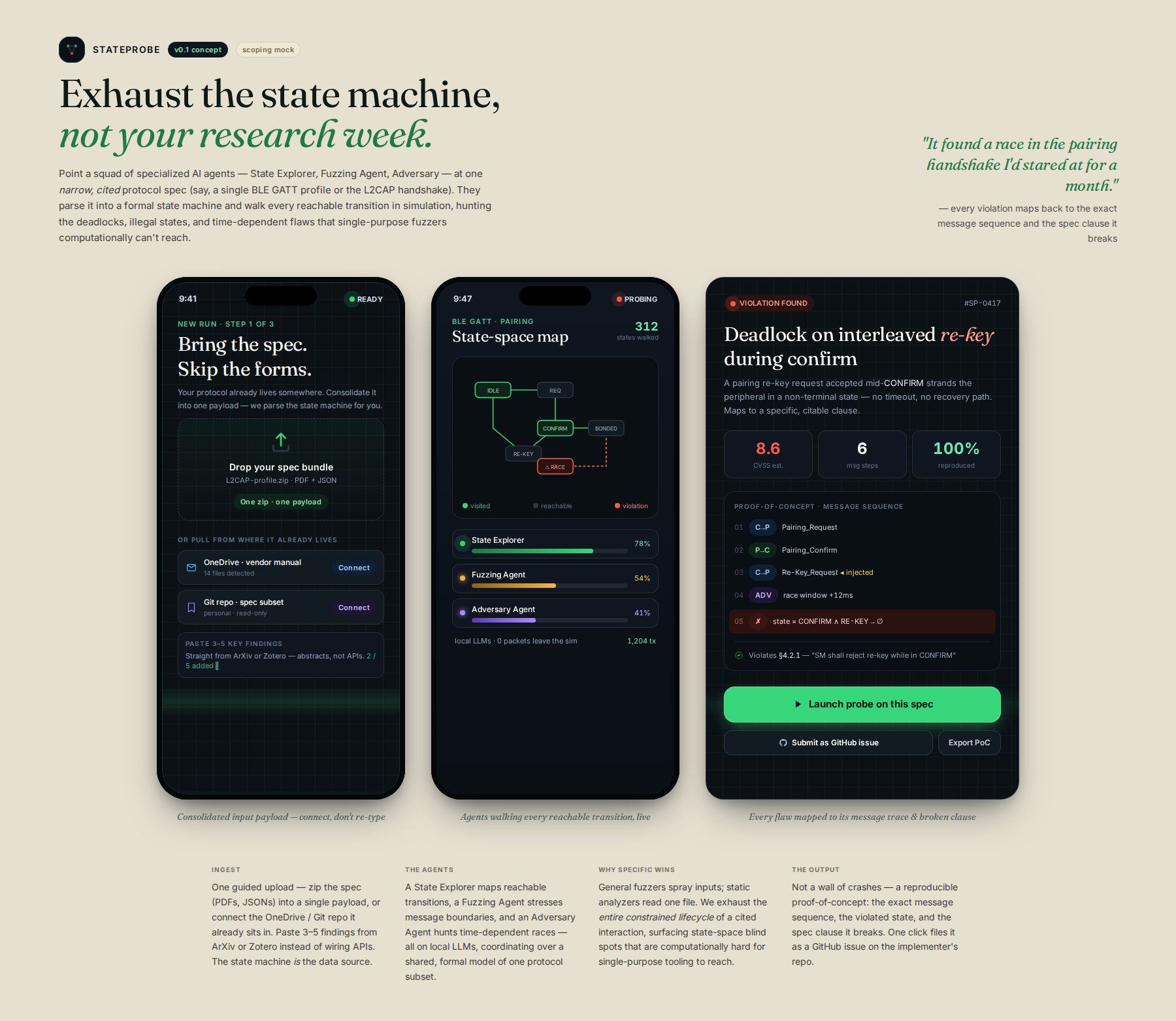
Process flow
Who it's for
IoT/Embedded Systems Security Researchers, Protocol Implementers for regulated industries (e.g., medical devices, industrial control).
Why they need it
The increasing reliance on interconnected, resource-constrained IoT devices (e.g., Zigbee, BLE profiles) makes them susceptible to subtle state-space exhaustion or sequence manipulation attacks that general scanners miss. We move from general risk to demonstrable, high-stakes failure points.
What it is
A specialized, agent-driven simulation platform that ingests a specific, limited protocol specification (e.g., a subset of Bluetooth LE GATT service interactions) and systematically probes its defined state transitions for security flaws.
How it works
- Target Selection: Focus on a narrow, public specification (e.g., the L2CAP layer handshake or a specific vendor's BLE service profile).
- State Modeling: Develop a formalized state machine parser for the chosen protocol subset.
- Agent Deployment: Deploy specialized agents (State Explorer, Fuzzing Agent, Adversary Agent) leveraging local LLMs.
- Execution & Validation: Agents interact within the simulated environment, monitoring for state violations, deadlocks, or unexpected data handling, flagging potential exploits against the known constraints of the target protocol.
- Proof-of-Concept Output: Output must map found violations back to the specific message sequence and protocol rule violated.
Differentiation
Our strength is specificity. Unlike general fuzzers or static analyzers, we orchestrate specialized AI agents to model complex, time-dependent interaction flaws across the entire, constrained lifecycle of a specific, cited protocol interaction. We are designed to find state-space blind spots that are computationally hard for manual or single-purpose tooling to reach. This moves beyond the scope of single-source vulnerability research like '4b5ef1764a539759' by adding multi-agent coordination and state-space exploration tailored to formal constraints.
Implementation sketch
- Adapt the 'agentcollective' architecture to operate strictly on a formalized state machine derived from a narrow protocol subset (e.g., Bluetooth LE pairing flow).
- Develop a rigorous input parser specialized for handling structured protocol messages (Type-Length-Value format) rather than general data streams.
- Integrate a formal verification/constraint checking layer (like 'capsule-fhe-bench') to validate agent findings against the protocol's documented operational boundaries, providing quantifiable proof of violation.
First step: Select one specific, academic, and publicly documented protocol subset (e.g., the initial handshake sequence of a specific Zigbee channel pairing) and manually map its entire state transition graph. Use this small, fixed graph as the mandatory input for developing the initial, non-generalized state machine parser prototype.
Remaining risks
- The complexity of the state-space model, even when narrowed, may still exceed the computational limits of current LLM-based simulation environments, leading to state-space explosion or intractable runtime errors. — Implement aggressive state-pruning heuristics based on known protocol invariants (e.g., message sequence ordering, resource limits) and cap the search depth/breadth during initial PoC testing.
- The reliance on 'formalized state machine parsing' requires deep domain expertise in formal methods (e.g., automata theory, TLA+), which is scarce and difficult to automate, creating a significant bottleneck for scaling beyond the initial PoC. — Focus initial development on integrating the system with an existing, established formal verification tool (e.g., model checkers like SPIN or NuSMV) rather than building the parsing logic from scratch, treating the LLM agents as 'hypothesis generators' for the external checker.
- The 'Agent Orchestration' layer might introduce novel, emergent coordination failures (e.g., agents overriding each other's assumptions, deadlock in the agent communication protocol itself) that are fundamentally different from the protocol vulnerabilities being tested. — Develop a formal 'Agent Interaction Protocol' (AIP) that strictly governs agent handoffs, state updates, and conflict resolution, treating the agent interaction as a separate, testable protocol layer.
Watch for: If the initial PoC cannot successfully parse and simulate a protocol subset whose state graph is documented to be small (e.g., fewer than 100 reachable states) within a defined, measurable time limit (e.g., 1 week), the core technical assumption of feasibility is severely undermined. Kill criterion: If the development team cannot successfully ingest and validate the state transitions of the first academic protocol subset using the proposed parser/simulator architecture, it indicates the fundamental technical hurdle (generalizing state modeling) is insurmountable with current tooling, necessitating a pivot away from protocol simulation.