Structured Execution Log Generator for Local LLM Workflows
A CLI utility that standardizes and exports the step-by-step execution trace of multi-agent workflows from major local LLM frameworks (LangChain/LlamaIndex) into a portable, machine-readable JSON format.
How do I standardize execution traces from different LLM frameworks?
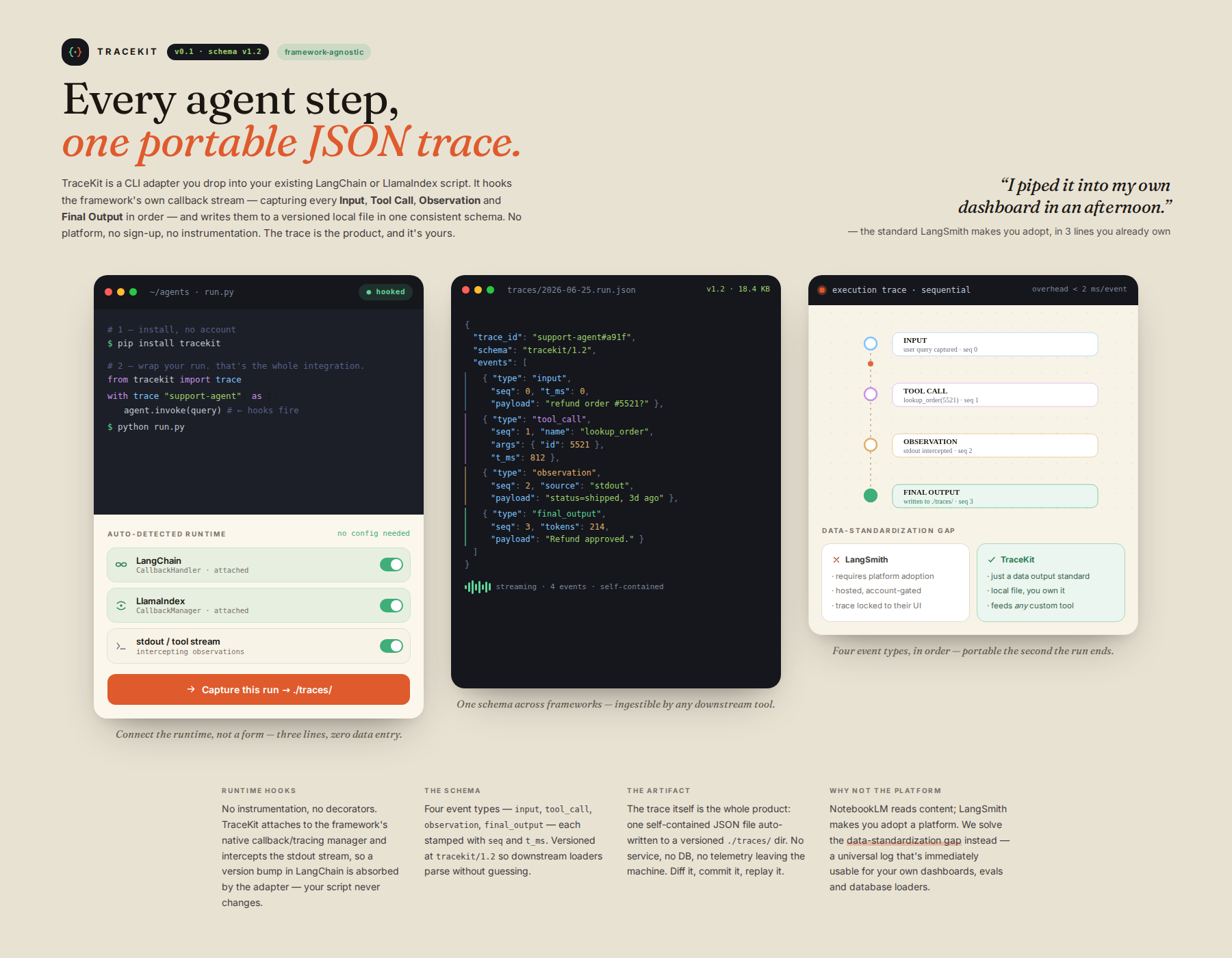
A CLI utility hooks into major frameworks' callback mechanisms and standardizes step-by-step execution traces into portable JSON format. The adapter captures core agent events (Input, Tool Call, Observation, Final Output) and serializes them into a consistent schema usable by any downstream tool. This solves the Data Standardization Gap for local agent reasoning, making traces portable and immediately usable.
Process flow
Who it's for
Developers building complex, multi-agent LLM systems using established frameworks like LangChain or LlamaIndex locally.
Why they need it
Developers struggle to debug complex, multi-agent workflows because current tracing mechanisms are either proprietary, visually opaque, or lack a standardized, portable output format for offline analysis.
What it is
A standardized logging adapter that intercepts core agent execution events (Input, Tool Call, Observation, Final Output) and outputs them sequentially as structured JSON objects.
How it works
The user integrates our CLI adapter into their existing framework execution script. The adapter hooks into the framework's callback/tracing mechanism, captures the raw event data, and serializes it into a consistent JSON schema. This structured log file can then be ingested by any downstream tool (e.g., custom visualization scripts, database loaders) without needing to understand the internal workings of the original LLM framework.
Differentiation
Unlike source analysis tools (e.g., NotebookLM) that focus on content, or commercial observability platforms (e.g., LangSmith) that require platform adoption, our MVP provides a framework-agnostic data output standard. We solve the 'Data Standardization Gap' for local, iterative agent reasoning by producing a universal, structured log file, making the process portable and immediately usable for custom tooling.
Implementation sketch
- Develop a minimal Python CLI wrapper that accepts the target framework and a callback function.
- Implement a specific adapter for LangChain callbacks that forces serialization of key events (Thought/Action/Observation) into a standardized JSON dictionary structure.
- Create a basic file writer within the CLI that appends these standardized JSON objects to a single output file, ensuring chronological order.
First step: Select LangChain as the initial target framework. Write a minimal Python script that executes a simple, known LangChain chain and, instead of relying on default logging, explicitly capture and print the structured JSON representation of the intermediate steps to a file, proving the serialization mechanism works end-to-end.
Remaining risks
- Framework API Drift/Breaking Changes: The core dependency on specific, rapidly evolving framework callbacks (LangChain/LlamaIndex) means that any minor update to these major libraries could break the adapter layer, requiring immediate, high-priority maintenance effort. — Abstract the adapter layer using a robust interface definition. Instead of directly calling framework internals, monitor the official release cycles and dedicate a small, paid 'maintenance retainer' budget specifically for dependency compatibility testing against the next major version of the target frameworks.
- Adoption Inertia: Developers may prefer to stick with existing, albeit imperfect, logging methods (e.g., print statements, built-in logger) because integrating a third-party CLI tool adds friction to their already complex development loop, even if the output is superior. — Develop 'wrapper' integration examples that require zero code changes from the user's existing workflow script, making the integration feel like an optional, drop-in replacement rather than an added dependency step.
- Data Schema Ambiguity: While the goal is standardization, the meaning of certain events (e.g., 'Observation' content, 'Tool Input' context) can vary wildly between frameworks or use cases, leading to ambiguous or incomplete JSON records that are hard for downstream consumers to interpret consistently. — Create a public, versioned JSON Schema specification that requires users to contribute examples of their most complex workflows. Treat the schema itself as a product feature that evolves based on community input, establishing early thought leadership in the domain.
Watch for: A major, established platform (e.g., LangSmith, Weights & Biases) announcing a first-class, open-source, standardized logging/tracing API for local execution that abstracts away framework specifics. Kill criterion: If the core LangChain/LlamaIndex adapters cannot be kept functional and up-to-date for two consecutive major framework releases without significant, unplanned engineering effort, the project should pivot to focusing on a more stable, lower-level component, such as pure serialization/deserialization utilities, rather than active framework integration.
Sources the council used
Real-world evidence that grounded this idea — judge it for yourself.