
Local Benchmarking Framework for Scientific Data Pipeline Transitions
A self-contained, local LLM agent framework that benchmarks the measurable performance of complex, multi-stage scientific data transitions, ensuring reliability across diverse hardware.
How can I measure performance bottlenecks when converting scientific data for LLMs?
A specialized benchmarking system measures data transformation latency in multi-stage scientific workflows. By profiling format conversions, parsing operations, and LLM inference stages locally, researchers can identify the 'weakest link' in their pipeline—the specific transition causing the biggest delay. The system generates comprehensive performance reports highlighting computational bottlenecks without requiring cloud infrastructure or proprietary data exposure.
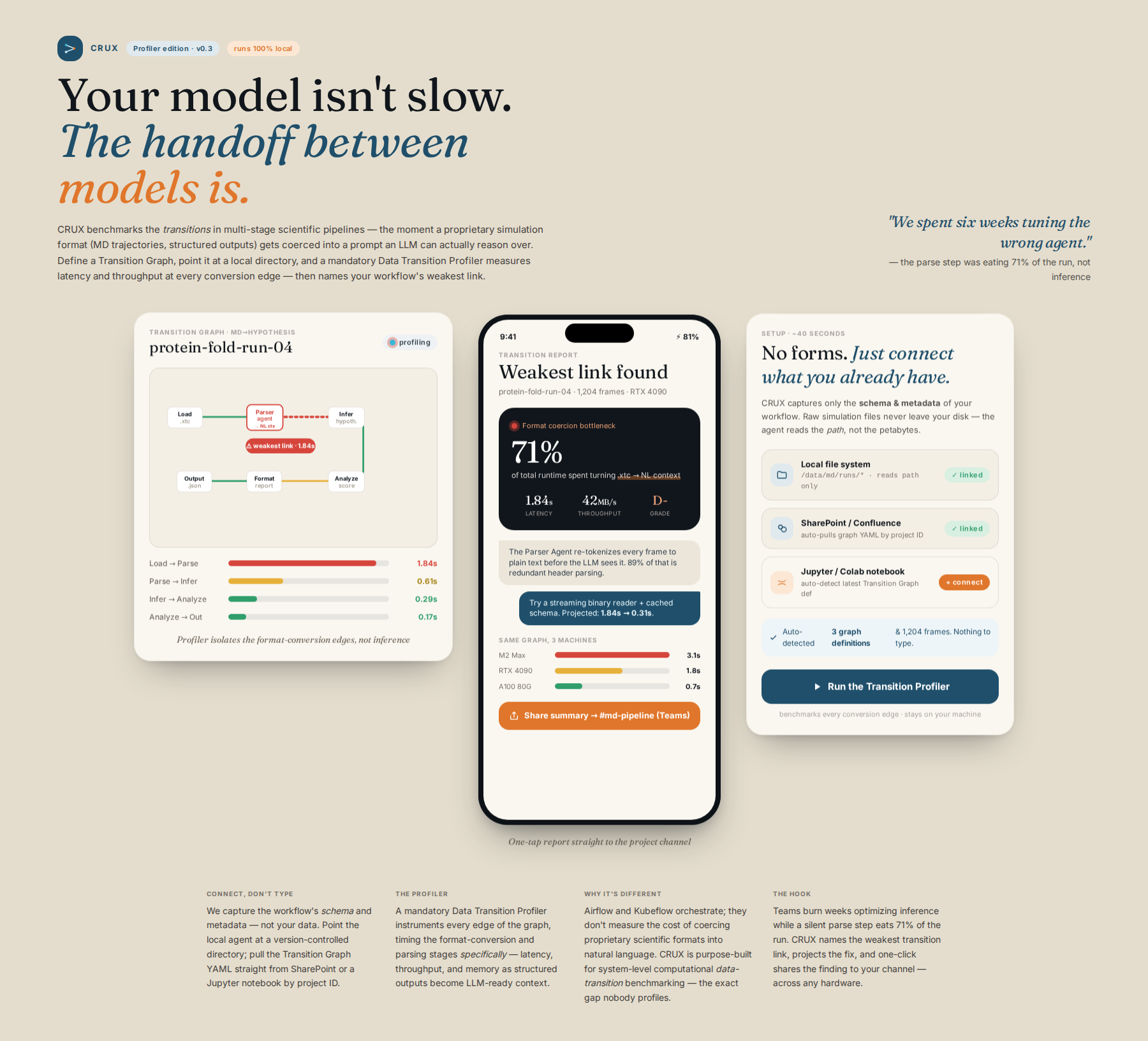
Process flow
Who it's for
Academic researchers and industrial R&D teams whose scientific pipelines involve transitioning structured simulation outputs (e.g., MD formats) into complex natural language reasoning prompts.
Why they need it
Current workflows fail to quantify the performance bottleneck when converting highly structured, specialized simulation outputs (Format X) into the context required by modern LLMs for hypothesis generation. This transition point is a critical, unmeasured failure point.
What it is
A platform that orchestrates multiple specialized local LLMs to execute structured, multi-step scientific workflows, focusing specifically on the measurable I/O and computational efficiency of the data transformation steps between specialized models.
How it works
Users define a 'Transition Graph' representing the research process (e.g., Data Load (Format X) -> Specialized Parser Agent (Output Y) -> LLM Inference Agent (Hypothesis) -> Analysis Model). The system runs this graph locally, using a mandatory 'Data Transition Profiler' to measure latency and throughput specifically during the format conversion and parsing stages, outputting a comprehensive report on the workflow's weakest transition link.
Differentiation
Unlike simple model routing or general workflow orchestration (Airflow, Kubeflow), this system is purpose-built for System-Level Computational Data Transition Benchmarking. We don't just measure model inference; we measure the measurable failure/latency incurred when proprietary, structured scientific data must be coerced into a natural language context usable by an LLM. This directly addresses the gap identified in translating simulation results to LLM prompts.
Implementation sketch
- Integrate the 'agentcollective' framework to manage the flow graph execution.
- Build a mandatory 'Data Transition Profiler' component that hooks into data I/O and specialized parsing APIs to measure the time/error rate of Format X -> Format Y transformations.
- Develop a structured report generator that visualizes the performance bottlenecks across the entire scientific workflow graph, highlighting the worst transition link.
First step: Select a single, publicly available, and documented scientific data transition (e.g., converting raw public genomics reads into a standardized JSON prompt structure). Build a minimal proof-of-concept pipeline using Python's timeit module to measure the serialization/parsing time for this single transition, simulating the 'Data Transition Profiler' function, and document the measured metrics in a GitHub repository README.
Remaining risks
- Proprietary Data Lock-in and Integration Barrier: The core value proposition hinges on profiling proprietary, specialized scientific formats (Format X). If users cannot provide access to these formats or the necessary parsing APIs, the 'Data Transition Profiler' becomes a non-starter, rendering the entire system useless for its target market. — Pivot the initial focus from 'profiling proprietary data' to 'benchmarking standardized, open-source data schema transformations' (e.g., converting public genomics data formats like FASTQ to a standardized prompt JSON). This lowers the initial integration barrier and allows for a demonstrable MVP using existing open-source tooling.
- Commoditization of Benchmarking: The concept of measuring I/O and serialization bottlenecks is not novel; established HPC workflow managers (Airflow, Kubeflow) already profile resource usage. The risk is that the market views this as an expensive, niche wrapper around existing, general-purpose infrastructure tools. — Do not compete on general workflow orchestration. Instead, emphasize the semantic layer: the system must prove that its profiling captures failure modes unique to the LLM context generation process (e.g., token limit exhaustion during prompt construction, or the specific overhead of structured data embedding into natural language context) that generic ETL tools ignore.
- Over-engineering the Solution: The combination of agent orchestration, custom profilers, and visualization is a massive scope. Attempting to build all components simultaneously will lead to significant delays, resource exhaustion, and an inability to achieve product-market fit quickly. — Adopt a strict Minimum Viable Product (MVP) scope: Focus only on the 'Data Transition Profiler' for one specific, public domain transition (as suggested in the first concrete step). Treat the agent orchestration and visualization as V2 features, deferring them until the core, measurable profiling mechanism is proven valuable.
Watch for: If initial user feedback focuses heavily on the 'agent orchestration' capabilities (e.g., 'Can it run Agent A, then Agent B?'), rather than the measurable performance of the data transition itself, it signals that the market is buying the 'cool tech' rather than the 'hard problem' we are solving. Kill criterion: If, after initial outreach, potential users cannot articulate a specific, measurable failure point related to the conversion of structured data into LLM context, or if they default to asking how to use existing ETL tools for this, the core value proposition is unvalidated.