
Standardized State Protocol for Federated Local LLM Workflows
How can multiple local LLMs reliably pass state and context to each other?
A defined standardized protocol specifies the canonical JSON/YAML format, serialization method, and validation steps for structured data exchange between distinct, locally-running LLM agents. A lightweight middleware wrapper enforces this contract, allowing agents to communicate reliably regardless of underlying LLM backend or hardware constraints. This solves the systemic reliability gap in multi-step reasoning by standardizing the "glue" interface between agents.
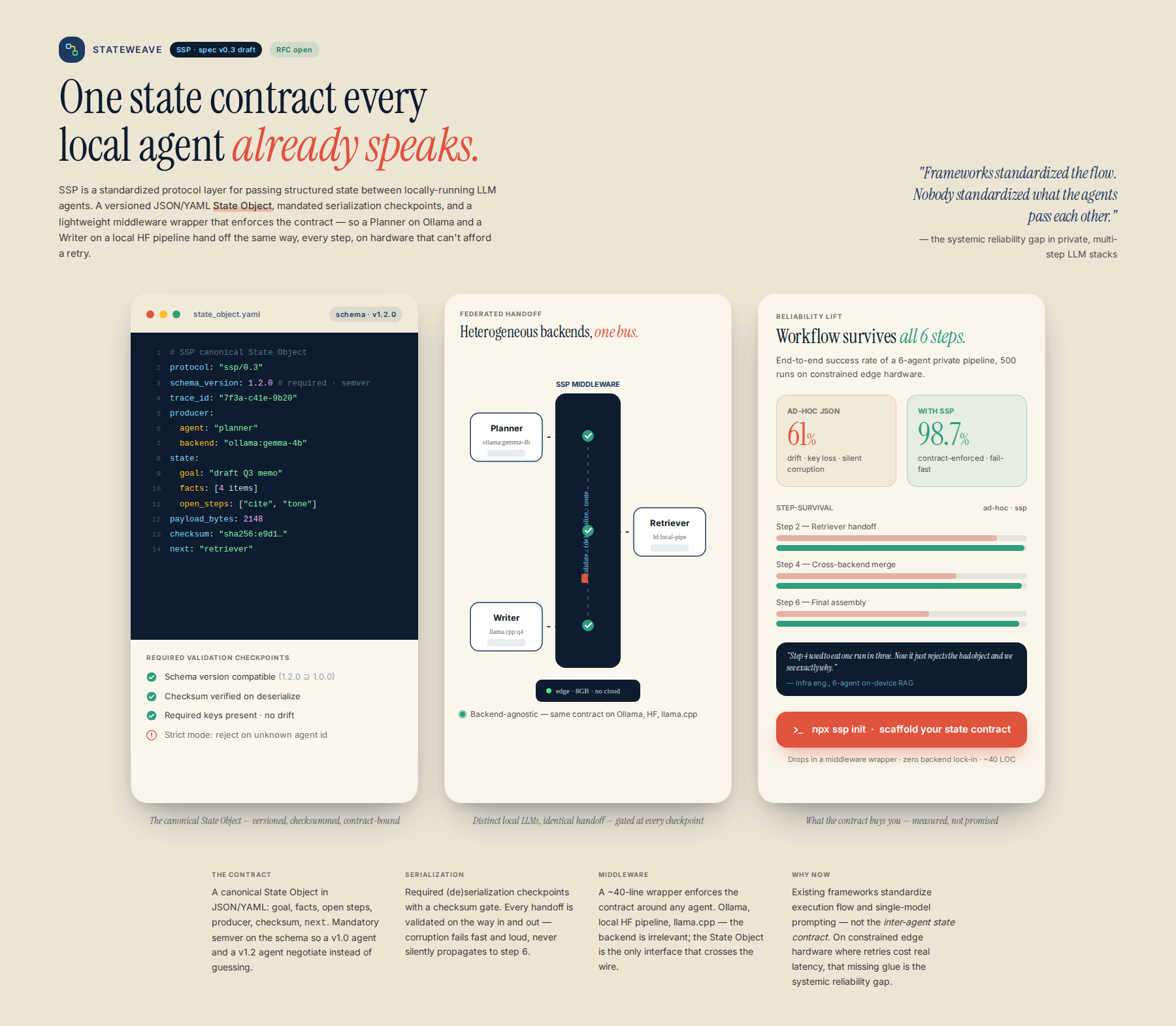
Process flow
Who it's for
AI Infrastructure Engineers and Academic Researchers building multi-agent systems for private, on-device AI applications.
Why they need it
Current local LLM deployments suffer from brittle, ad-hoc communication layers when chaining models (Model A -> Logic -> Model B). This lack of standardized state passing makes multi-step reasoning unreliable and non-portable, particularly on edge devices where every millisecond matters.
What it is
A specification defining the canonical format, serialization method, and required validation steps for structured data exchange (State Object) between distinct, locally-running LLM agents.
How it works
The protocol specifies a JSON/YAML-based State Object structure, mandates versioning, and outlines required serialization/deserialization checkpoints. Implementation involves creating a lightweight middleware wrapper that enforces this contract, allowing agents to communicate reliably regardless of the underlying LLM backend (e.g., Ollama, local HF pipeline) or hardware constraints.
Differentiation
Existing frameworks (cf4d43e87a3505f7) focus on execution flow or single-model prompting. They fail to standardize the inter-agent state contract. This protocol defines the necessary 'glue' interface, solving the systemic reliability gap for multi-step, private LLM deployments on constrained hardware. The gap is the lack of a universally adopted, machine-readable state passing standard for local agentic workflows.
Implementation sketch
- Define the initial State Object schema (e.g., mandatory fields:
workflow_id,step_number,input_context,output_data,error_trace).
- Define the initial State Object schema (e.g., mandatory fields:
- Select 2-3 representative, constrained model formats (e.g., GGUF Q4_K_M) and create initial wrappers that accept/output the defined State Object structure.
- Develop a proof-of-concept middleware that intercepts the output of Agent A and validates/transforms it into the State Object before feeding it as input to Agent B, measuring the overhead of this serialization/validation step.
First step: Draft the formal JSON schema for the State Object and validate it against the input/output structures of two different local model runtimes (e.g., one using Ollama API, one using a direct HF pipeline call) to quantify the initial serialization overhead.
Remaining risks
- Adoption/Ecosystem Risk: The protocol standard is useless if the core LLM/Agent frameworks (Ollama, Llama.cpp wrappers, etc.) do not adopt or integrate with the defined State Object schema. The middleware becomes a single point of failure requiring constant, manual maintenance against evolving third-party APIs. — _Focus the initial marketing/pitch not on the protocol itself, but on building a high-value, open-source reference implementation that solves a specific, visible pain point (e.g., _