Vertical-Specific Agent Orchestrator for Artisanal Workflow Automation
How can I automate complex, multi-step craft workflows like custom furniture order fulfillment?
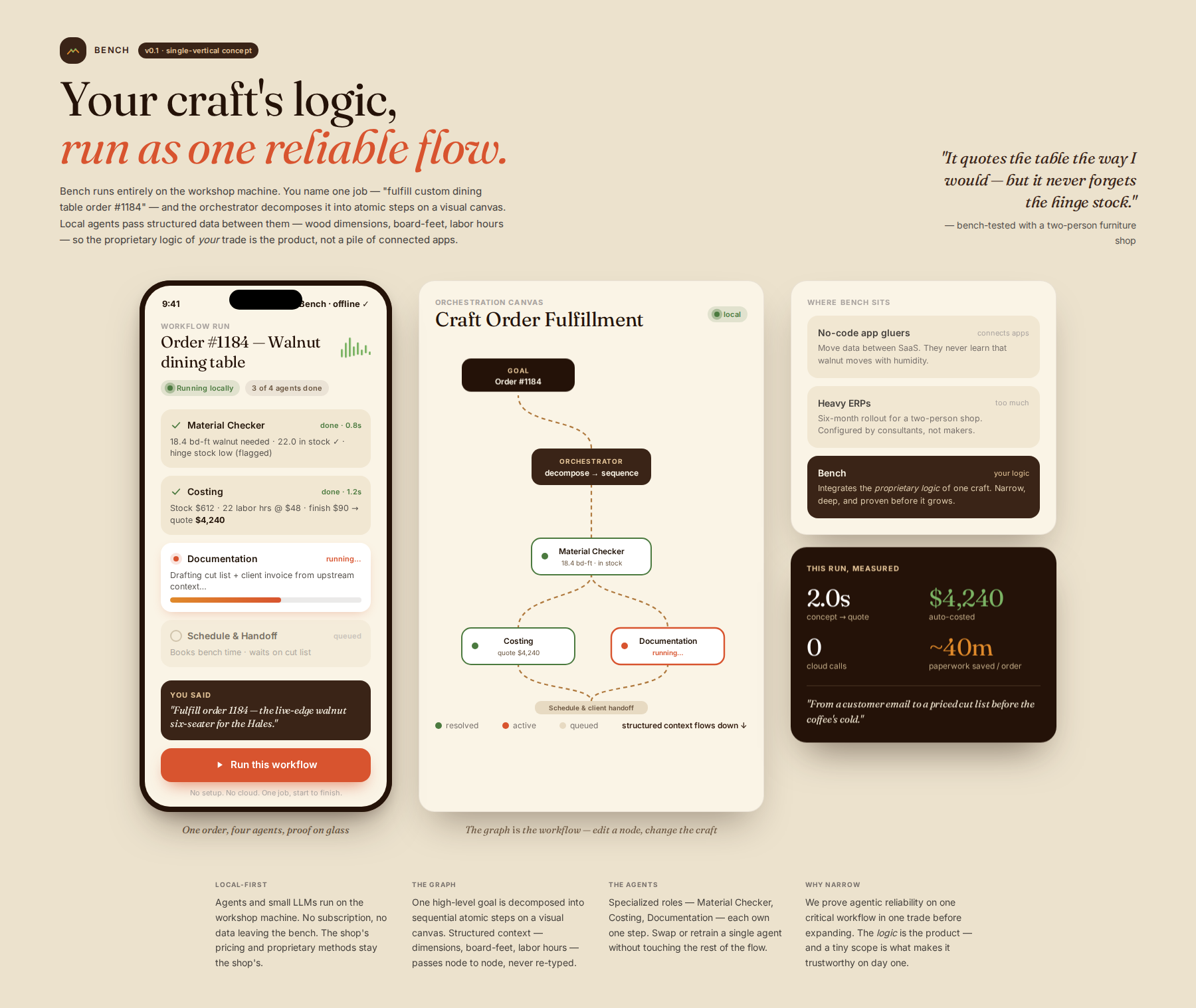
A local-first agent orchestration system manages single, complex workflows within specific trades like woodworking by decomposing high-level goals into sequential steps, with specialized agents (Material Checker, Costing, Documentation) passing structured context between them. The system handles craft-specific logic (material availability, labor hour calculations) via agents that understand the domain, not generic automation rules. This proves agentic orchestration for highly specialized, non-standardized operational logic.
Process flow
Who it's for
Small, specialized, non-tech artisans/craftspeople (e.g., custom furniture makers, small batch bakers).
Why they need it
These businesses rely on highly nuanced, multi-step processes that are poorly served by generic ERPs or simple app connectors. They need an operational core that understands the logic of their craft, not just the data points.
What it is
A local-first agent orchestration layer designed to manage a single, complex, end-to-end workflow. For example, the 'Automated Craft Order Fulfillment' flow, which chains specialized local agents (Material Checker Agent, Costing Agent, Documentation Agent) to process an order from concept to completion.
How it works
- User defines the specific, single high-level workflow goal (e.g., 'Fulfill custom dining table order X'). 2. The system's orchestration layer decomposes this goal into sequential, atomic steps, using the visual node graph. 3. Specialized, local LLMs execute these steps, passing structured context/data (e.g., wood dimensions, labor hours) between them. 4. The entire flow is managed via a visual canvas, providing immediate, reliable execution proof for one vertical before expanding.
Differentiation
We pivot from 'all SMB operations' to 'one critical operational logic.' Unlike general no-code platforms which connect apps, or complex ERPs which are too heavy, this platform focuses on integrating the unique, proprietary logic of a specific craft. We prove the agentic capability on a narrow, high-value workflow, making the 'logic' the core product and drastically reducing initial technical scope.
Implementation sketch
- Build a proof-of-concept CLI tool that executes the single 'Automated Craft Order Fulfillment' workflow end-to-end, focusing solely on state transfer between 3 hardcoded, specialized local LLM calls.
- Develop the foundational 'Context/Data Context' layer to ensure structured, reliable data passing between these sequential calls, treating the state transfer mechanism as the primary deliverable.
- Once the CLI proves stable, begin mocking up the visual node graph UI around the successful CLI execution path, deferring complex UI features.
First step: Prototype the CLI: Write a Python script that simulates the 'Automated Craft Order Fulfillment' flow by sequentially calling three local LLM APIs (mocked initially) and strictly passing a JSON context object between each call to prove state integrity.
Remaining risks
- Local LLM Performance and Resource Overhead: Running multiple specialized, local LLMs sequentially for a complex workflow (e.g., 3-4 agents) will consume significant CPU/GPU resources, leading to poor latency and high operational costs for the end-user on standard small business hardware. — Initially, benchmark the required computational load against the lowest common denominator hardware (e.g., a basic modern laptop). If latency exceeds an acceptable threshold (e.g., >10 seconds for the full flow), the scope must immediately pivot to cloud-hybrid execution for the most compute-intensive steps, even if it compromises 'local-first' purity.
- Context Drift and State Schema Rigidity: The core mechanism relies on passing a structured JSON context object between agents. If any single agent fails to adhere perfectly to the expected output schema, or if the initial input data is ambiguous, the entire chain will fail non-gracefully, leading to 'context drift' and data loss. — Implement aggressive, multi-stage schema validation and error handling at the context layer. The system must not just fail; it must capture the exact point of failure, log the corrupted context, and offer the user a guided remediation prompt (e.g., 'Agent 2 failed because 'Wood Type' was missing. Please manually input the wood type now.').
- Verticalization Trap: Successfully proving the concept in one vertical (e.g., woodworking) creates a false sense of security that the next vertical (e.g., baking) will be equally easy to model. The underlying process logic for a second vertical may require an entirely different set of agents or data structures. — Do not treat the first successful vertical as a reusable template. Treat it as a proof of concept for the state management infrastructure only. For the second vertical, re-run the entire process, treating the required agents as completely new components, forcing the team to validate the underlying infrastructure's adaptability rather than its reusability.
Watch for: Any indication that the required 'logic' for the next vertical is not purely sequential data transformation, but requires human intuition, subjective judgment, or physical dexterity that cannot be reliably modeled by text prompts and structured data. Kill criterion: If the team cannot demonstrate a stable, repeatable, end-to-end execution of the single target workflow (CLI prototype) on a standard developer machine without encountering a fundamental, unresolvable state management or context passing error, the core premise of the 'agent orchestration' mechanism is flawed, and the project should pivot to a simpler, single-agent SaaS solution.
Sources the council used
Real-world evidence that grounded this idea — judge it for yourself.