
CredentialGuard: Policy-Enforced Boundary Layer for Local AI Agent Workflows
How can I prevent local AI agents from accessing credentials or data outside their intended scope?
A policy-enforced sandbox intercepts all resource access requests from agents and validates them against a defined Policy Manifest that specifies which agents can use which tools and data. It only retrieves and provides the minimal, time-boxed credentials necessary for each authorized interaction, enforcing workflow-level authorization rather than just checking if a credential exists. This moves beyond "Can this secret be accessed?" to "Should this agent use this secret right now according to the workflow?"
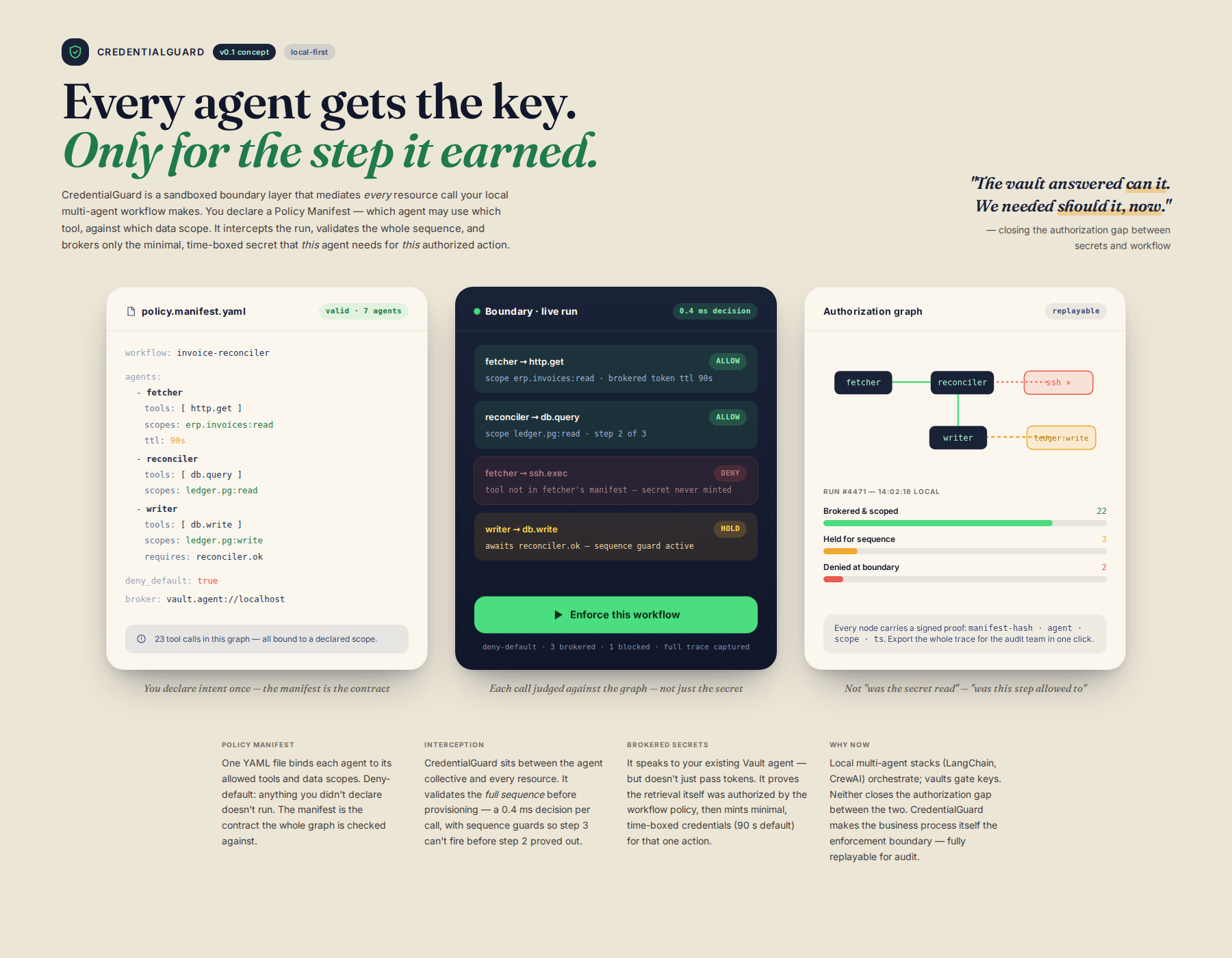
Process flow
Who it's for
Developers building complex, multi-agent AI systems that process proprietary or sensitive local data/APIs.
Why they need it
Local AI agents risk not only inheriting sensitive credentials (AWS keys, environment variables) but also executing unauthorized actions or accessing data/tools outside their defined operational scope, leading to security breaches and data leakage.
What it is
A sandboxed execution layer, 'CredentialGuard', that mediates all resource access (credentials, local APIs, data sources) for agent collectives. It enforces a workflow policy that dictates which agent can use which tool/data, and only retrieves the minimal, time-boxed credentials necessary for that specific, authorized interaction.
How it works
The user defines a 'Policy Manifest' detailing agent roles, allowed tools, and required data scopes. CredentialGuard intercepts the workflow request, validates the entire sequence against the Manifest, and orchestrates necessary resource provisioning. It integrates with existing local secret managers (e.g., Vault agent mode) not just to pass secrets, but to prove that the secret retrieval itself was authorized by the workflow policy, thus enforcing boundary enforcement over the entire interaction graph.
Differentiation
Unlike general local agent orchestrators (e.g., LangChain/CrewAI local setups) or standard secret managers (e.g., Vault), CredentialGuard focuses on workflow-level policy enforcement. It solves the 'Authorization Gap' by linking credential access directly to the explicit, sequential steps of the agent workflow. It moves beyond 'Can this secret be accessed?' to 'Should this agent be allowed to use this secret to perform this action right now, according to the overall business process?'
Implementation sketch
- Develop the Policy Manifest schema (YAML) to define Agent Roles, allowed Tool Calls, and associated Resource Scopes.
- Build a core workflow validation engine that parses the Manifest and validates the sequence of required actions.
- Develop the Adapter Layer to interface with a chosen local secret provider (e.g., Vault API simulation) to ensure credential retrieval is policy-gated.
- Develop the Runtime Interceptor (Python/JS wrapper) that wraps standard library calls (e.g.,
requests.get(local_api)) to intercept all external/local resource calls, checking the scope against the validated Manifest before proceeding.
First step: Draft the YAML schema for the Policy Manifest, focusing first on defining a single, simple workflow: Agent A reads from Tool X, which requires Credential Y. This forces the definition of the minimum necessary policy structure.
Remaining risks
- The 'Runtime Interceptor' layer remains the single largest technical bottleneck. Intercepting all external/local resource calls (including internal library calls, asynchronous operations, or complex serialization/deserialization paths) reliably across diverse, modern agent frameworks (which are often written in Python/JS/etc.) will inevitably lead to performance degradation or unhandled exceptions, making the system unusable for non-trivial workloads. — Limit the initial scope to intercepting only the highest-risk I/O points (e.g., network sockets, file system writes/reads) and explicitly document that the system's performance profile is optimized for security enforcement over raw speed. Alternatively, build a highly constrained execution environment (e.g., using WebAssembly or a dedicated VM) from Day 1, accepting the initial development overhead for long-term stability.
- The 'Authorization Gap' claim relies on the assumption that current orchestrators cannot enforce workflow-level policies. If a major competitor (e.g., a major cloud provider or enterprise automation platform) integrates workflow-level authorization into their local agent tooling, CredentialGuard becomes a feature wrapper rather than a unique product, eroding its differentiation. — Pivot the marketing and sales narrative immediately to 'Compliance & Auditability' for regulated industries (Finance, Healthcare). Frame it not as a technical capability, but as a necessary compliance layer that proves adherence to internal governance models, which is a business problem, not just a technical one.
- The Policy Manifest schema, while comprehensive, risks becoming overly complex and brittle. Developers are already fighting to get local agents working; adding a mandatory, complex policy layer might introduce too much friction, leading to low adoption despite the high security value. — Implement a 'Default Allow/Deny' model that defaults to 'Deny' but provides a minimal, 'zero-config' path for the absolute simplest use case (e.g., reading one specific, known file). The complexity should be additive, not multiplicative, in the user experience.
Watch for: If early technical prototypes cannot demonstrate reliable interception of a standard, non-trivial library function call (e.g., a complex Pandas data manipulation call that triggers an internal resource access) without significant, visible performance impact, the core technical premise is flawed. Kill criterion: If a major, well-funded competitor (e.g., Microsoft, Google, or a leading enterprise workflow engine) announces a feature that demonstrably solves workflow-level authorization for local AI agents, the market window for this specific product definition closes.
Sources the council used
Real-world evidence that grounded this idea — judge it for yourself.