Ultra-Niche Data Integrity Guard for Subscription Stacks
A focused, low-code data integrity layer that guarantees continuous, stateful synchronization for one critical, high-friction data flow (e.g., Stripe Webhooks to Airtable/CRM) for solo founders.
How can a solo SaaS founder stop Stripe webhook failures from breaking CRM data?
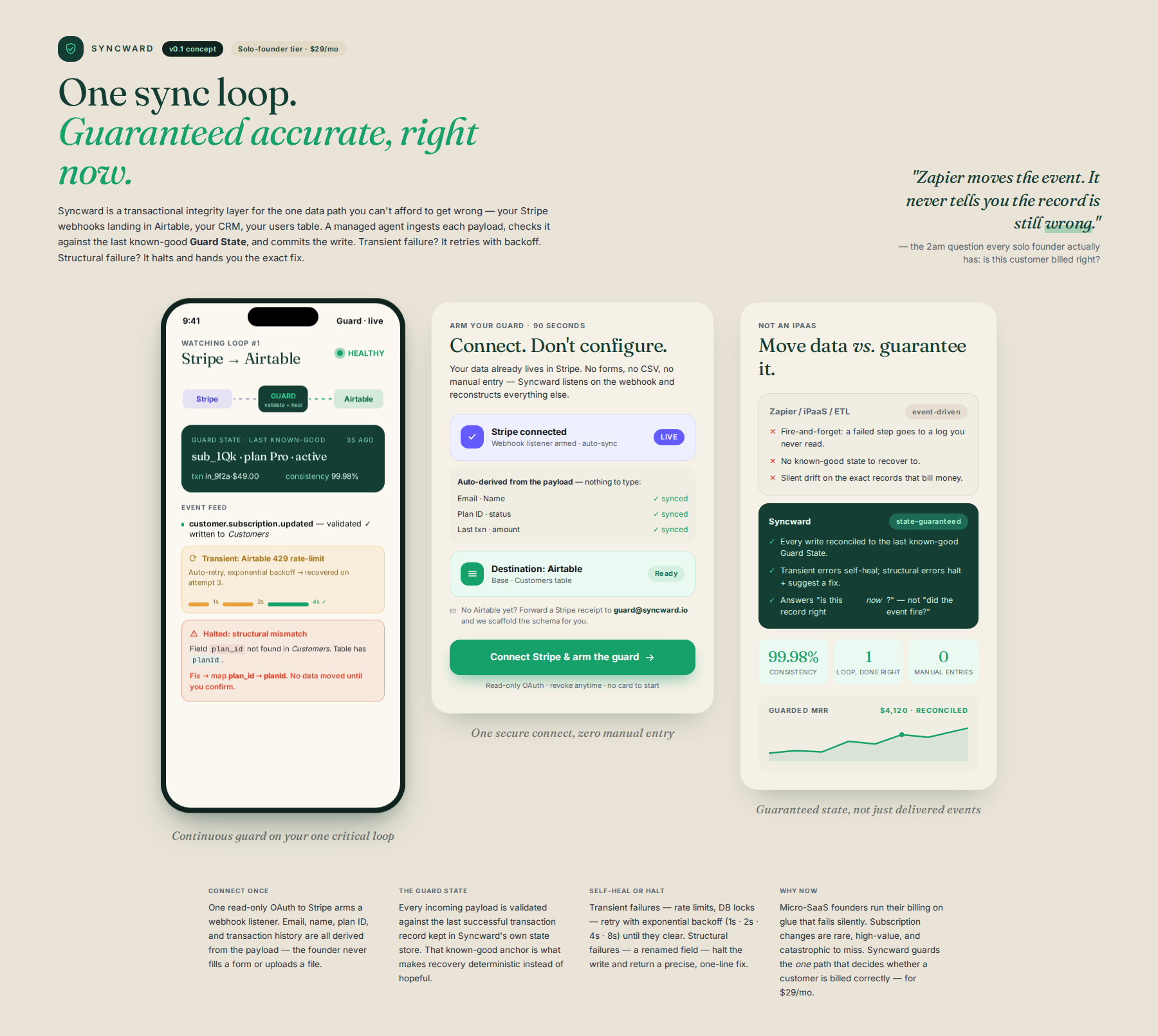
Yes: a narrow, agent-managed integrity layer can watch a single critical sync path, like Stripe webhooks writing to a CRM or database, and self-heal it. It validates each webhook against the last known-good transaction state, retries transient failures like rate limits or locks with exponential backoff, and halts with a specific fix suggestion on structural errors like a renamed field. It targets solo founders and indie hackers running subscription micro-SaaS who cannot afford billing state drift but lack time to build full sync infrastructure.
Process flow
Who it's for
Indie hackers/solo founders running subscription-based micro-SaaS.
Why they need it
Solo founders lose revenue or waste hours debugging manual data discrepancies when critical systems (like billing/CRM) fail to sync state correctly after an external event (e.g., Stripe webhook failure).
What it is
A specialized, agent-managed synchronization guard that focuses exclusively on monitoring and self-healing a single, defined data path, ensuring transactional consistency for billing/user state data.
How it works
- User defines one critical sync loop (e.g., Stripe Webhook -> Internal DB Table).
- The system runs an agent that ingests the webhook payload, validates the state against the last known successful transaction record (the 'Guard State'), and executes the write.
- If the write fails due to transient errors (API rate limit, database lock), the agent automatically retries with exponential backoff. If the failure is structural (e.g., wrong field name), it halts and provides a precise, actionable fix suggestion.
Differentiation
We are not a general iPaaS. We are a 'transactional integrity layer' focused on the most critical data paths. Unlike Zapier, which is event-driven but lacks robust, guaranteed state recovery, or general ETL tools, we provide guaranteed, stateful recovery specifically for high-value, low-frequency sync failures (like subscription changes). We solve the 'is the customer record accurate right now?' problem for the solo founder, not just 'move data from A to B.'
Implementation sketch
- Build the core state machine focusing only on transaction IDs and sequence numbers for the chosen niche (e.g., Stripe Subscription ID).
- Develop a highly resilient 'Webhook Listener' agent that wraps the entire data ingestion process with transactional integrity checks.
- Create a simplified dashboard view that only shows the status and history of the single, critical sync path, minimizing cognitive load.
First step: Build a minimal viable proof-of-concept (PoC) state machine in a local environment (e.g., using Python/SQLite) that can successfully process three consecutive, known-good Stripe webhook payloads, correctly logging and checking the sequence ID after each successful write attempt.
Remaining risks
- API Provider Changes/Deprecation: The core assumption is that the critical data path (e.g., Stripe's webhook format or schema) will remain stable. If Stripe changes its payload structure, deprecates an endpoint, or alters webhook delivery mechanisms, the entire 'Guard State' logic breaks, requiring immediate, high-effort maintenance. — Build a dedicated 'Schema Drift Monitor' agent that proactively tests incoming payloads against the expected schema, logging deviations before they cause a write failure. Prioritize building the PoC against a sandbox environment that simulates known future breaking changes.
- State Machine Complexity Creep: While the scope is narrowed to one niche, the temptation to handle 'edge cases' (e.g., refunds processed months later, subscription downgrades that trigger multiple downstream events) will lead to exponential state complexity, ballooning the required engineering effort beyond a solo founder's capacity. — Strictly limit the initial MVP scope to only the most common, highest-value transaction (e.g., 'Subscription Activated' or 'Payment Successful'). Document and explicitly defer all other state transitions (e.g., 'Trial Ended', 'Payment Failed') to V2, treating them as scope creep.
- Webhook Throttling/Backpressure: In a real-world scenario, a sudden burst of events (e.g., a mass billing cycle) can overwhelm the system's ability to process them sequentially, leading to internal queue backlogs or external rate-limiting that the current retry logic cannot handle gracefully. — Implement an explicit, user-configurable rate-limiting profile per connected service, allowing the user to set a 'safe processing ceiling' (e.g., 'Process no more than 10 webhooks per minute') to prevent self-induced failure loops.
Watch for: If early user feedback shows that users are spending more time debugging our state machine's failure modes than they are using the guard to solve their actual data issues, the complexity is too high for the target user. Kill criterion: If the first three paying users cannot articulate the exact specific, high-value data sync failure (e.g., 'When X happens, Y fails to sync') that they would pay to solve, the pain point is not acute enough to justify the infrastructure build.
Sources the council used
Real-world evidence that grounded this idea — judge it for yourself.