
Data Source Attestation Layer for AI Workflows (DSA-AI)
A specialized, cloud-native runtime security module that guarantees the verifiable data lineage and source integrity of all inputs and outputs for mission-critical, constrained AI workflows (e.g., RAG pipelines).
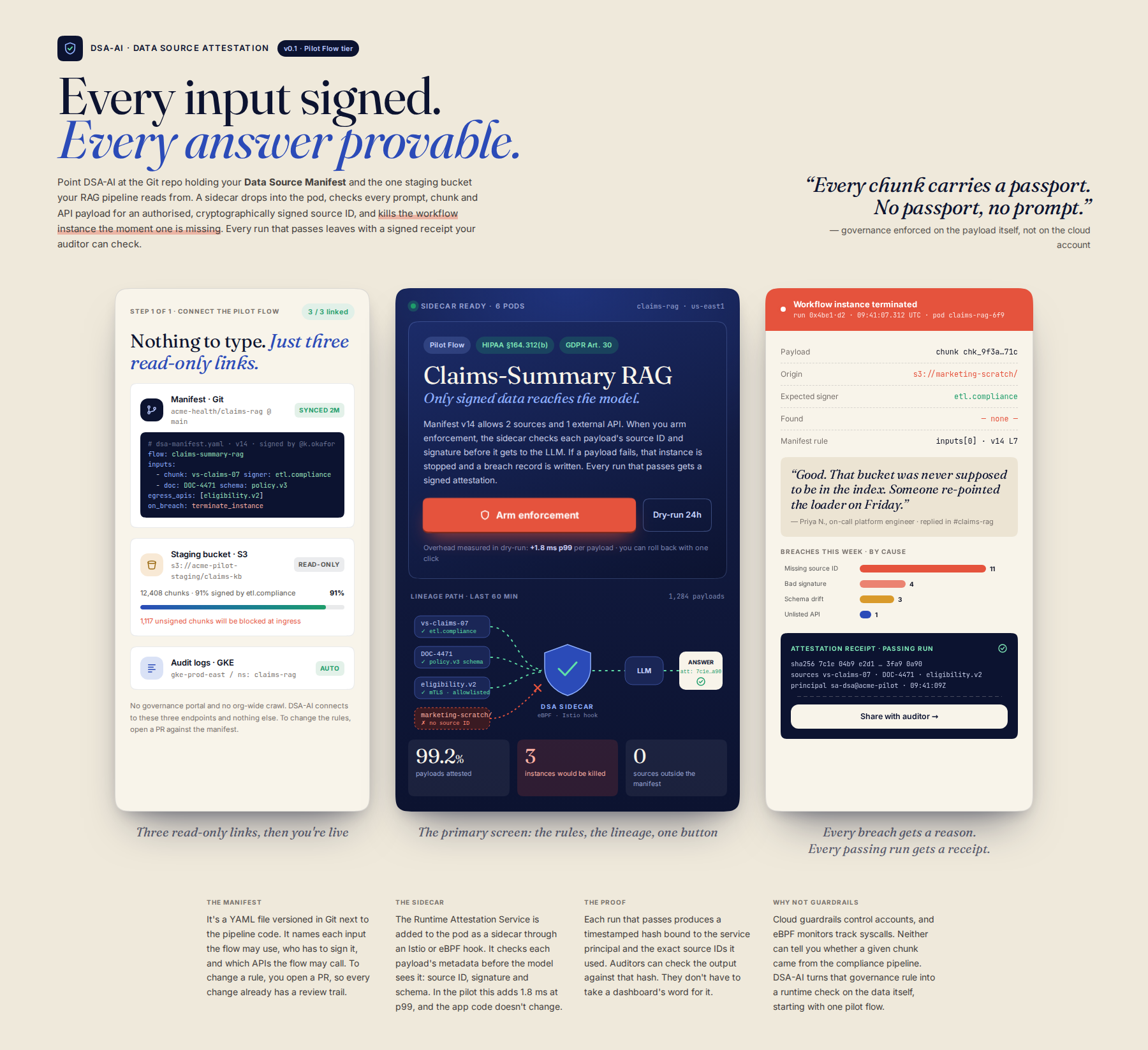
Process flow
Who it's for
Large enterprises adopting LLM-powered workflows (RAG, data extraction) under strict regulatory compliance (HIPAA, GDPR); organizations requiring auditable data provenance for AI compute.
Why they need it
As enterprises rely on LLMs, the highest-value attack vector is not just credential theft, but the subtle contamination of the AI process by unauthorized or unverified data (data poisoning, unauthorized source mixing). We solve the high-value problem of proving data provenance and source integrity within the allowed compute boundary, making the entire workflow auditable down to the originating data chunk.
What it is
A focused Runtime Attestation Service (RAS) that integrates into a defined cloud container service (Kubernetes/Cloud Run). It enforces a 'Data Source Manifest' which dictates that every input (prompt, data chunk, external API payload) must originate from a cryptographically verifiable, authorized source ID.
How it works
- Define the Manifest: The client defines a strict 'Data Source Manifest.' This includes allowed external APIs, resource limits, and crucially, a mapping of required data inputs to their verifiable source IDs (e.g., 'Prompt must use data from VectorStore ID X and Document ID Y').
- Integration Layer: The RAS deploys as a sidecar container/service mesh hook (e.g., Istio/eBPF) within the target cloud environment.
- Real-Time Enforcement: The sidecar intercepts data ingress/egress. It validates the payload metadata against the Manifest, checking for the required source signatures/IDs.
- Action: If the data source ID is missing, invalid, or if the payload deviates from the expected data schema/origin, the RAS immediately terminates the specific workflow instance and logs a failure detailing the provenance breach.
Differentiation
We are not a general-purpose monitoring tool. Unlike cloud guardrails (AWS Guardrails) which manage resource accounts, or general eBPF tools which track basic syscalls, we specialize in AI data provenance enforcement. Our unique value is translating high-level data governance requirements (e.g., 'Only use data chunks signed by the Internal Compliance Pipeline') into concrete, low-level, enforceable runtime checks on the data payload itself. We solve the problem of data integrity in a regulated AI context.
Implementation sketch
- Build the MVP sidecar service utilizing eBPF/Istio hooks within a single, controlled Kubernetes cluster (GKE/EKS).
- Develop the core data validation module: A library that accepts a Manifest and a data payload, and can verify the presence and validity of required source identifiers (e.g., checking for a specific metadata header or cryptographic signature).
- Implement the enforcement loop: Intercept -> Extract Metadata -> Validate Metadata against Manifest -> (If valid: Allow) -> (If invalid: Trap/Deny/Alert).
First step: Set up a single-node Kubernetes cluster (e.g., local Minikube or a dedicated GCP sandbox). Write a minimal Python script that uses the bcc library to deploy a simple eBPF program hook on container ingress, specifically designed only to read and validate a mandatory metadata header (e.g., 'X-Provenance-ID') on incoming HTTP requests.
Remaining risks
- The 'Blind Spot' of Internal Data Transformation: The current focus is on verifying the source ID upon data ingress (the initial prompt or data chunk). However, the most sophisticated attacks do not involve external data exfiltration; they involve data poisoning or subtle contamination within the workflow's local compute boundary (e.g., a malicious intermediate step modifying the data before the next API call). The current model does not enforce data integrity or provenance across internal, in-memory transformations. — Shift the focus of the Manifest to include 'Transformation Signatures.' The system must enforce that any data output (e.g., a summarized chunk) must carry a new, verifiable signature identifying the specific function/module that created it, thus creating a cryptographic chain of custody for the data throughout the entire process, not just at the entry point.
- Vendor Lock-in and Technical Brittle-ness: The reliance on deeply integrated, low-level hooks (eBPF/Istio) ties the solution to the specific kernel and API structure of major cloud providers. A single, non-backward-compatible update to Kubernetes, Linux kernel, or a major cloud service mesh could render the entire enforcement layer useless overnight, creating an unacceptable operational risk for mission-critical enterprise clients. — Design a robust, high-level abstraction layer that sits above the cloud hooks. This layer should allow developers to define the enforcement logic using a vendor-agnostic language, while the service itself handles the translation into the lowest required API calls (eBPF, Sidecar proxy rules, etc.). This makes the system resilient to underlying infrastructure changes.
- The 'Non-Data' Attack Vector: The current Manifest is overwhelmingly data-centric. It assumes that security failures revolve around data provenance. However, autonomous agents can be compromised through non-data vectors, such as timing attacks, resource exhaustion (DoS), or exploiting internal function unit logic (e.g., forcing a recursive call stack overflow). The system must prove it can enforce resource boundaries and behavioral safety, not just data source safety. — Expand the Manifest to include strict, quantifiable behavioral constraints (e.g., 'Maximum number of function calls allowed,' 'Maximum compute time per step,' 'Mandatory jitter injection'). This shifts the value proposition from pure 'data governance' to 'AI compute reliability and safety.'
Watch for: If enterprise discussions consistently pivot away from 'data provenance' and instead focus on general 'API access control' or 'resource quotas,' it signals that the market perceives the solution as overly complex or that the core value proposition is being misunderstood as a niche data governance tool rather than a fundamental AI security layer. Kill criterion: If the product cannot demonstrate effective runtime enforcement for a workflow where the data is processed and transformed entirely in memory (i.e., the data never crosses a network boundary or file system write), the technical feasibility of the RAS is fundamentally compromised, rendering the service useless for complex, modern AI pipelines.
Sources the council used
Real-world evidence that grounded this idea — judge it for yourself.