
Verifiable Output Job Execution Layer (MVP)
A trust-minimized, on-chain marketplace that guarantees the successful completion and verifiable output of fixed-scope, high-volume AI jobs (e.g., vector embedding generation). We shift the financial guarantee from 'time elapsed' to 'output verified.'
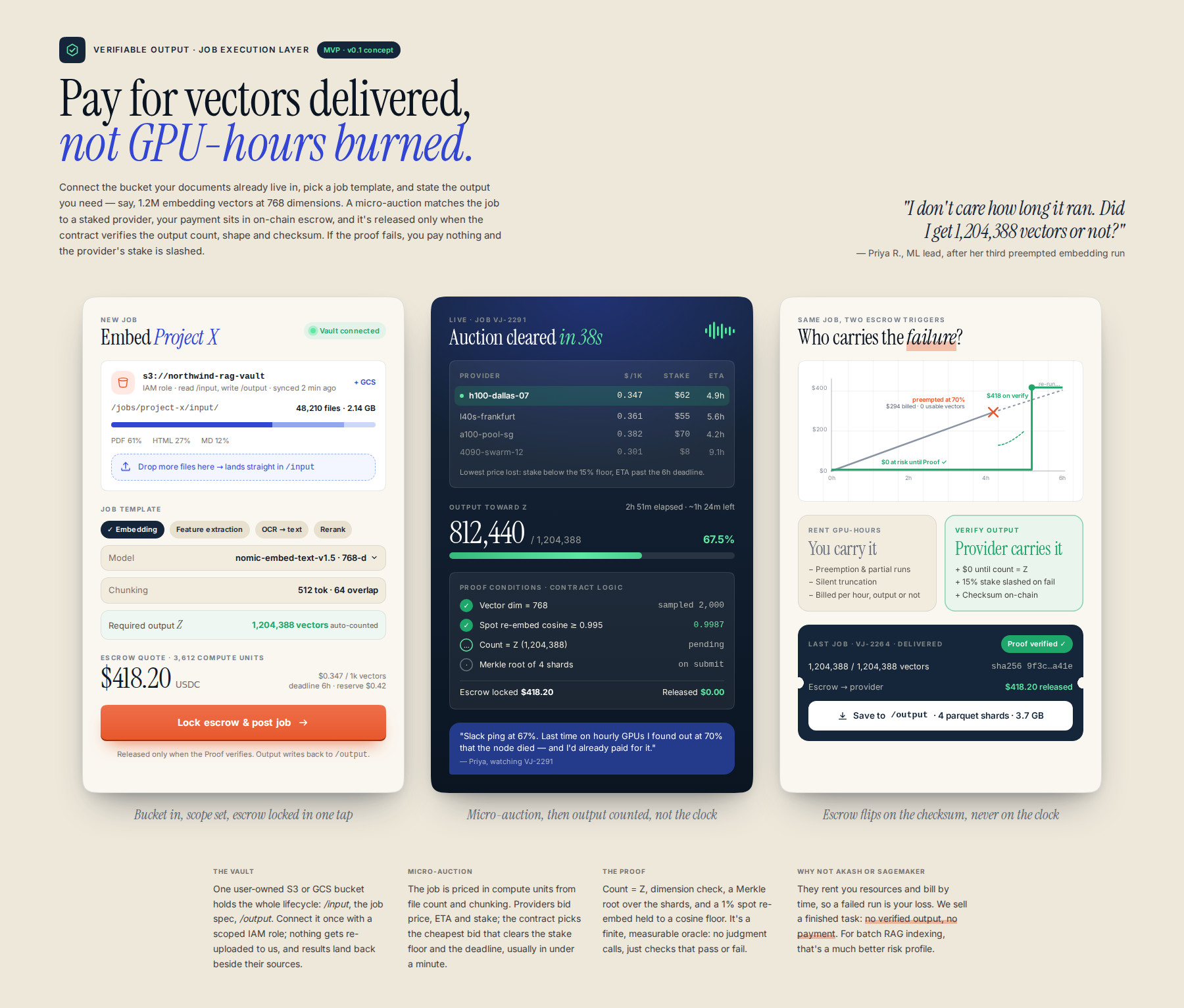
Process flow
Who it's for
ML Engineers, AI startups, and data teams requiring verifiable, scalable compute for specific, batch-oriented tasks (e.g., RAG index creation, feature extraction).
Why they need it
High-value AI workloads require predictable compute capacity for specific primitives, but current compute markets fail to provide a trust-minimized Service Level Agreement (SLA) tied to verifiable output. This forces teams into expensive, opaque, centralized API reliance.
What it is
A decentralized exchange that tokenizes and trades defined computational jobs. The transaction is based on the successful execution and verifiable output size/checksum of the job, not merely 'GPU hours.'
How it works
- The Client defines a fixed-scope Job (Job Definition API) specifying inputs, target primitive (e.g., embedding), and required output count (Z).
- The platform calculates the required compute units and initiates a micro-auction, matching the fixed job requirement with available Provider capacity.
- The Provider executes the job locally and submits the resulting data payload and a simple, standardized verification hash (the 'Proof') back to the contract.
- Payment is automatically released only upon successful verification of the defined output size and quality by the contract's logic, making the oracle problem finite and measurable.
Differentiation
We are not a general compute market; we are a specialized Verifiable Job Execution Layer. While competitors (e.g., Akash, AWS SageMaker) manage general resources, they lack the foundational trust-minimized financial guarantee that the resource will complete a specific, measurable task to a verifiable standard. Our novelty lies in shifting the escrow trigger from 'time elapsed' to 'output verified,' providing a fundamentally superior risk profile compared to existing, centralized, or general-purpose compute providers.
Implementation sketch
- Develop a standardized Job Definition API (JSON schema) that forces the client to specify input/output constraints and a target primitive (e.g., embedding, image resize).
- Build a smart contract module that acts as a job escrow and auction manager, managing 'Job Tokens' tied to specific output units and accepting USDC.
- Implement a simple Proof-of-Completion mechanism: The Provider must calculate and submit a verifiable, deterministic hash (e.g., SHA-256) of the final, structured output data payload. The smart contract verifies this hash against the expected output parameters, minimizing the oracle risk.
First step: Draft the Job Definition API JSON schema and write a simple Python function that takes a structured JSON data payload and reliably generates a standardized SHA-256 hash. This proves the core verification primitive and allows us to mock the 'Proof' mechanism immediately.
Remaining risks
- The 'Proof' mechanism (SHA-256) is insufficient for complex, multi-step jobs. Real-world ML tasks often fail due to intermediate data corruption or resource exhaustion, not just final output size. If the system cannot verify the integrity of the process (e.g., proving that 10 distinct steps were executed in the correct order, rather than just hashing the final result), the trust model collapses. — Focus future development on integrating verifiable computation primitives (e.g., secure multi-party computation or verifiable circuit execution) that prove the integrity of the entire computational graph, not just the final payload hash. This requires a shift from 'data verifiability' to 'process verifiability.'
- The critical mass failure risk: The platform requires both a robust supply (Providers) and a high-volume, standardized demand (Clients). If the initial niche (embeddings) proves too small, or if major centralized players (AWS, Azure) replicate the 'output verified' SLA feature, the network effect stalls, leaving the marketplace isolated and unprofitable. — Develop a secondary, adjacent utility early on (e.g., a standardized job logging/auditing service for enterprise ML teams) that can attract non-compute-specific users and build a broader, non-compute-dependent network effect before attempting to scale the core exchange.
- Regulatory and jurisdictional complexity. As the system handles cross-border compute transactions and utilizes decentralized compute resources, it immediately runs into complex, conflicting regulations regarding data sovereignty, AI model ownership, and compute taxation. A single regulatory crackdown on 'compute arbitrage' could render the entire model illegal or unviable. — Structure the initial legal framework to operate within specific, favorable jurisdictions (e.g., Switzerland, Singapore) and build compliance modules (e.g., KYC/AML checks on job owners/providers) into the smart contract layer from day one, rather than treating it as an afterthought.
Watch for: If the initial adoption rate shows that the average transaction cost (including the overhead of defining the Job Schema and generating the Proof) is consistently higher than the marginal cost savings achieved by using a centralized provider, the core economic value proposition will fail. Kill criterion: If a major, established centralized cloud provider (e.g., AWS, Google) announces a dedicated, API-first, enterprise-grade service that explicitly guarantees 'Verifiable Output SLAs' for fixed-scope jobs, this would prove the market has internalized the value of the feature, making the decentralized auction mechanism economically unnecessary and functionally obsolete.