
Guaranteed Data-Flow Reservation Market for Agent Workloads
A decentralized marketplace that allows advanced AI agents to lock in guaranteed access to specific data sets, model weights, or computation *rights* for complex agent workflows, shifting the focus from monitoring compute execution to securing the critical data/IP layer.
How can AI agents guarantee they won't lose access to a specific model version or dataset mid-workflow?
A collateralized reservation market lets agents lock in guaranteed access to a specific dataset or model version before running a multi-stage workflow. Providers pre-commit versioned assets into an escrow smart contract, the agent posts a collateral bond sized to the asset's scarcity, and compute is only scheduled once the required data or model rights are matched and locked for the task's duration. This targets data provenance loss and model version drift, not raw compute availability, and is aimed at research labs, data/IP owners, and DePIN infrastructure managers running high-stakes agent pipelines.
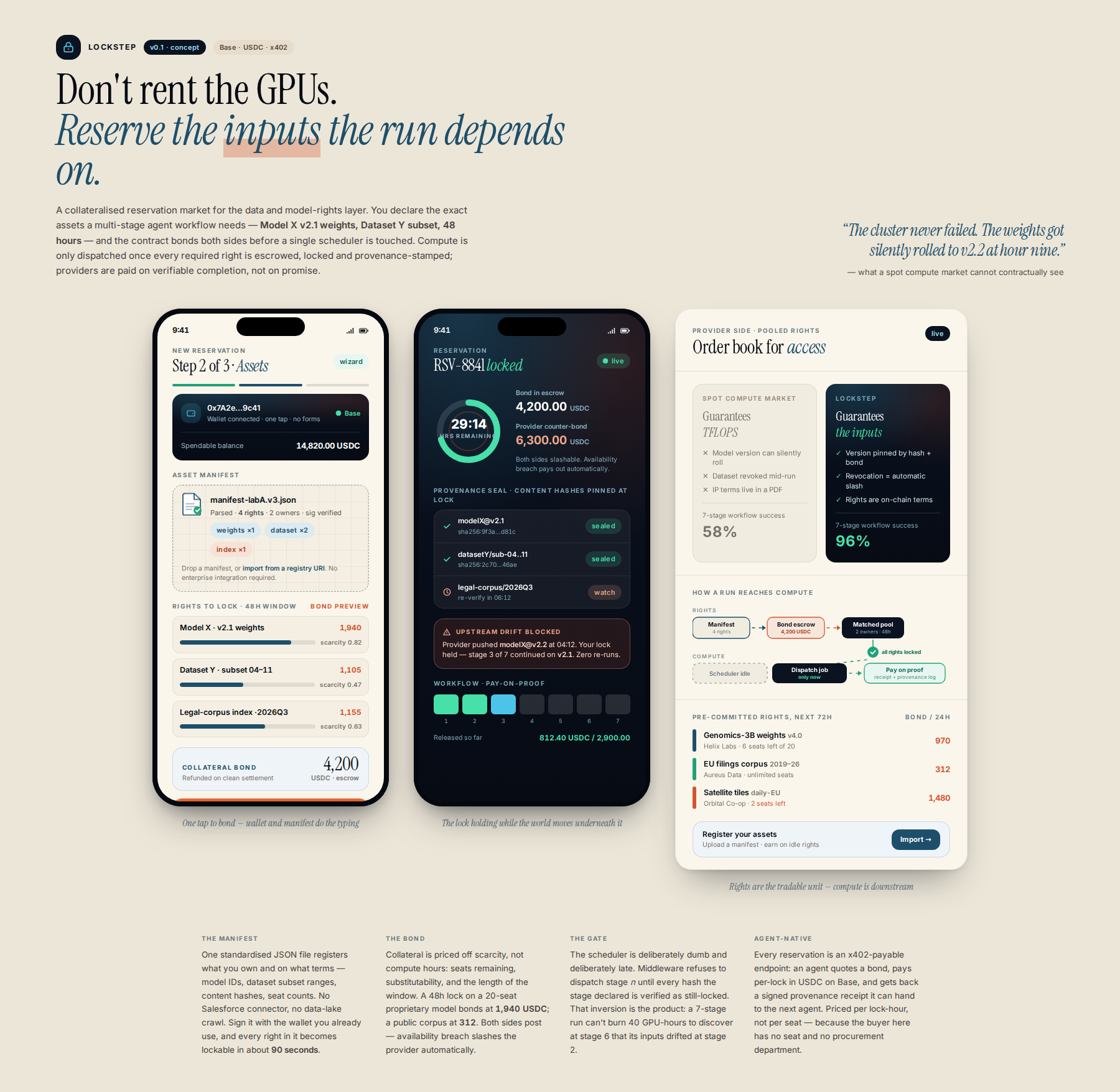
Process flow
Who it's for
Advanced AI agents/research labs needing guaranteed, traceable access to specific model versions or proprietary data streams; Data/IP owners looking for contracted utilization of their assets; DePIN infrastructure managers.
Why they need it
The current compute market's primary failure mode for advanced agents is not just compute availability, but the risk of data provenance loss, model version drift, or unauthorized access during multi-stage, complex workflows. This platform solves this by contractually guaranteeing the integrity and availability of the inputs and models required for computation.
What it is
A composite platform that combines a collateralized data/IP reservation system with a specialized job-scheduling middleware that orchestrates compute only when the required data/model assets are guaranteed and locked.
How it works
- Users define a complex agent task and specify minimum required data/model rights (e.g., 'guaranteed access to Model X v2.1 weights and Dataset Y subset for 48 hours').
- The system calculates the required collateral bond based on the scarcity and value of the locked assets/data rights.
- The user deposits collateral (USDC/bond) into an escrow smart contract.
- The system matches the reservation request against pooled, collateral-backed data/IP rights from providers who are willing to pre-commit access to their assets. Upon matching, the assets/rights are 'reserved' and locked in the contract, guaranteeing provenance and availability for the duration.
- The request is routed to the compute owner(s) via a standardized API/middleware, paying only upon verifiable successful completion and verifiable data provenance tracking.
Differentiation
We are not optimizing compute efficiency (like spot markets) or guaranteeing raw TFLOPS (which is hard to observe). We guarantee the inputs and model provenance required for the computation. This solves the failure mode of complex, multi-stage agent workflows where the critical failure is data drift or IP theft, which existing infrastructure tools (e.g., standard cloud schedulers, basic DePIN compute listings) fail to contractually address. The gap filled is the lack of a decentralized, collateralized mechanism for securing the data and model rights layer.
Implementation sketch
- Develop a minimal smart contract escrow mechanism to accept collateral bonds and manage release upon verified completion/failure.
- Build a 'Resource Profiling Engine' that translates abstract agent needs (e.g., 'requires Model X v2.1 and Dataset Y') into quantifiable, contractually measurable asset requirements (e.g., 'Model ID + Data Hash').
- Create a 'Reservation Matching' layer that aggregates available, collateral-backed data/IP rights from providers who are willing to pre-commit access to specific, versioned assets for a locked-in period.
First step: Draft the initial smart contract interface (Solidity/Rust) defining the 'Asset Reservation Bond' structure, requiring two inputs: an Asset ID (Model/Data Hash) and a Time Window, and linking the collateral release to a successful, verifiable 'Provenance Report' from the compute execution layer.
Remaining risks
- The 'Provenance Report' verification mechanism is fundamentally dependent on trust or centralized attestation, which undermines the core decentralized ethos. If the report cannot be cryptographically verified by a decentralized consensus mechanism (e.g., zero-knowledge proofs or verifiable computation proofs), the entire SLA guarantee collapses into a centralized oracle dependency. — Focus initial development on a narrow, verifiable domain, such as guaranteeing access to a publicly auditable, immutable data hash (e.g., a specific dataset snapshot on IPFS/Arweave) rather than the complex, internal state of a proprietary model execution. The collateral should secure the data pointer, not the computation itself.
- The complexity of defining and standardizing 'Model Rights' and 'Data Provenance' across heterogeneous, proprietary, or academic datasets is immense. Different entities use different hashing, versioning, and access control mechanisms, leading to integration paralysis and a massive upfront integration cost. — Initially restrict the scope to a single, well-defined, and open-source model ecosystem (e.g., Llama 3 weights from a specific commit hash) and a single, standardized data format (e.g., Parquet with specific schema requirements). Treat the first market vertical as a proof-of-concept for asset standardization before attempting market-wide adoption.
- The primary value proposition relies on advanced agents, which are themselves nascent and highly speculative. If the adoption curve for complex, multi-stage agent workflows stalls or slows down, the market for guaranteed, high-value assets dries up, leaving the platform with high fixed overhead for asset management and escrow services. — Develop a secondary, immediate use case that does not rely on 'advanced agents,' such as guaranteeing compute access for established, high-value, but currently unreliable tasks (e.g., mandatory regulatory compliance simulations or high-stakes financial modeling that requires provable inputs).
Watch for: Any significant, non-academic adoption signal from established, regulated industries (e.g., pharmaceutical research, defense contractors) that explicitly cites the need for contractual data provenance over mere compute power. This would validate the IP/data-centric pivot. Kill criterion: If the core community or early adopters cannot agree on a standardized, auditable method to prove the integrity of the input data or model weights (the 'Asset ID') in a trustless manner, the project is stuck in an unresolvable technical specification loop.