
Verifiable Agent State Ledger for Auditable DeFi Flows
A dedicated, gas-efficient persistence layer ensuring that complex, multi-step AI agent execution paths—especially those interacting with financial instruments—leave an immutable, verifiable, and auditable record on-chain.
How can DeFi protocols prove an AI agent's transaction history to regulators or auditors?
A dedicated on-chain ledger can record each AI agent's execution steps as immutable, cryptographically linked State Transition Records, tying together the previous state hash, input parameters hash, logic step identifier, and resulting state hash. This gives regulated DeFi protocols, compliance firms, and auditors a verifiable trail showing exactly what happened, when, and under what authorization, without exposing raw internal data. It targets institutions that need provable execution history for regulatory reporting or dispute resolution where off-chain agent logs are insufficient.
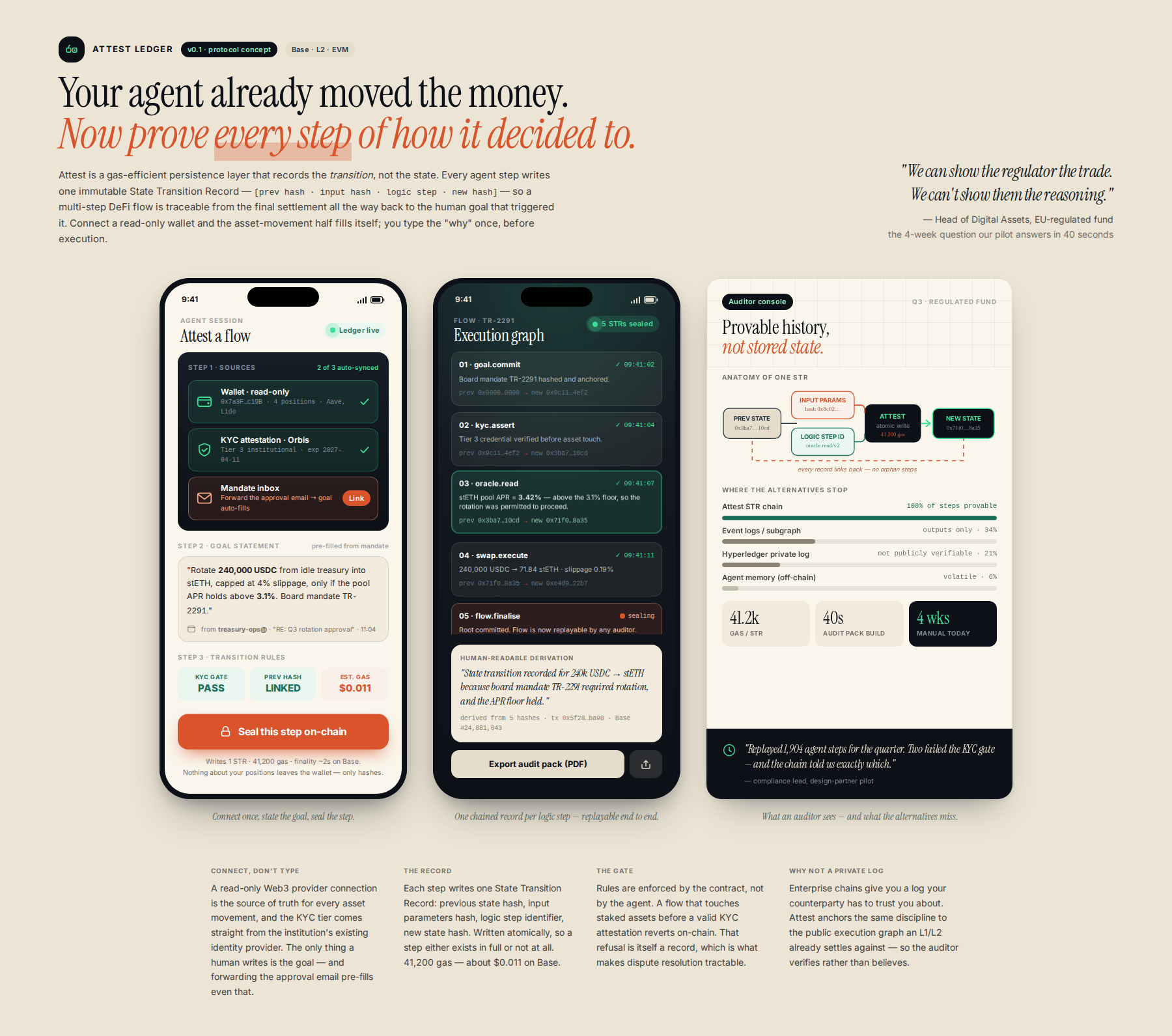
Process flow
Who it's for
Regulated DeFi protocols, compliance firms, institutional DeFi participants, and advanced smart contract auditors who require provable execution history for regulatory reporting or dispute resolution.
Why they need it
For high-stakes financial interactions, knowing what happened, when it happened, and who authorized each step is critical. Offchain state is insufficient for compliance. The current problem is that while agents can execute complex logic, the resulting state transitions lack a standardized, cryptographically verifiable audit trail necessary for institutional adoption.
What it is
A modular 'Auditable Agent Context Ledger' smart contract/protocol layer. This system doesn't just store state; it records the transition of state, linking the input parameters, the executed logic step (via verifiable input hash), and the resulting state change into a single, immutable transaction record.
How it works
- An Agent initiates a transaction by calling the Ledger contract, specifying the Agent ID and the initial context payload.
- The contract verifies the input context and enforces state transition rules (e.g., must pass KYC check before interacting with staked assets).
- It atomically stores a structured State Transition Record (STR) containing: [Previous State Hash, Input Parameters Hash, Logic Step Identifier, New State Hash].
- Subsequent steps read this verifiable STR, ensuring the entire flow is traceable back to the initial trigger, satisfying compliance requirements.
Differentiation
Unlike general state storage (e.g., NFTs) or volatile memory, this system is purpose-built for auditability. We are not selling 'state'; we are selling 'provable, auditable execution history.' This directly addresses the need for settlement finality and regulatory transparency. Existing enterprise tooling (e.g., Hyperledger) is designed for private logs, but they lack the standardized, native integration point with the public, verifiable execution graph of a decentralized agent interacting with L1/L2 assets.
Implementation sketch
- Develop a Solidity mock contract demonstrating the State Transition Record (STR) structure and immutable logging mechanics.
- Integrate with a local simulation environment focusing on simulating regulatory checkpoints (e.g., checking for required signatures/permissions before state update).
- Design the API wrapper (Rust/TypeScript) to generate and attach cryptographic hashes of the external input data and agent parameters alongside the state update, making the transaction payload self-documenting for auditors.
First step: Draft a detailed technical specification (TL;DR) for the StateTransitionRecord struct in Solidity, explicitly defining the input hashing mechanism (e.g., using Keccak256 on concatenated, sorted inputs) and the required gas cost estimates for this specific write operation on a target L2.
Remaining risks
- Regulatory Overreach/Scope Creep: The solution is positioned for compliance, making it a prime target for regulatory scope creep. Regulators might demand access to, or the ability to query, the internal decision-making logic or the raw, unhashed data that generated the state transition, which the system is designed to abstract away for gas efficiency. — Explicitly scope the system's role to recording the verifiable inputs and outputs of the agent's execution, not the logic itself. Frame the contract as a 'Proof of Execution Boundary' rather than a 'System of Record' for the agent's internal reasoning.
- Adoption Fragmentation: The need for this ledger is highly specific (institutional DeFi). If the primary target users (large regulated protocols) adopt a private, permissioned ledger (e.g., Corda, specialized enterprise blockchain) that also provides auditability, this public, gas-dependent solution becomes redundant or too costly to integrate with. — Develop a clear 'bridge' or 'attestation' mechanism. The goal should not be to replace private logs, but to provide a cheap, verifiable, public attestation that a complex, regulated action did occur on-chain, which the private system can then reference.
- Gas Cost Volatility for Auditability: Even with input hashing, the gas cost for writing a structured STR remains a significant, non-trivial cost. If L2 gas fees spike unpredictably, the cost of achieving 'auditability' could become prohibitively expensive for the very protocols it aims to serve, undermining the 'gas-efficient' claim. — Design the system to support batching or batch-proof submission. Instead of one transaction per step, allow the agent to submit a single transaction containing a Merkle proof summarizing the state transitions of N steps, drastically reducing the per-step write cost.
Watch for: A major DeFi protocol or compliance firm publicly announcing a solution that achieves verifiable auditability without requiring the gas expenditure of writing a full, structured state transition record on L1/L2. Kill criterion: A major L2 scaling breakthrough (e.g., a new rollup architecture) that makes state persistence and verifiable computation proofs effectively free or negligible in cost, rendering the need for this specific, gas-intensive contract layer obsolete.