
Agent Interoperability Compute Abstraction Layer
A decentralized protocol standard ensuring compute resources purchased from any source can be reliably formatted and consumed by any destination endpoint, abstracting away heterogeneous hardware specifics.
How can I stop agent workflows from breaking when they pull compute from different hardware vendors?
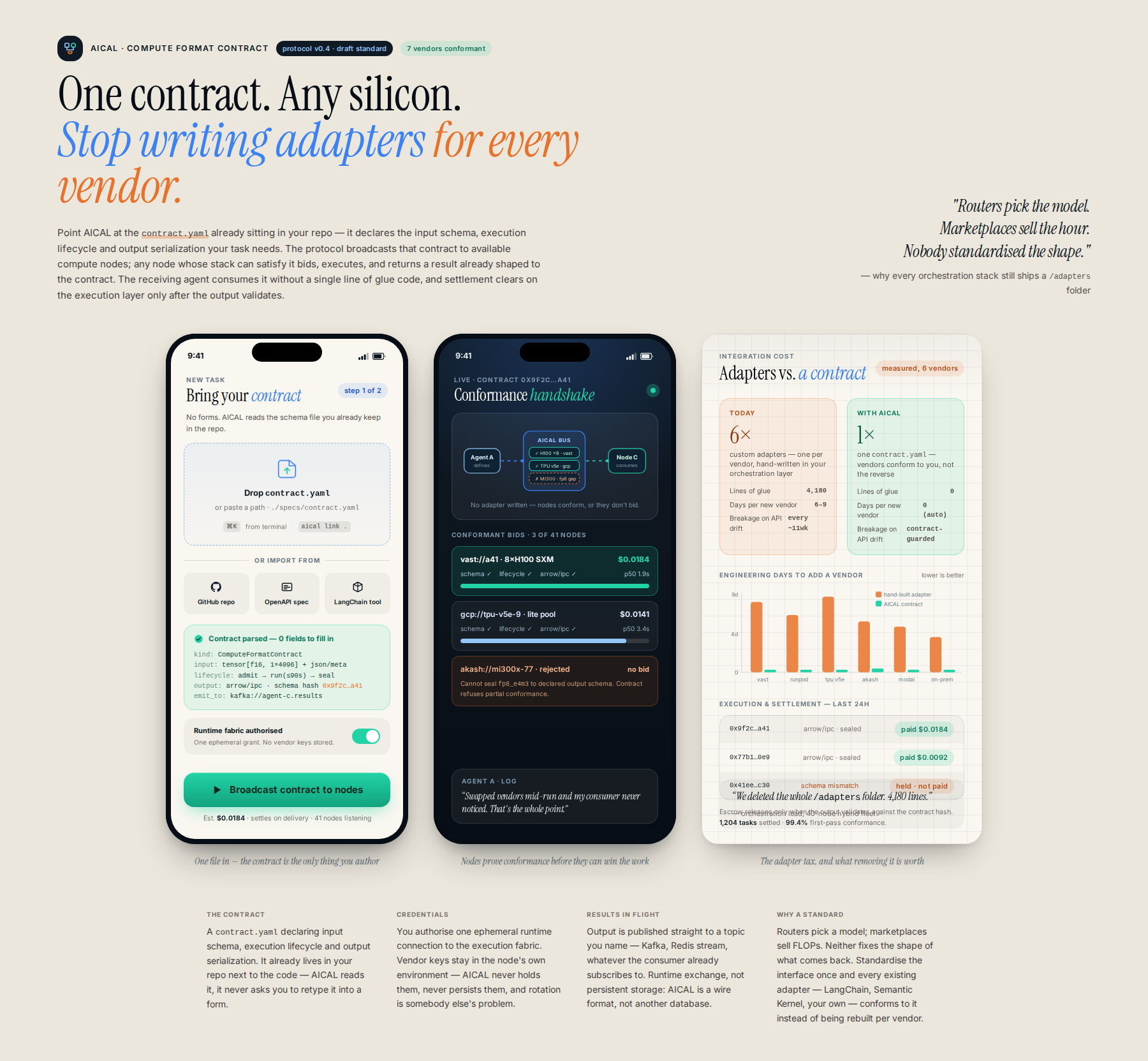
A standardized compute format contract that defines input/output schemas and execution requirements before a task runs can prevent this kind of failure. Requesting agents specify required schemas, supplying nodes verify they can meet the contract, and results are returned in the agreed format so the receiving system can consume them without custom adapters. This targets AI agent developers and orchestration frameworks that source compute from multiple vendors and currently hit 'last mile' format mismatches between nodes.
Process flow
Who it's for
AI Agent Developers and Model Orchestration Frameworks seeking reliable, multi-vendor compute pipelines.
Why they need it
The core pain is the lack of guaranteed interoperability between compute units. When agents source compute from different nodes/hardware types, there is no standardized protocol layer to guarantee the output format or execution context, leading to workflow failure (the 'last mile' problem).
What it is
A standardized 'Compute Format Contract' protocol layer that sits above raw compute units, defining the necessary inputs, execution lifecycle, and standardized output serialization format for any computational task, regardless of underlying hardware vendor or model type.
How it works
- Agent A defines a required task using the standardized 'Compute Format Contract' (e.g., defining required input/output schemas).
- The protocol queries available compute nodes.
- Node B (the supplier) verifies that its stack can meet the Contract's specifications.
- Upon execution, Node B submits the result formatted according to the Contract, which the receiving system (Node C) consumes immediately.
- Payment is guaranteed via a compute execution layer.
Differentiation
This differs from model routers (which only route model calls) and raw compute marketplaces (which only track time/FLOPs). It is an interoperability standard layer. The gap is that existing orchestration frameworks (LangChain, Semantic Kernel) require developers to build custom adapter patterns for every new hardware/model integration; this protocol standardizes the interface itself, providing a unified contract that existing adapters must conform to, rather than requiring the developer to build the adapter from scratch.
Implementation sketch
- Develop a smart contract standard (ERC-...) defining the 'Compute Format Contract' structure: {input_schema, output_schema, required_runtime_environment}.
- Build a minimal middleware/runtime layer that validates and enforces this contract on compute execution, abstracting vendor APIs.
- Implement a proof-of-format mechanism: nodes must stake compute capacity against the contract, proving they can deliver the guaranteed output format.
First step: Draft the initial technical specification for the 'Compute Format Contract' smart contract, focusing only on defining the JSON schema structure for input/output validation, and identify the three most common, conflicting output formats (e.g., raw tensor vs. structured JSON vs. XML) to use as proof-of-concept examples.
Remaining risks
- The 'Compute Format Contract' standard becomes too complex or restrictive, leading to vendor lock-in at the protocol level. — Design the standard using an extensible, modular schema (e.g., JSON Schema draft 2020-12) that allows for optional extensions and custom format handlers without breaking backward compatibility for core functionality.
- Adoption is bottlenecked by the need for major cloud providers (AWS, Azure) to build native support for the middleware/runtime layer, which they are incentivized to keep proprietary. — Initially focus the scope on niche, decentralized compute providers (e.g., academic clusters, specialized GPU rental pools) where the pain of interoperability is highest and the incentive to adopt an open standard is greater than the risk of proprietary lock-in.
- The runtime middleware layer proves computationally expensive or introduces unacceptable latency overhead, negating the benefit of interoperability. — Prototype the middleware layer using highly optimized, low-level serialization/deserialization techniques (e.g., FlatBuffers or Protocol Buffers) and benchmark the overhead rigorously against current state-of-the-art workflow engines.
Watch for: Any major cloud provider (AWS/Azure/GCP) announces a native, first-class, standardized 'Compute Output Contract' feature in their core SDKs or compute offerings, as this would render the protocol layer redundant. Kill criterion: If the initial technical specification for the 'Compute Format Contract' cannot be drafted and validated against three distinct, real-world, non-standardized output formats within a 6-week period, indicating the problem is a fundamental research hurdle rather than a solvable protocol design.