
Fault-Tolerant ML Job Scheduler for Niche Compute
A highly specialized, decentralized compute layer that guarantees reliable, checkpoint-aware execution for standardized machine learning model training (e.g., LoRA fine-tuning), solving the problem of state loss across heterogeneous hardware.
How can I train ML models on decentralized spot compute without losing progress to hardware failures?
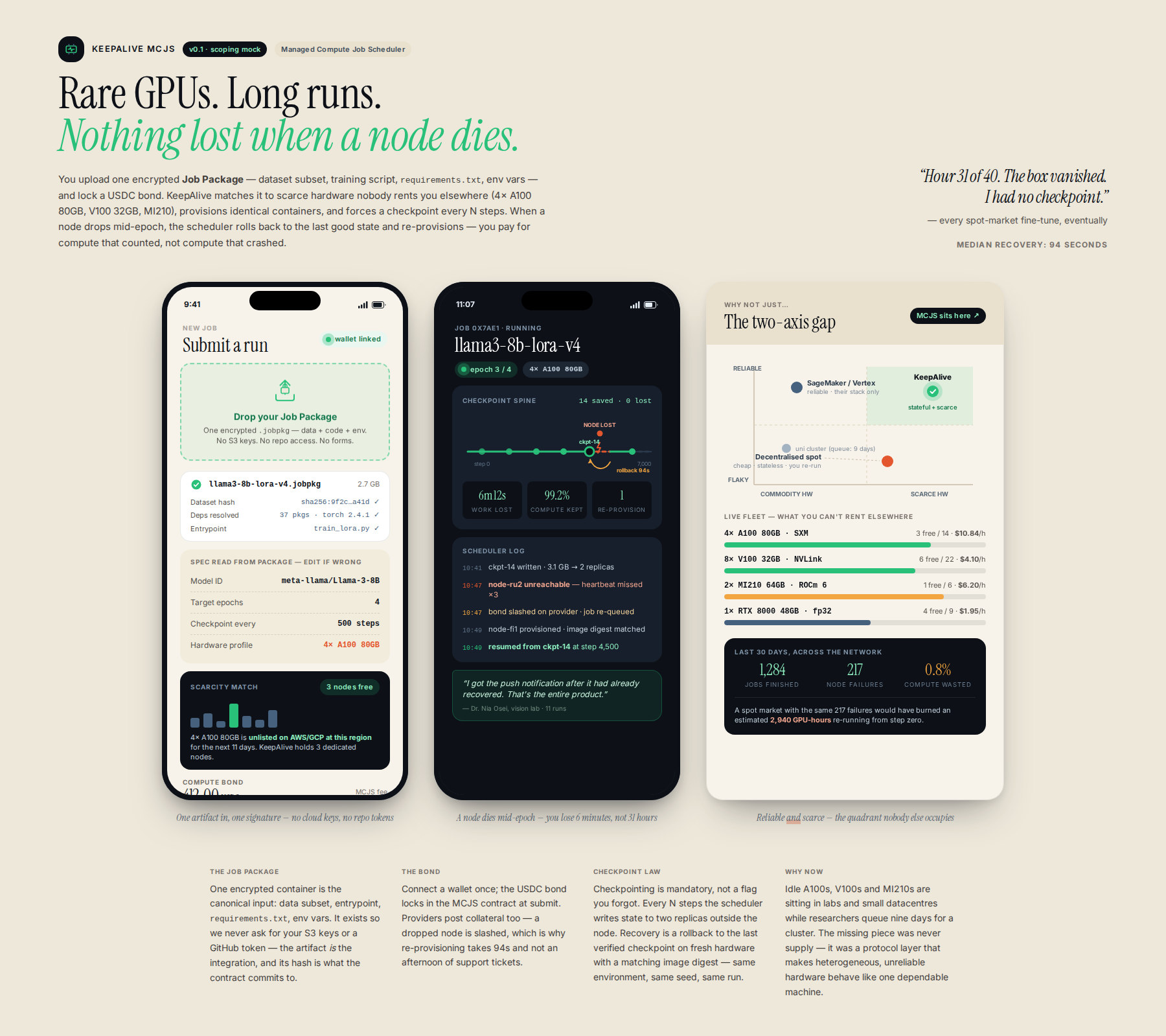
A managed compute job scheduler solves this by treating training runs as deterministic, checkpointed processes rather than raw spot capacity. It accepts a standardized job spec (model ID, dataset hash, target epochs, hardware profile), provisions isolated containers on matching nodes, enforces mandatory checkpointing at set intervals, and automatically rolls back to the last checkpoint on node crash or network failure. It targets ML researchers and small AI teams needing dedicated access to niche or high-memory GPUs unavailable on major clouds.
Process flow
Who it's for
ML researchers, small AI startups, and academic teams requiring dedicated, fixed-resource compute time for model training, especially those needing access to niche or older-generation GPU hardware (e.g., specific high-memory cards) unavailable on major cloud platforms.
Why they need it
Running repeatable, stateful ML training jobs on generic decentralized spot markets is prohibitively risky due to hardware failure and environmental drift. The market needs a managed layer that treats the job as a deterministic, checkpointed process, mitigating the cost of expensive, multi-day compute failures.
What it is
A 'Managed Compute Job Scheduler' (MCJS) that accepts a standardized Job Specification (Model ID, Dataset Hash, Target Epochs, Required Hardware Profile) and manages the allocation of continuous, dedicated compute resources. It orchestrates the job, enforces mandatory checkpointing, and handles state recovery upon failure.
How it works
- User submits a Job Specification and a compute bond (USDC) to the MCJS smart contract.
- MCJS first verifies the Job Specification against the available hardware profile, prioritizing resource scarcity (e.g., 4x A100 80GB) which is the core differentiator.
- The MCJS provisions the required nodes into standardized, isolated containers (e.g., Singularity/Docker) to ensure environment consistency.
- The job executes, with the system automatically managing mandatory checkpointing at set intervals.
- If a failure is detected (node crash, network partition), the system automatically attempts recovery or rollback to the last successful checkpoint, minimizing wasted compute time.
- Upon successful completion, the final payment minus the MCJS commission is transferred to the job owner.
Differentiation
Unlike raw spot markets, which offer fungible power, the MCJS offers a dedicated, stateful, and fault-tolerant ML environment. Unlike centralized cloud providers (AWS SageMaker, Google Vertex AI), which offer high reliability but are limited by their proprietary hardware stacks, the MCJS uniquely provides the combination of reliable execution and access to niche, high-memory, or specialized hardware (e.g., specific older-gen GPUs) that are scarce or unavailable from major providers. Gap: The current gap is the lack of a robust, standardized protocol layer that abstracts the reliability challenge of heterogeneous decentralized hardware.
Implementation sketch
- Define and standardize the Job Specification JSON schema, mandating fields for checkpoint frequency, required container base image, and hardware constraints.
- Develop a Hardware Abstraction Layer (HAL) API that accepts raw node metrics and provides a standardized 'readiness score' for checkpointing capability (e.g., checking local storage write speed, network latency).
- Build the MCJS smart contract on Base/Solana to manage the compute bond, track job state (RUNNING, PAUSED, FAILED, COMPLETE), and execute the checkpoint/payout logic.
First step: Draft the minimum viable Hardware Abstraction Layer (HAL) API specification. This API must define how to programmatically query a node's checkpointing capability (e.g., 'Can this node reliably write a 10GB checkpoint file every 15 minutes?') and standardize the output across different GPU vendor/OS combinations.
Remaining risks
- The 'Niche Hardware' advantage is temporary. If a major cloud provider (AWS, Google) decides to acquire or integrate a standardized way to access high-VRAM/specialized hardware (e.g., specific A100 generations or niche accelerators), the core differentiation—access to scarce resources—is instantly neutralized, leaving the MCJS merely as a more complex, expensive wrapper around existing cloud functionality. — Focus on building deep, proprietary relationships with hardware owners or regional compute centers that are structurally difficult for major cloud providers to integrate (e.g., specialized academic clusters or private data centers in jurisdictions with unique regulations).
- The operational overhead of the Hardware Abstraction Layer (HAL) becomes a fatal scaling bottleneck. The cost and complexity of maintaining compatibility across thousands of heterogeneous node combinations (different drivers, OS versions, physical hardware models) will consume all revenue, making the service economically unviable at scale, regardless of demand. — Restrict the initial operational scope to a single, highly standardized hardware stack (e.g., only NVIDIA enterprise-grade cards running a specific Linux kernel and container runtime) and treat the HAL development as a dedicated, highly capitalized infrastructure play, not a software feature.
- The decentralized network's inherent volatility (power outages, physical theft, intermittent connectivity) remains a systemic risk. Even with checkpointing, if the underlying supply layer cannot guarantee continuous, reliable power and connectivity for the duration of a multi-day job, the entire value proposition of 'fault-tolerance' collapses, leading to massive user mistrust and abandonment. — Require and mandate that participating nodes provide verifiable, third-party attested guarantees of uptime and power redundancy (e.g., integration with local UPS/generator reporting) as a prerequisite for participation, effectively raising the barrier to entry and cost for suppliers.
Watch for: Any increase in the average time required for the MCJS to provision a job from 'requested' to 'running' state. If the scheduling and resource verification process becomes slow, it indicates the complexity of the HAL is outpacing the speed of the market, making the service unusable for time-sensitive research. Kill criterion: A sustained period (2+ months) where the average successful job completion rate drops below 80%, or where the operational cost of maintaining the HAL/network integrity exceeds 40% of the total revenue generated from compute bonds.