
Agent Compute Mesh: Specialized Fine-Tuning Market (Locked Spec)
A specialized infrastructure layer providing guaranteed, transactional access to niche, high-value hardware configurations (A100, specialized VRAM) for advanced, multimodal model fine-tuning, proving the market mechanism before scaling to a general compute mesh.
How can AI research teams get guaranteed access to A100 GPUs for fine-tuning without spot-market failures?
A specialized compute exchange can guarantee A100 access by trading standardized, time-bound 'Computational Service Slots' tied to a specific task rather than raw hardware time. Orchestrators submit a constrained job (model, dataset, hardware, time window), the system queries liquidity pools for that exact configuration, decomposes the job into the minimum slots needed, and settles cost programmatically via token rails. This targets AI research teams and fine-tuning firms whose niche multimodal training jobs generalized spot markets like Akash or Render cannot reliably partition or guarantee.
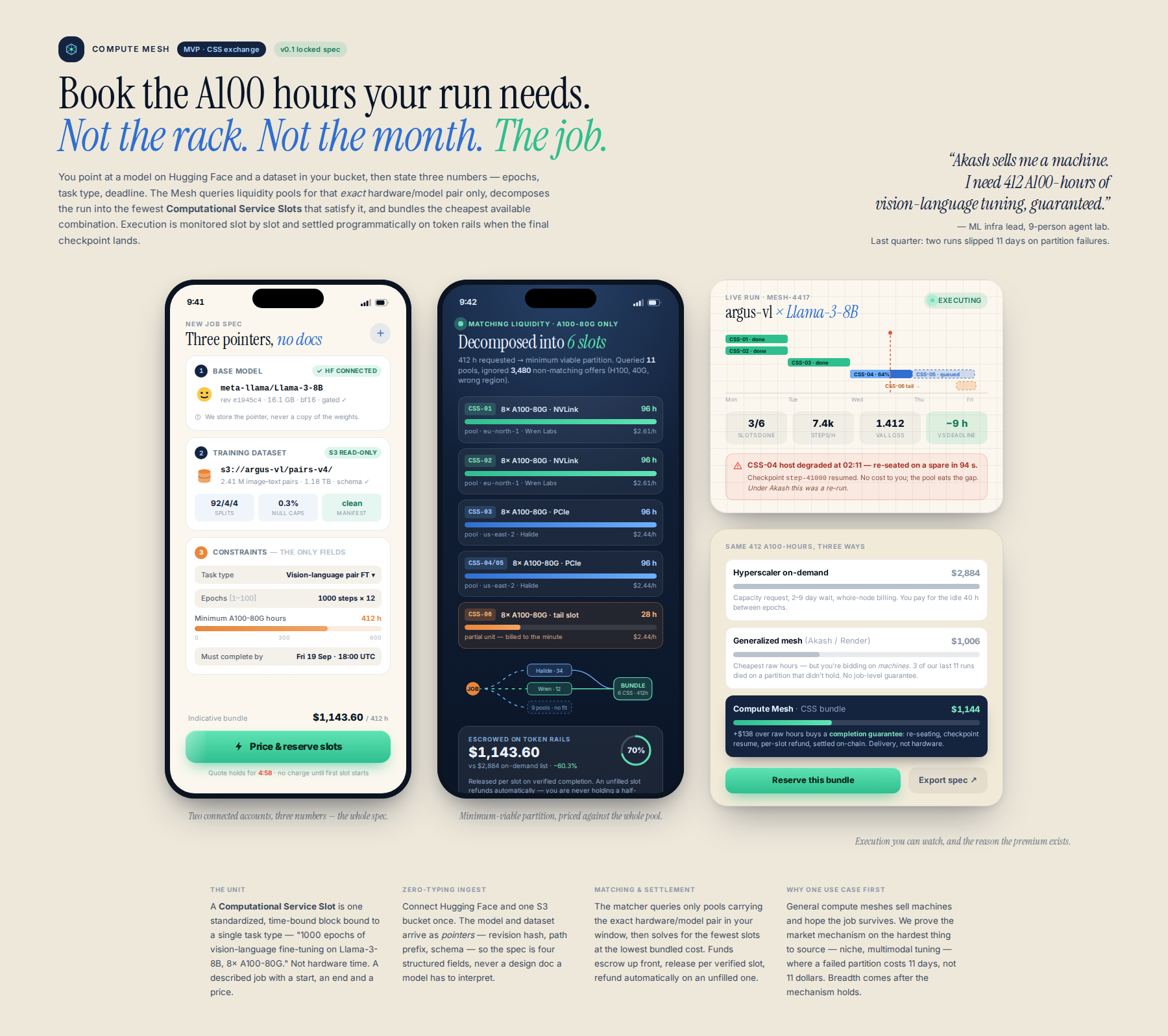
Process flow
Who it's for
AI research teams, specialized agent development firms, and advanced model fine-tuners requiring predictable, high-throughput access to niche hardware configurations for state-of-the-art, complex tasks.
Why they need it
The most advanced agentic systems depend on complex, expensive, and non-standard compute tasks (e.g., multimodal fine-tuning). These tasks require guaranteed resource partitioning and quality control that generalized spot markets cannot reliably provide, creating a critical bottleneck for cutting-edge AI development.
What it is
A specialized middleware platform (The Compute Mesh MVP) that acts solely as a high-fidelity market exchange for Computational Service Slots (CSS). A CSS is a standardized, time-bound unit dedicated to executing one specific, computationally intensive task type (e.g., '1000 epochs of vision-language pair fine-tuning on Llama-3-8B using A100 hardware').
How it works
- The user/agent orchestrator submits a detailed, constrained compute requirement (e.g., 'Fine-tune Model X using dataset Y on A100').
- The Mesh queries liquidity pools ONLY for the required specific hardware/model combination and time window.
- It automatically decomposes the job into the minimum number of CSS units required and bundles the lowest-cost, highest-availability combination.
- The job is executed, monitored, and the final cost is settled programmatically via token rails, proving the transaction viability for a single, high-value use case.
Differentiation
This differs from generalized compute marketplaces (Akash/Render) because it is highly specialized, focusing on utility-based transaction booking for specific, expensive processes rather than raw hardware time. It differs from general market data feeds because it is the transactional execution layer for a single, difficult-to-source, high-value service. The GAP is the lack of a proven, transactionally reliable mechanism to source and trade the compute for state-of-the-art, niche AI training/tuning tasks, where failure to guarantee resource state or partitioning leads to critical project delays.
Implementation sketch
- Draft the core CSS booking API schema: Define input parameters (Model ID, Dataset hash, Hardware requirement, Time window) and the expected output (Quote, Failure Code, Resource Guarantee Level).
- Build a mock liquidity service: Create a simple database layer simulating limited, high-cost A100 capacity to test the quoting logic against defined constraints.
- Develop the settlement simulation: Integrate a basic smart contract stub (on Base/USDC) that accepts the quote and simulates the atomic transfer, closing the transactional loop for the MVP use case.
First step: Identify and contact 3-5 specialized AI research teams (via LinkedIn or academic contacts) and conduct 15-minute interviews to document their single biggest, most costly, and most unpredictable compute failure point in the last 6 months. This directly feeds the 'pain_evidence' field.
Remaining risks
- Regulatory and IP Compliance Risk: The high-stakes nature of multimodal fine-tuning means that the underlying data (datasets, model weights, fine-tuning results) are extremely sensitive. If the Mesh fails to provide ironclad, auditable data provenance, usage rights tracking, or compliance with international data sovereignty laws, the entire platform becomes a legal liability, regardless of technical success. — Build legal compliance and data provenance tracking into the core protocol from day one. Implement smart contract logic that automatically enforces data residency rules and generates immutable audit trails for every CSS transaction, making compliance a core, non-negotiable feature.
- Generalized Competition Risk (The 'Cloud Catch-up'): If the specialized market proves successful, major centralized cloud providers (AWS, Google Cloud, Azure) will view the CSS model as a critical strategic vulnerability. They will dedicate massive resources to replicate the utility-based booking and resource guarantee mechanism, potentially undercutting the decentralized model with superior capital and regulatory compliance. — Focus the network effect on the decentralization and agility aspect. The Mesh must prove that its liquidity sourcing can handle highly volatile, niche, or geopolitical resource demands that centralized players are slow or legally unable to service, positioning itself as the necessary 'escape hatch' for cutting-edge research.
- Economic Valuation Drift: The complexity of defining and pricing a Computational Service Slot (CSS) is inherently prone to economic modeling failure. If the market fails to establish a universally agreed-upon, stable, and transparent method for valuing the utility of a specific compute task (e.g., 'Is 1000 epochs of fine-tuning worth more or less than 500 epochs?'), the market will suffer from pricing paralysis and liquidity gaps. — Develop a dynamic, decentralized governance layer (DAO) that allows the community to propose, vote on, and adjust the meta-economic parameters and pricing models for the CSS units, ensuring that the pricing mechanism evolves with the technological frontier rather than being dictated by initial founders.
Watch for: A sudden shift in the industry focus toward raw, massive-scale commodity compute (e.g., general LLM inference volume) over specialized, niche, high-value training/tuning. This would signal that the 'specialized' abstraction layer is not the primary bottleneck, and the market gap is smaller than assumed. Kill criterion: The announcement of a major, established cloud provider (e.g., Google Cloud or Microsoft Azure) launching a dedicated, fully compliant, and economically competitive API that replicates the CSS booking model, making the core value proposition of 'guaranteed resource state' instantly commoditized and non-differentiated.