
Structured Utility Schema & Metering Standard (SUSMS)
A governance-led, standardized schema definition service that defines and validates the 'Utility Unit' for highly constrained, structured data interactions (e.g., SQL/Graph queries), allowing third-party billing providers to build their own metering APIs.
How do you standardize billing units for AI agents making database queries?
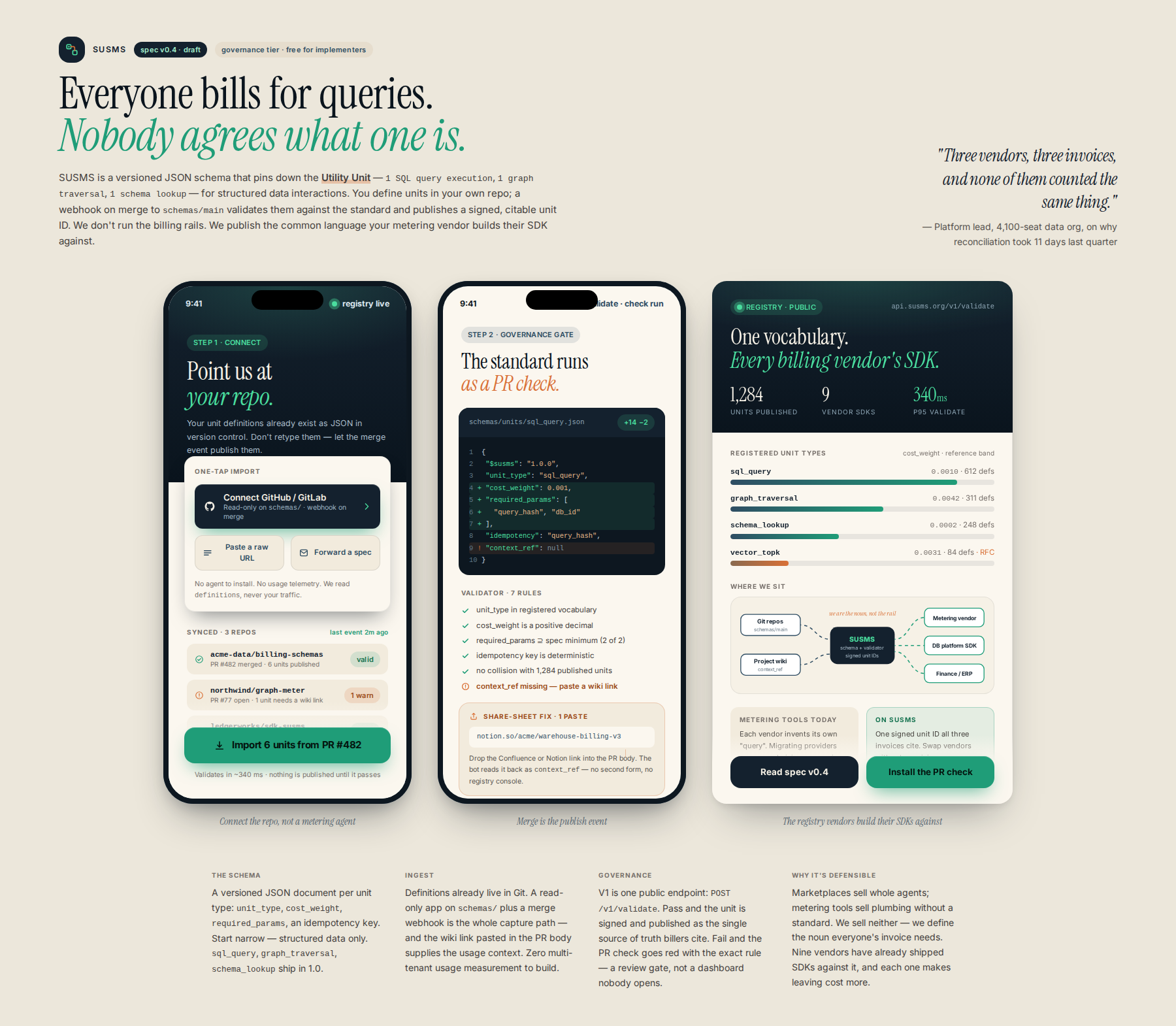
A versioned, vendor-agnostic JSON schema can define predictable 'Utility Units' — like one SQL query execution or one graph traversal — with fields such as unit type, cost weight, and required parameters. A governance API validates definitions against this schema, letting third-party billing and metering providers build their own SDKs without a centralized platform. It targets enterprise AI development teams and database vendors who need a common measurement language before they can meter structured data access consistently.
Process flow
Who it's for
Enterprise AI Development Teams and Database/Data Platform Vendors.
Why they need it
The core market need is not a centralized API, but a universal language for measuring computational utility. By standardizing the schema of utility units for predictable actions (like database access), we solve the governance problem and drastically lower the barrier to entry for billing platforms.
What it is
A standardized, versioned JSON schema definition for 'Utility Units' focused initially on structured data interactions. This schema defines predictable units like '1 SQL Query Execution,' '1 Graph Traversal,' or '1 Schema Lookup,' and provides the blueprint for third-party SDKs to implement metering against it.
How it works
- Schema Definition: Define the foundational JSON schema for structured utility units (e.g.,
{'unit_type': 'sql_query', 'cost_weight': 0.001, 'required_params': ['query_hash', 'db_id']}). - Governance Service (V1): Build a simple, public API endpoint that validates incoming utility unit definitions against the approved schema, serving as the single source of truth for billing.
- Adoption Model: Market this schema to established metering/billing providers (e.g., s3, specialized database monitoring tools), encouraging them to build their own SDKs around our standard, rather than us building the entire infrastructure.
Differentiation
Unlike general marketplaces that sell whole agents, or general metering tools that lack standardization, SUSMS provides the foundational, vendor-agnostic schema for utility units. We are not building the billing rails; we are defining the common language for them. This shifts the gap from 'technical infrastructure' to 'governance standard,' which is a much more defensible and scalable position. We provide the blueprint, allowing existing billing providers to rapidly adopt the standard.
Implementation sketch
- Develop a minimal, public API endpoint that accepts a JSON payload and validates it against the core 'Structured Utility Unit' schema (e.g., checking for required fields like
unit_typeandcost_weight). - Create a comprehensive documentation package detailing the schema, use cases, and integration guides for third-party developers (e.g., 'How to wrap your SQL service with the SUSMS standard').
- Identify and prototype the first target vertical (e.g., RAG agents querying a Postgres database) to create a proof-of-concept implementation demonstrating the schema in action.
First step: Draft the initial core JSON Schema definition for 'SQL Query Execution' utility unit and host it on a GitHub repo, opening it for community review to start establishing governance and proof of concept.
Remaining risks
- The 'Standard' Becomes a Governance Bottleneck (Standardization Paralysis). — The effort to create a single, universal schema (even if focused on structured data) will inevitably lead to endless debates over edge cases, definitions, and cost weights. The project risks spending all its energy in committee meetings and documentation, failing to produce any working, adopted utility unit definition. Mitigation requires establishing a clear, limited scope for the initial V1 schema and prioritizing speed of definition over absolute completeness.
- The Standard is Overridden by Incumbent Vendor Proprietary Systems. — Major database vendors (e.g., Snowflake, AWS Redshift, Google BigQuery) already have their own highly optimized, proprietary metering and billing mechanisms. If these incumbents view SUSMS as a competitive threat, they will not adopt the standard; instead, they will build a compatibility layer that bypasses the standard or simply ignore it, leaving the schema useful only for niche, non-enterprise use cases.
- Lack of Utility (The 'Schema Dump' Problem). — The core value proposition is defining the schema, but a schema is just a definition. If the market cannot agree on which units are high-value enough to warrant standardized billing, or if the utility units defined are too generic (e.g., '1 data access'), the standard becomes a meaningless 'schema dump' that adds no commercial value. We must prove the economic necessity of the units, not just the technical possibility.
Watch for: A lack of critical, non-competitive early adoption from at least two major database/data platform vendors. If the foundational users refuse to build their SDKs around the standard, the governance layer has no teeth. Kill criterion: If the initial community review of the core JSON schema (the proposed first step) fails to generate any concrete, actionable feedback or buy-in from the target enterprise audience within 90 days, indicating the standard is either irrelevant or too complex.
Sources the council used
Real-world evidence that grounded this idea — judge it for yourself.