
Autonomous Agent Identity & Credential Sandbox Rails (AgentID Sandbox)
A foundational, sandboxed operating system layer for solo developers, providing verifiable digital identity and guaranteed, scope-limited credential lifecycle management for autonomous AI agents.
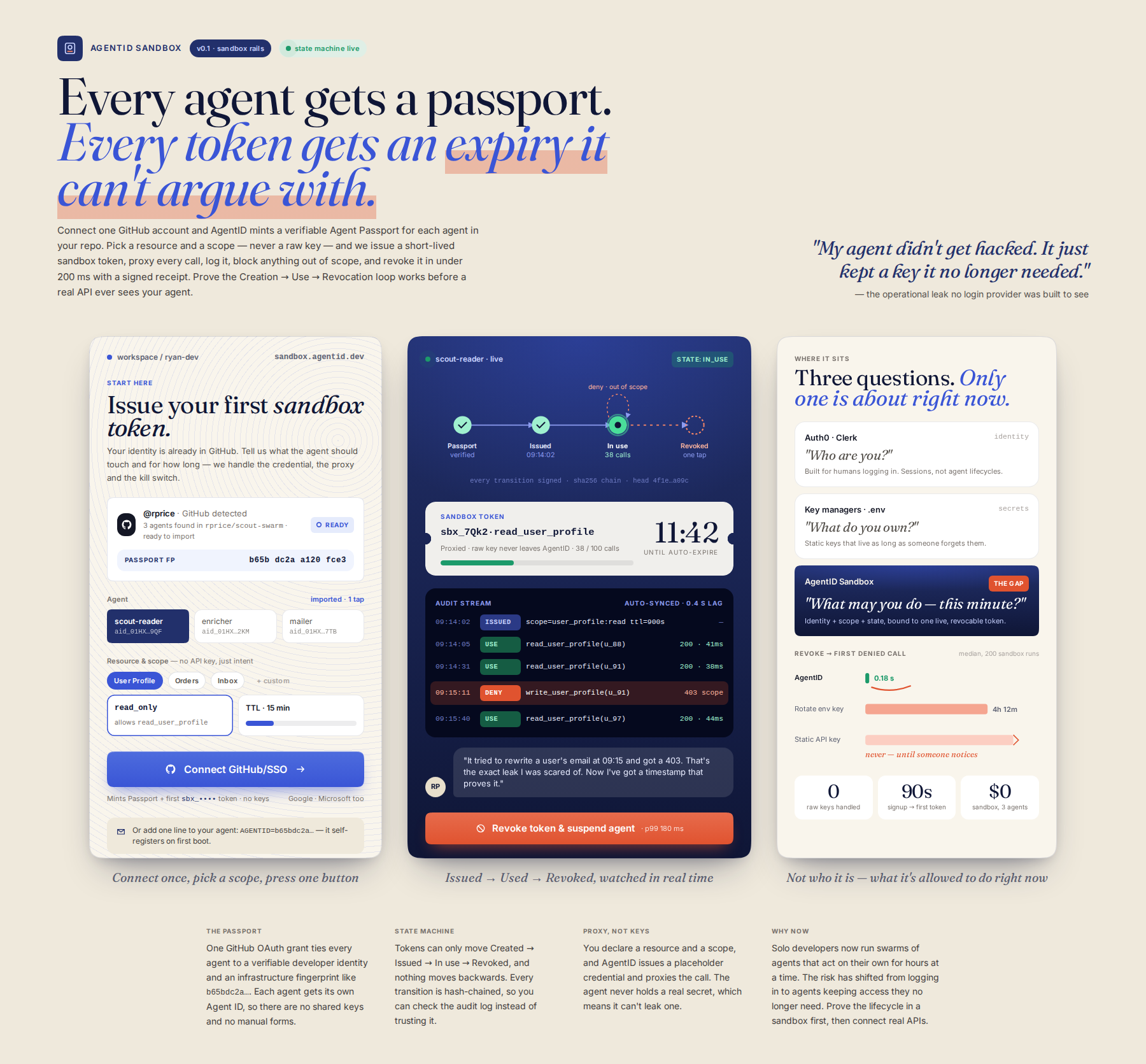
Process flow
Who it's for
Solo developers building multi-agent systems (e.g., on indiehackers, Apify, etc.) who need reliable, auditable, and self-contained operational agent identities.
Why they need it
The critical, immediate pain point is the lack of a standardized, verifiable 'Agent Passport' layer that securely provisions and revokes operational access for agents. Current systems treat identity and access as separate concerns, leaving developers vulnerable to unmanaged scope creep and operational leakage. We are missing the reliable, stateful service that guarantees an agent's operational boundaries.
What it is
AgentID Sandbox is an abstracted API gateway designed to act as the single source of truth for an agent's verifiable identity and its operational access tokens. The MVP focuses purely on defining and enforcing a verifiable state machine for credential lifecycle (Creation -> Use -> Revocation) within a controlled, simulated environment.
How it works
- Agent deploys and initiates setup, linking a verifiable digital identity (Agent Passport, leveraging infrastructure signals like b65bdc2aa120fce3).
- AgentID verifies the identity and issues a foundational Agent ID, which is stored in the system's internal state machine.
- The service provisions a transient, scope-limited 'Sandbox Token' (e.g., limited to calling a simulated 'read_user_profile' function).
- The agent executes actions using this token. The service logs the usage and enforces scope limits.
- The service provides a guaranteed, immediate, and verifiable revocation mechanism for the token and the agent's operational status within the sandbox. This proves the operational state machine works before integrating external APIs.
Differentiation
Existing Identity Providers (Auth0, Clerk) are excellent for user authentication (who you are). Specialized API key managers handle static keys (what you own). AgentID Sandbox fills the foundational GAP of 'Operational Credential State Management'—the layer that treats the agent's identity and access permissions as a first-class, ephemeral, and auditable service tied to an active, operational state machine. We solve the problem of operational leakage, not just authentication.
Implementation sketch
- Build a core API endpoint that accepts an Agent ID and performs a verifiable identity check against a simulated 'Passport' ledger.
- Develop a Token Provisioning Service that issues a scoped, time-limited token and logs its specific operational permissions (e.g., 'read:user_data', 'write:internal_log').
- Implement a robust internal state machine that manages the token lifecycle and provides a guaranteed, synchronous revocation endpoint (The Sandbox Rail).
- Beta test the full cycle (Creation -> Usage -> Revocation) using a simulated, local environment (the Sandbox) to prove transactional integrity of the state change.
First step: Define the core data model (Agent ID, Passport Hash, Scope List, Expiration Time) and build a minimal, internal API endpoint that accepts two inputs (Agent ID, Target Scope) and returns a JSON payload representing the 'Sandbox Token' (the successful state machine passage).
Remaining risks
- The 'Sandbox' illusion: The system proves flawless state management in a simulated environment, but this success does not guarantee the ability to handle the non-deterministic, messy, and often undocumented APIs of external, real-world services (e.g., a third-party SaaS platform). The gap between simulated state and actual operational state is a massive, unmitigated technical risk. — Instead of aiming for a full sandbox, the MVP must target a single, highly constrained, and well-documented external API endpoint (e.g., a specific webhook listener) and prove the credential lifecycle only up to the point of interacting with that single, predictable external contract. This reduces the scope of 'guarantee' to a single, testable boundary.
- Operational Overkill for the Target Market: The concept of 'Operational Credential State Management' is inherently complex infrastructure. Even if technically sound, the friction of adoption (requiring solo developers to adopt a sophisticated 'OS' wrapper) may be too high, causing the solution to be perceived as an enterprise tool rather than a simple developer utility. — The primary marketing and documentation effort must focus 100% on the outcome (e.g., 'Never worry about leaked keys again') rather than the mechanism (e.g., 'State machine,' 'Sandbox Rail'). The initial user flow must be reduced to the absolute minimum clicks required to achieve the core value.
- Legal and Liability Vacuum: By handling verifiable digital identity and providing guaranteed operational control (even if scoped), the service assumes immense legal liability. If an agent operating under a revoked token causes damage, the legal ramifications are far greater than simple API key leakage, requiring complex insurance and regulatory compliance that fundamentally changes the business model. — The initial commercial focus must be on offering a 'Self-Audit/Monitoring' service for existing key management systems, rather than becoming the primary identity source. This shifts the legal risk from 'operational control' to 'data observation,' which is a significantly safer initial market entry.
Watch for: If the initial user feedback focuses on 'How do I get this working?' rather than 'How does this solve my operational leakage problem?' It indicates the pain point is not the lack of state management, but the difficulty of integration. Kill criterion: If the development team cannot define a clear, non-simulated, low-friction path to the first external API integration that proves the value, the concept remains a theoretical academic exercise rather than a viable product.
Sources the council used
Real-world evidence that grounded this idea — judge it for yourself.
- blog.apify.com
- indiehackers.com
- indiehackers.com
- maxio.com
- nuvei.com
- appexchange.salesforce.com
- braze.com
- apps.odoo.com