Structured Due Diligence Utility Protocol (SDDUP)
A highly specialized, auditable protocol for conducting cross-agent, micro-transactional data extraction and validation in high-stakes verticals like finance. It guarantees that AI services provide measurable, structured utility output (e.g., extracting specific XBRL tags or defined financial metrics) before payment is finalized.
How can AI agents guarantee structured, complete data before payment in due diligence workflows?
A dedicated validation protocol can enforce this by escrowing payment until output passes a mandatory schema check. The Structured Due Diligence Utility Protocol breaks a query into micro-tasks executed by specialized agents, routes each output through a Schema Validator Agent that checks only structural completeness (required fields and types), and releases funds only after all tasks pass validation. It targets financial institutions, PE firms, and M&A compliance teams that need auditable, verifiable extraction of metrics like revenue or debt from filings, mitigating the malformed-data risk common in multi-agent pipelines.
Process flow
Who it's for
Financial institutions, Private Equity firms, and M&A legal/compliance teams that require verifiable, deep-dive intelligence from specialized AI agents.
Why they need it
High-stakes due diligence requires combining diverse, specialized AI capabilities into a single, verifiable workflow. The core pain point is not the analysis itself, but the lack of a standardized, auditable layer that guarantees the structured format and completeness of the output, mitigating the risk of malformed or incomplete data that plagues current multi-agent workflows. (Signal: p1)
What it is
The Structured Due Diligence Utility Protocol (SDDUP) is a managed smart contract layer that orchestrates a defined, multi-step data extraction and validation workflow. It accepts a complex query, breaks it into discrete, measurable micro-tasks, and escrowing payment only upon the successful, verifiable completion of all required steps and the aggregation of a structured output that adheres to a predefined schema.
How it works
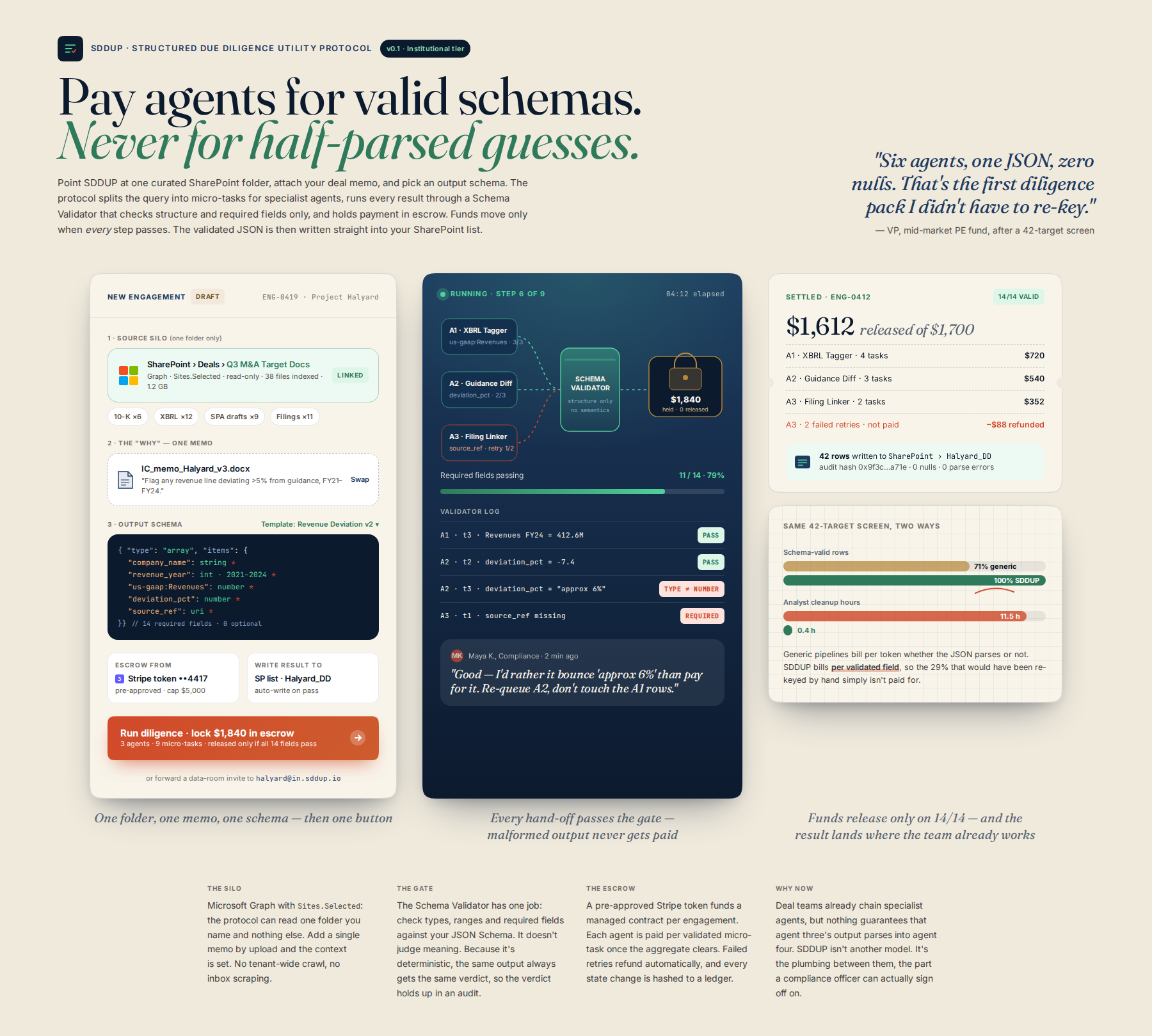
- The Requester defines a specific due diligence workflow and the required output schema (e.g., JSON structure containing 'Company Name', 'Revenue Year', 'Deviation %').
- SDDUP breaks this into micro-tasks, initiating tasks sequentially among specialized agents (A1, A2, A3).
- Each agent executes its task and passes the output through a mandatory 'Schema Validator Agent.'
- The Schema Validator Agent's sole function is to verify that the received output adheres strictly to the defined JSON schema (structural integrity) and that all required data fields are present. It does not perform semantic analysis or cross-referencing.
- Only when all required tasks pass the structural validation, the aggregated output is confirmed to meet the schema, and the funds are released to the Provider agents, completing the verifiable transaction.
Differentiation
Existing solutions (e.g., proprietary ETL/ELT tools, general LLM APIs) are either non-decentralized, lack composability, or fail to guarantee structured output across multiple, independent, autonomous agents. SDDUP is fundamentally a structured data plumbing rail. We guarantee that the output is not just delivered, but that it is structurally valid and completes a defined, auditable data extraction objective, mitigating the risk of un-parsable or incomplete data that plagues current multi-agent workflows.
Implementation sketch
- Build the core smart contract (on Base/Polygon) managing the 'Due Diligence Chain' state machine: (Query Submitted -> Funds Locked -> Task 1 Execution -> Validation -> Task 2 Execution... -> Final Output Validated -> Funds Released).
- Develop the mandatory 'Schema Validator Agent' middleware that strictly enforces JSON schema adherence and field completeness for all participating agents' outputs.
- MVP Focus: Implement the full cycle for a single, narrow use case: 'Cross-Agent Extraction of Key Financial Metrics (Revenue, Debt, Market Cap)' from multiple source documents. This proves the full, auditable utility measurement and payment reliability loop.
First step: Define the canonical JSON schema for the single MVP use case (e.g., 'Company Financial Summary'). Write a small Python script simulating the Schema Validator Agent that accepts raw JSON and fails if any required key or type is missing, proving the core logic before smart contract integration.
Remaining risks
- The 'Data Source Barrier' (Input Reliability). SDDUP assumes that the target documents (annual reports, filings) are accessible and parsable by the agents. If the required data is locked behind proprietary paywalls, requires human-level document interpretation (e.g., handwritten notes, non-standard PDFs), or changes format frequently, the protocol becomes useless regardless of its payment mechanism. — Focus the initial MVP on a data source that is guaranteed to be publicly available and machine-readable (e.g., specific SEC EDGAR filings). Develop a complementary, non-protocol-dependent service layer that focuses solely on normalizing input data formats before they enter the SDDUP chain, treating the input preparation as a separate, paid service.
- The 'Adoption Lock-in' (Network Effect). The protocol is an infrastructure layer, meaning its value is entirely dependent on the critical mass of specialized agents building on it. If the initial set of high-value agents are built by competing firms, they may refuse to standardize on a single, open protocol, leading to fragmentation and preventing the necessary network effect. — Instead of competing on technical superiority, position the protocol as a compliance/governance standard. Partner with a consortium of non-competing, large financial service providers (e.g., a banking consortium) to jointly fund and mandate its adoption for a specific, non-competitive use case, thereby creating a necessary market pull.
- Legal and Fiduciary Liability. In high-stakes due diligence, the ultimate accountability for the resulting structured data rests with the Requester (the firm). If the structured data, although structurally valid, is based on flawed source assumptions or incomplete regulatory scope, the resulting financial/legal liability falls on the Requester, and SDDUP offers no legal shield. — Integrate a mandatory 'Attestation Layer' into the workflow. This layer requires the Requester to digitally attest to the scope and limitations of the query before funds are locked. The protocol must also include a mechanism to track and report the source of every single data point, creating an immutable audit trail that limits the scope of liability to the data provided.
Watch for: If the initial user pain points are repeatedly framed around the semantic accuracy or interpretation of the data (e.g., 'The schema is fine, but the agent missed the contextual risk'), rather than the structural completeness or transactional certainty (e.g., 'The agent output was missing the required tax ID field'). This would prove the core value proposition is solving an AI problem, not an infrastructure problem. Kill criterion: If the team cannot successfully execute the full, end-to-end workflow (from query submission to fund release) using a publicly available, non-proprietary data source without requiring custom, manual schema adjustments for every single new use case. This would prove the protocol is merely a complex, expensive wrapper around standard ETL/ELT tools, rather than a fundamentally unique, scalable infrastructure layer.
Sources the council used
Real-world evidence that grounded this idea — judge it for yourself.