
Autonomous Agent Security Guardian Rail (MVP)
A foundational runtime API gateway that strictly enforces security policies and provides mandatory visibility into potential operational costs for every autonomous LLM agent action.
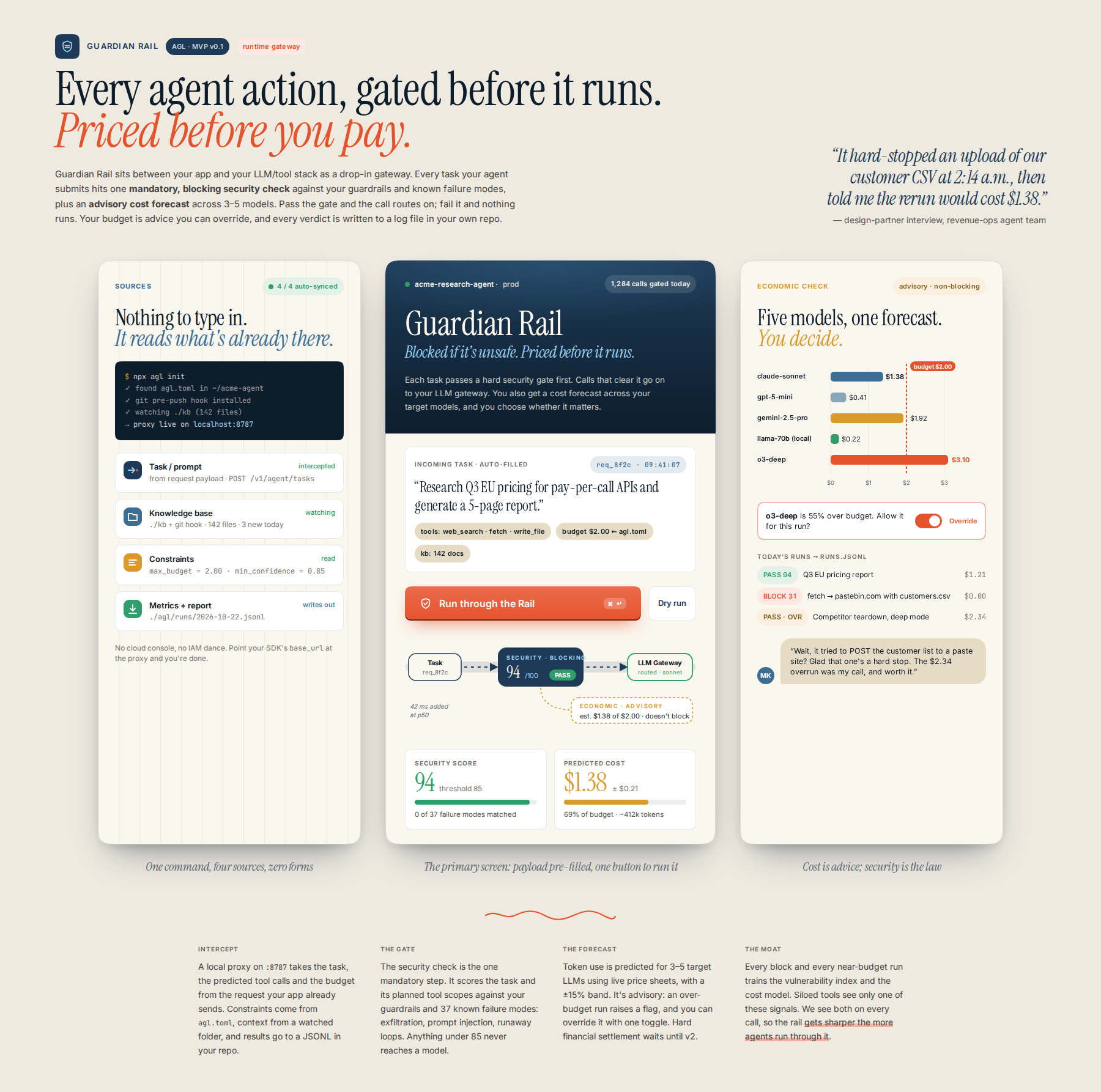
Process flow
Who it's for
Developers building mission-critical, revenue-generating autonomous LLM-based web agents.
Why they need it
Autonomous agents introduce unacceptable risks related to security breaches and unmanaged operational costs. The market needs a unified system that provides mandatory, proactive security validation and reliable cost visibility before execution, preventing catastrophic gross margins.
What it is
A full-stack Agent Governance Layer (AGL) service that sits between the calling application and the LLM/Tool infrastructure. It intercepts every agent request to run a single, mandatory check: Policy/Security. Additionally, it runs a non-blocking, advisory Economic Check.
How it works
- Agent submits a high-level task (e.g., 'Research X and generate a report') and an optional maximum budget parameter.
- The AGL intercepts the request and runs it through two micro-services: a. Security Check (Mandatory): Validates the task and predicted tool usage against defined guardrails and known failure modes. This is a hard, blocking gate. b. Economic Check (Advisory): Uses a real-time, multi-model API to predict token usage across 3-5 target LLMs and estimate the total cost flow. This calculation is advisory and displayed to the user, allowing them to manually override the execution if costs are acceptable, but it does not block the flow by default.
- If the Security Check passes, the request is routed to the LLM Gateway for execution. All metrics (security score, predicted cost) are logged and presented to the user dashboard.
Differentiation
Existing solutions are siloed. We combine robust runtime security enforcement with advisory, predictive cost visibility. Our defensibility lies in the proprietary data feedback loop: the system learns and dynamically refines its vulnerability indexes and cost forecasts by analyzing all agent activity—especially security policy violations and near-budget runs—making the governance layer smarter and more adaptive over time. We deliver immediate, actionable governance without the initial complexity of hard financial settlement.
Implementation sketch
- Develop a core API endpoint that accepts agent task definitions and an optional budget parameter.
- Implement the Security Validator: Integrate a model trained on failure modes into the API gateway to perform mandatory, blocking security checks before routing the request.
- Implement the Cost Predictor Service: Build a dedicated, isolated microservice that accepts the task definition and returns a predicted cost estimate (tokens/cost) for the user dashboard. This service is advisory and does not block the request by default.
- Build a dashboard that provides visibility into the 'Security Vulnerability Index' and the 'Predicted Cost Estimate' per agent run.
First step: Create a detailed technical spec and proof-of-concept for the 'Security Validator' microservice. Focus only on taking a sample agent prompt/tool call list and outputting a quantifiable 'Vulnerability Index' score, proving the core security gating mechanism first.
Remaining risks
- Model Drift and Non-Determinism in Cost Prediction. Even if the cost check is advisory, the accuracy of the predictive model relies on assumptions about agent behavior (e.g., prompt length, tool call complexity, external API latency). As agents interact with new, unforeseen tools or generate novel reasoning chains, the model will inevitably drift, leading to wildly inaccurate cost estimates and eroding user trust in the core 'Economic' function. — Instead of aiming for predictive accuracy, the service should pivot to providing a 'Worst-Case Scenario Estimate' based on historical failure modes and maximum theoretical token usage for the defined toolset. This manages expectations by being intentionally conservative, making the service a risk-management tool rather than an accounting tool.
- The Cold Start Problem for the Feedback Loop. The proprietary value is the learning loop (analyzing failures). However, initial adoption will be slow, and the initial data set will be limited to controlled environments. If the system cannot quickly gather high-volume, diverse failure data (both security and economic), the 'Vulnerability Index' and 'Cost Estimate' will be based on insufficient data, rendering the core differentiation useless and forcing the system to rely on static, easily bypassed rule sets. — Partner with a small group of early-adopter, highly regulated vertical use cases (e.g., financial compliance, medical research) that mandate stringent governance from day one. This guarantees the high-quality, failure-rich data necessary to bootstrap the feedback loop and prove the system's value in high-stakes environments.
- Integration Friction and Vendor Lock-in Resistance. The AGL sits as a mandatory middleware layer. While necessary, forcing every application to route through a third-party API gateway introduces significant integration friction. Large, sophisticated enterprise clients may prefer to build governance logic within their existing, proprietary stack to maintain maximum control and avoid the dependency on a third-party rate limit, uptime, or pricing structure. — Develop a highly modular, open-source SDK that allows the governance layer's logic (security rules, cost calculation functions) to be 'embedded' or 'side-loaded' into the client's existing infrastructure, rather than forcing a single, monolithic API call. This reduces the perceived risk of adopting a single point of failure.
Watch for: If the market begins treating the Security Validator as merely a 'best-effort' feature rather than a mandatory, blocking gate. This would signal that developers view the governance layer as optional overhead rather than a critical utility, undermining the entire value proposition. Kill criterion: The development of a simple, open-source, community-driven 'Prompt Guardrail' library that achieves 80% of the security validation capability without requiring any proprietary middleware or API call, making the AGL redundant for the average developer.
Sources the council used
Real-world evidence that grounded this idea — judge it for yourself.
- arxiv.org
- startups.com
- llmgateway.io
- confident-ai.com
- chromewebstore.google.com
- runware.ai
- github.com