
StateGraph: Intermediate Representation Layer for Audit-Grade Agent Observability
A highly structured, auditable observability platform that solves schema drift by enforcing a canonical Intermediate Representation Layer (IRL), transforming complex, multi-agent execution logs into compliant, queryable State Graphs for regulated industries.
How can regulated companies make AI agent logs usable for compliance audits?
By forcing every agent event through a validated schema before it's logged, so logs are structured and queryable rather than inconsistent raw text. A canonical Intermediate Representation Layer validates tool calls, LLM outputs, and data access against strict JSON/YAML typing, then assembles them into an immutable State Graph mapping causality between steps. Enterprise developers, risk officers, and compliance teams in finance, healthcare, and legal can query this graph to prove how an agent reached a given conclusion, satisfying post-mortem and regulatory review requirements that unstructured logs cannot meet.
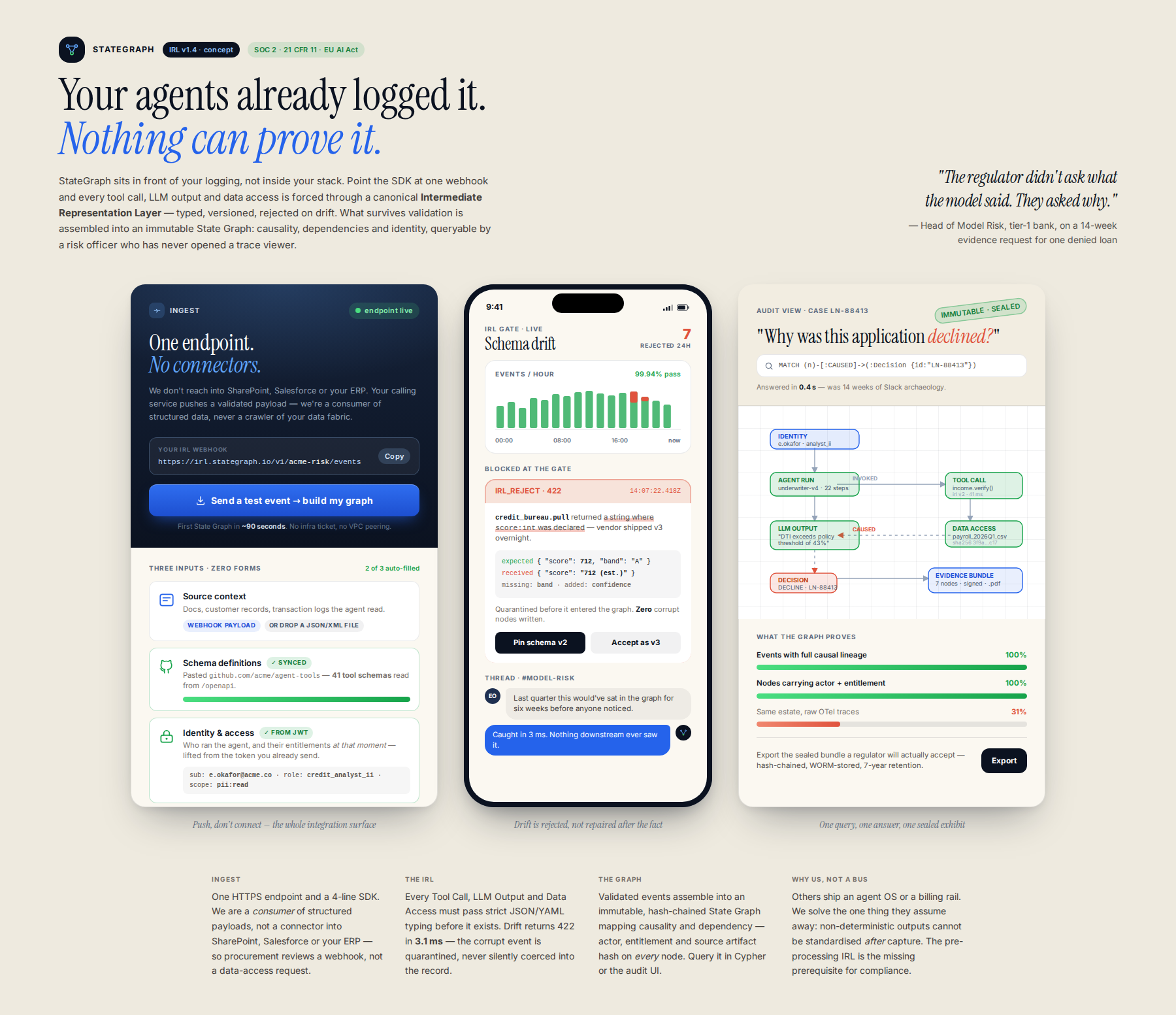
Process flow
Who it's for
Enterprise developers, risk officers, and compliance teams in regulated sectors (Finance, Healthcare, Legal).
Why they need it
Current agent logging fails in high-stakes environments because LLM outputs and tool results are non-deterministic and lack standardized schemas. This 'Schema Drift' renders traditional logging unusable for compliance, post-mortem auditing, or regulatory review. We provide the necessary structure.
What it is
The StateGraph Engine is a service that ingests raw, variable-format agent events, passes them through a mandatory, schema-validated Intermediate Representation Layer (IRL), and then constructs a definitive, canonical, immutable State Graph. This provides a single source of truth for the agent's entire process.
How it works
- Developers integrate the lightweight StateGraph SDK, which mandates that all critical events (Tool Call, LLM Output, Data Access) must first pass through the IRL schema validation endpoint.
- The IRL enforces strict JSON/YAML typing and structure, mitigating schema drift.
- The platform ingests the validated, structured data and constructs the State Graph, mapping causality and dependencies.
- End-users query the graph via a specialized UI to satisfy regulatory requirements by proving how a conclusion was reached.
Differentiation
We are not a general 'Operating System' (Bus). Our unique focus is solving the Schema Drift problem—the technical impossibility of standardizing non-deterministic LLM/tool outputs. While others focus on billing or general protocols, we deliver the definitive, auditable data structure (the State Graph) by enforcing a pre-processing IRL, which is the necessary and missing prerequisite for compliance and high-stakes debugging.
Implementation sketch
- Define the core IRL Schema: Create a canonical, restricted JSON/YAML schema that all incoming events (LLM response, tool output) must conform to, including mandatory fields for type, source, and timestamp.
- Build the Ingestion Validation API: Develop a minimal API endpoint that accepts raw event data and immediately validates it against the IRL schema. If validation fails, the event is rejected and flagged for debugging, preventing corrupt data from entering the graph.
- Develop the State Graph Builder Logic: Implement the backend service that takes the validated IRL objects and maps them into the graph structure, establishing verifiable links between nodes (e.g., linking a 'Tool Call' node to its corresponding 'Validated Output' node).
First step: Define the mandatory intermediate JSON schema (the IRL) for the single most critical event type (e.g., 'Tool Call Result'). Build a simple Python function that attempts to validate incoming sample JSON data against this defined schema, proving the core validation mechanism works.
Remaining risks
- Integration friction and developer adoption resistance. Mandating the use of the Intermediate Representation Layer (IRL) adds a mandatory, complex step to the developer workflow. Even if technically sound, this friction point could prevent adoption, as developers prefer 'set it and forget it' logging solutions, making the StateGraph feel like an unnecessary compliance hurdle rather than an enabler. — Develop a 'headless' or 'passive' integration mode that allows agents to log raw data first, with the IRL validation and structuring being an optional, higher-tier feature. This lowers the initial barrier to entry and allows the product to prove value even to non-compliance-focused teams.
- The scope of 'audit-grade' compliance is not static. Future regulations may require analysis of intent, causal reasoning, or human oversight that cannot be captured merely by logging structured data inputs and outputs. If compliance moves beyond 'what data was used' to 'why was it used,' the State Graph structure becomes fundamentally insufficient. — Partner with regulatory bodies or legal firms early in the process to define a 'future-proof' compliance schema that explicitly models human decision points, ethical checks, and stated agent goals alongside data flow. This elevates the service from a logging tool to a governance layer.
- Platformization risk. Major cloud providers (AWS, Azure, GCP) are rapidly improving their native observability tools. If they integrate state-of-the-art graph database capabilities and standardized logging directly into their foundational AI/ML services, they could absorb the core value proposition, making the specialized, third-party StateGraph redundant. — Focus differentiation on the domain-specific nature of the graph (e.g., finance/healthcare rules, specific compliance taxonomies) rather than just the data structure. The service must be positioned as the expert layer that translates general cloud logs into industry-specific, actionable compliance narratives.
Watch for: If major, established agent frameworks (like LangChain or LlamaIndex) release a native, high-quality, and easily consumable logging/observability feature that bypasses the need for a third-party SDK, the market may view the StateGraph as an ancillary, optional tool rather than a foundational requirement. Kill criterion: The inability to secure early, paying pilot customers in a highly regulated industry (Finance or Healthcare) who are willing to commit to the mandatory, non-trivial integration effort required by the IRL, indicating that the pain point is perceived as theoretical rather than immediate and critical.
Sources the council used
Real-world evidence that grounded this idea — judge it for yourself.