
DAO Governance Pre-Commit Audit Gate (D-GATE)
A mandatory, verifiable governance layer that intercepts and audits complex, multi-step smart contract proposals, ensuring not only technical feasibility (gas/state) but also policy compliance and required multi-signature approvals before irreversible on-chain commitment.
How can a DAO stop a technically valid treasury transaction that breaks its own governance rules?
A policy audit gate placed between contract simulation and execution can block it by checking the proposal against the DAO's own rules before submission. The system first runs a technical simulation to confirm gas cost and state changes, then passes that simulated state delta through a policy engine checking constraints like maximum outgoing asset thresholds, approved pool restrictions, or required multisig counts, generating a pass/fail result with reasons before the proposal ever reaches a governance vote. It is intended for DAO treasuries, protocol governance teams, and large DeFi funds managing high-value, multi-asset treasuries.
Process flow
Who it's for
DAO Treasuries, Protocol Governance Teams, and Large DeFi Funds managing multi-asset, high-value treasuries.
Why they need it
The risk is no longer just technical failure (gas cost/revert); the critical risk is 'Governance Failure.' A technically sound, multi-step contract sequence can still fail if it violates the DAO's established operational policy (e.g., moving assets outside approved pools, exceeding a budget threshold, or requiring a specific governance vote). The pain is the lack of a formal, auditable 'Policy Gate' between the technical execution and the final governance consensus.
What it is
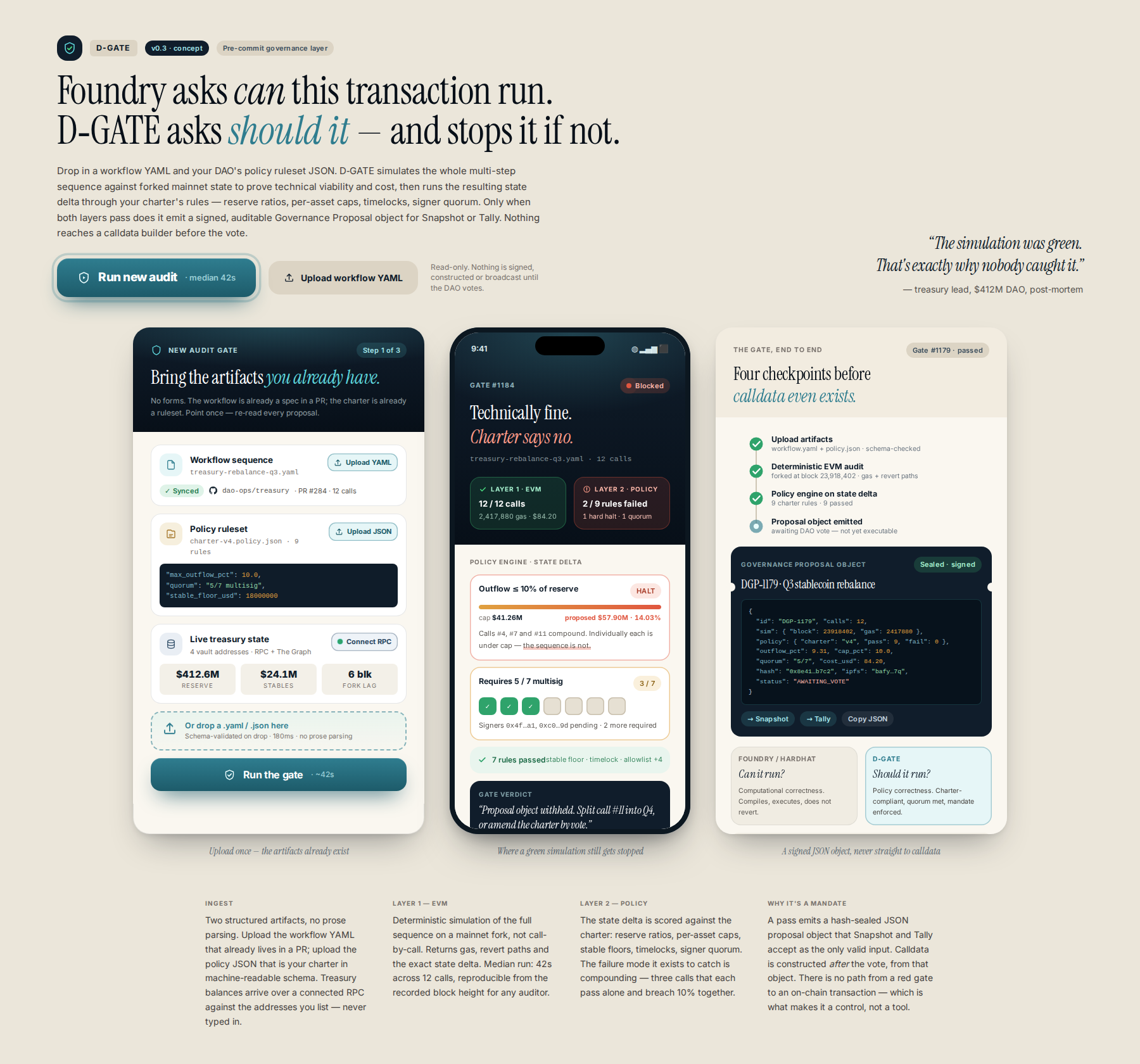
A parameterized, layered system that sits atop the deterministic execution simulator. It accepts a proposed contract sequence, runs the technical audit (gas/state), and then overlays a governance policy engine that checks the proposed state changes and inputs against a set of defined DAO rules (e.g., 'Total outgoing assets must be < 10% of total reserve' or 'Requires 5/7 multisig approval'). It generates a final, multi-layered proposal requiring explicit governance vote approval.
How it works
- The DAO/Builder submits the technical workflow (fixed function calls, parameters) to the D-GATE.
- The service runs the deterministic simulation (EVM audit) to confirm technical viability and cost.
- The service then runs the proposal through the Policy Engine, which checks the simulated state delta against pre-defined governance rules.
- If both technical and policy checks pass, the system generates a final, auditable Governance Proposal object, which must then be submitted to the DAO's native governance mechanism (e.g., Snapshot/Tally) for required consensus before the final transaction is even constructed.
Differentiation
Existing developer tools (Foundry, Hardhat) validate computational correctness—can the contract run? Our D-GATE validates policy correctness—should the contract run, and is the outcome compliant with the DAO's charter? We are not a simulation tool; we are a governance mandate layer. We solve the gap between technical execution capability and operational governance policy enforcement. This makes us indispensable for high-value, trust-minimized DAOs.
Implementation sketch
- Define a minimal viable Policy Engine: Start with a simple JSON ruleset (e.g.,
{'max_outgoing_usd': 100_000, 'requires_multisig_threshold': 5}). - Integrate a simplified EVM state simulator (using existing libraries) that only tracks balance changes and basic state writes for a fixed set of contract interactions (e.g., vault withdrawal).
- Build the core logic to pass the simulated state delta (input/output balances) into the Policy Engine for validation, returning a clear PASS/FAIL status and the reason for failure.
- Develop a minimal UI mockup showing the three stages: Technical Audit -> Policy Check -> Governance Proposal.
First step: Build the Policy Engine MVP: Create a Python/JS service that accepts a JSON object representing a state change (e.g., {'asset': 'USDC', 'change': -50000, 'source': 'VaultA'}) and validates it against a hardcoded list of 3-5 simple governance rules. This proves the policy layer's core logic without needing full EVM integration yet.
Remaining risks
- Governance Capture Risk (The Gatekeeper Problem): The D-GATE itself becomes a single, critical point of governance failure. If the policy engine or the governance mechanism required to update the rules (the 'Policy Ruleset') is captured, compromised, or subject to a hostile vote, the entire system ceases to be a trust-minimized solution and becomes a centralized veto point, undermining the core DAO ethos. — Design the Policy Engine ruleset to be governed by a decentralized, multi-layered, and highly expensive-to-change mechanism (e.g., requiring consensus from multiple, diverse, and non-aligned DAOs, or using a time-locked, irreversible governance upgrade path).
- Regulatory Overreach/Centralization Risk: As a third-party mandatory 'audit gate' for high-value treasury movements, the D-GATE could be perceived by regulators (especially in jurisdictions targeting digital asset control) as an unauthorized custodian or a centralized control mechanism, regardless of its technical neutrality. This could trigger regulatory action or legal challenges that de-risk the entire infrastructure. — Frame the service strictly as an 'information layer' or 'protocol standard' rather than a mandatory execution layer. Focus marketing and legal efforts on compliance and best practices, rather than enforcement, and lobby for its adoption as a recognized industry standard.
- Protocol Adoption Saturation: The value proposition relies on being necessary. If major, established protocols (like Aave or Uniswap) decide to integrate similar, robust, policy-checking logic natively into their core contract layer or governance modules, the D-GATE becomes an optional, redundant service, losing its critical 'mandatory' status and failing to achieve network effect. — __
Watch for: Any major, established, multi-billion dollar DAO or protocol successfully implementing a native, integrated, policy-checking mechanism within its core smart contract or governance module, thereby proving that the 'gate' functionality is best solved at L1/L2 protocol level rather than an external service. Kill criterion: The failure to secure initial, mandatory adoption from a Tier-1 DAO treasury (e.g., Compound, Uniswap, Aave) within the first 12 months, indicating that the market views the policy layer as a 'nice-to-have' feature rather than a 'mandatory guardrail' required for operation.