Agent Usage Data Proxy: Standardized Logging Middleware
A low-latency middleware service that intercepts complex, multi-agent API calls, standardizing and immutably logging variable compute usage into a format ready for modern data warehouses.
How can enterprises get auditable, standardized cost data across multi-agent AI workflows?
A middleware proxy that intercepts every external API call an agent makes, executes the task, and logs standardized usage metadata (service, tokens, cost, timestamp) as an immutable record streamed to a warehouse like Snowflake or BigQuery. It's built for B2B infrastructure teams running multi-agent workflows who need verifiable data for billing, cost optimization, and financial audits, since native billing systems don't standardize variable usage across services. Unlike basic billing proxies, it doesn't assume a billing endpoint — it provides the foundational, schema-consistent data layer any downstream system can consume.
Process flow
Who it's for
B2B infrastructure teams building multi-agent workflows who require verifiable, auditable usage metrics.
Why they need it
Current billing systems fail to provide a standardized, auditable record of variable, complex agent usage (e.g., token counts across multiple services). This lack of standardized data fidelity prevents enterprise users from accurately calculating cost, optimizing spending, and performing robust financial audits.
What it is
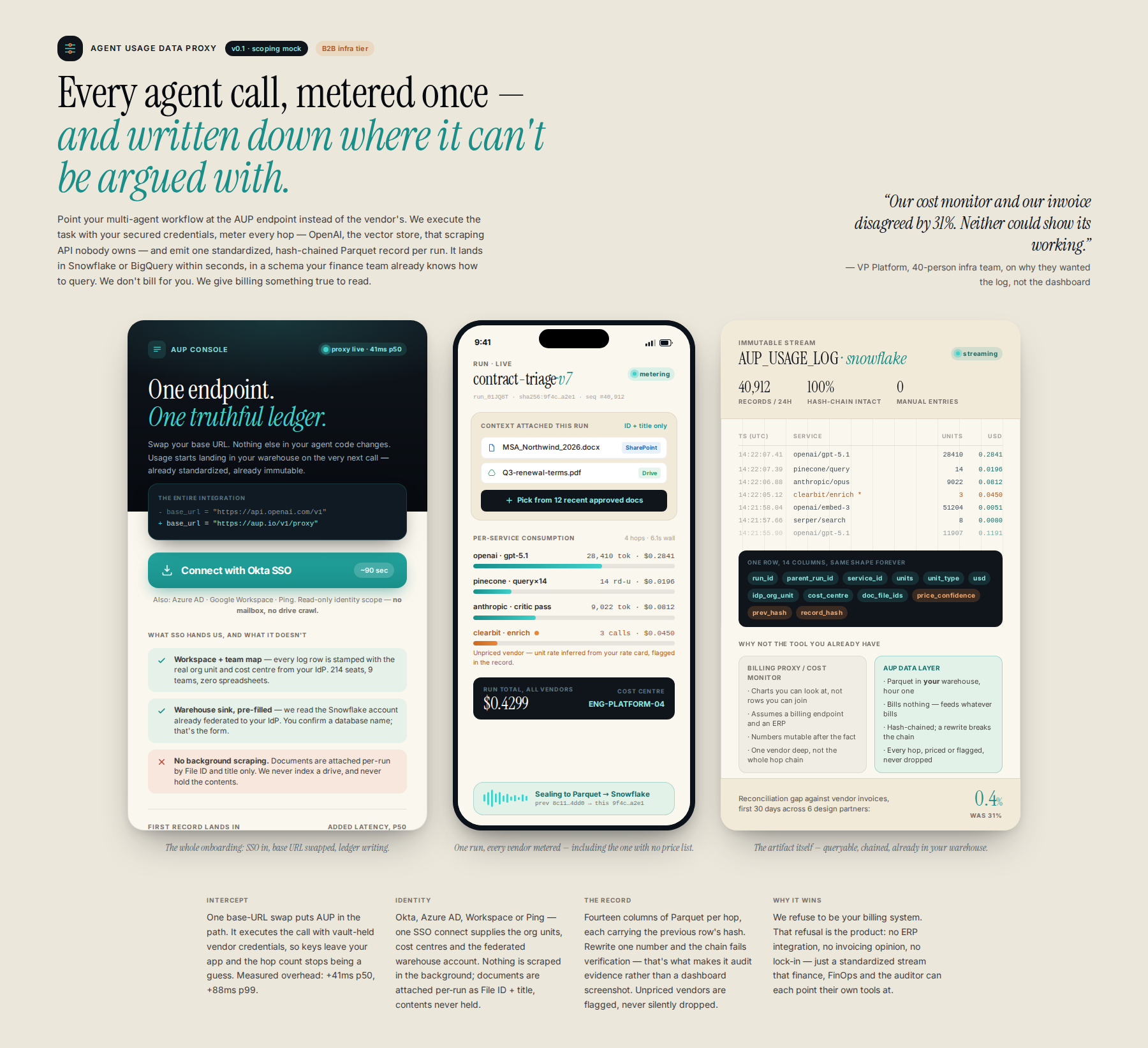
The Agent Usage Proxy (AUP) is a middleware layer that acts as the single source of truth for agent activity. It intercepts all external API calls, executes the task, and, critically, standardizes and logs the resulting metadata (service, cost, tokens, timestamp) into a high-fidelity, immutable data stream.
How it works
- The B2B application routes the agent's task request to the AUP endpoint.
- The AUP executes the task, using its secured credentials, and tracks the exact cost/token consumption per service (e.g., OpenAI, VectorDB, external API).
- Upon completion, the AUP calculates the total usage cost and, most importantly, generates a standardized, immutable log record (e.g., Parquet format). This log is immediately streamed to a designated data sink (e.g., Snowflake/BigQuery).
- The B2B founder consumes this standardized log, which can then be used for billing, cost optimization, and auditing by any downstream enterprise system.
Differentiation
Existing solutions provide basic billing proxies (5d04506813524513) or simple cost monitoring (2ef75e59c64c0bd8). We differentiate by solving the 'data standardization and fidelity' gap. We do not assume a billing endpoint; we provide the foundational, auditable data layer—a standardized, immutable stream—that enables billing and auditing for any downstream system. This decouples us from the massive overhead of connecting to legacy ERPs.
Implementation sketch
- Develop a core FastAPI service that accepts a task payload and returns a standardized log record.
- Build the Orchestration layer that calls external APIs (OpenAI, etc.) and captures all relevant metadata (cost, tokens, service ID) into a structured dictionary.
- Integrate a data streaming client (e.g., Snowflake Connector or BigQuery Client) to write the structured log record directly to a designated, partitioned table in a modern data warehouse, ensuring immutability and high throughput.
First step: Define the canonical, universal JSON/Parquet schema for the usage log (including fields like agent_id, timestamp, service_name, input_tokens, output_tokens, unit_cost, total_cost). Write a minimal FastAPI endpoint that accepts a dummy task and successfully logs a hardcoded, structured record into a local Parquet file to validate the schema integrity.
Remaining risks
- Commoditization by Cloud Providers (AWS/GCP/Azure) — The biggest risk is that major cloud infrastructure providers (who are the ultimate data sinks) will build this exact functionality (usage logging, standardization, cost tracking) directly into their core services. If they achieve this, the middleware becomes a non-essential, easily circumvented layer. Mitigation requires focusing on the 'last mile'—the unique, proprietary metadata or the specialized integration points that fall outside the major cloud vendors' direct control (e.g., niche, specialized AI models, or cross-cloud orchestration logic).
- Schema Fatigue and Standardization Failure — The AI agent ecosystem is highly fluid. What constitutes a 'standard' log today (e.g., OpenAI tokens) may be obsolete or expanded tomorrow (e.g., multimodal inputs, complex reasoning steps). If the schema is too rigid, it will fail to capture novel usage patterns, rendering the data incomplete. Mitigation requires building the schema with extreme extensibility, treating the standardized log as a minimum required set of fields, while actively encouraging and enforcing a mechanism for custom, non-breaking metadata fields.
- The Data Utility Problem (Data Swamp) — Simply logging data does not create value; the analysis of the data does. If the AUP is perceived merely as a logging sink, it will be treated as a data swamp by enterprise users. The value must be derived from the data. Mitigation is to bundle the logging service with a proprietary, actionable layer—such as automated cost optimization recommendations, spending anomaly detection, or pre-built cost-benefit analysis models—making the AUP an active intelligence layer, not just a passive pipe.
Watch for: Any initial resistance from potential enterprise users who prefer to build their own internal logging/observability solution using existing, non-proprietary tools (e.g., implementing OpenTelemetry standards directly) over adopting a new middleware. Kill criterion: If the market refuses to pay a premium for the 'standardized' data format, preferring to pay for the 'data ingestion' capability itself, it confirms that the product is merely a complex API gateway and the core value proposition of standardization is invalid.
Sources the council used
Real-world evidence that grounded this idea — judge it for yourself.