
Circuit Compiler for Privacy-Preserving LLM Inference Benchmarking
An automated, engineering-first tool that generates optimized, standardized FHE circuits required to execute common LLM components (e.g., attention, feed-forward layers) for privacy-preserving benchmarking.
How can I estimate computational cost of running LLMs with cryptographic privacy?
An automated compiler translates high-level LLM layer definitions into optimized Fully Homomorphic Encryption (FHE) circuit specifications. By mapping matrix multiplications and activations to polynomial arithmetic required by specific FHE libraries (TFHE, CKKS), the system outputs a standardized circuit ID with documented noise budgets and complexity profiles. This enables infrastructure teams to assess privacy-preserving deployment feasibility upfront, transforming an intractable theoretical problem into an engineering calculation.
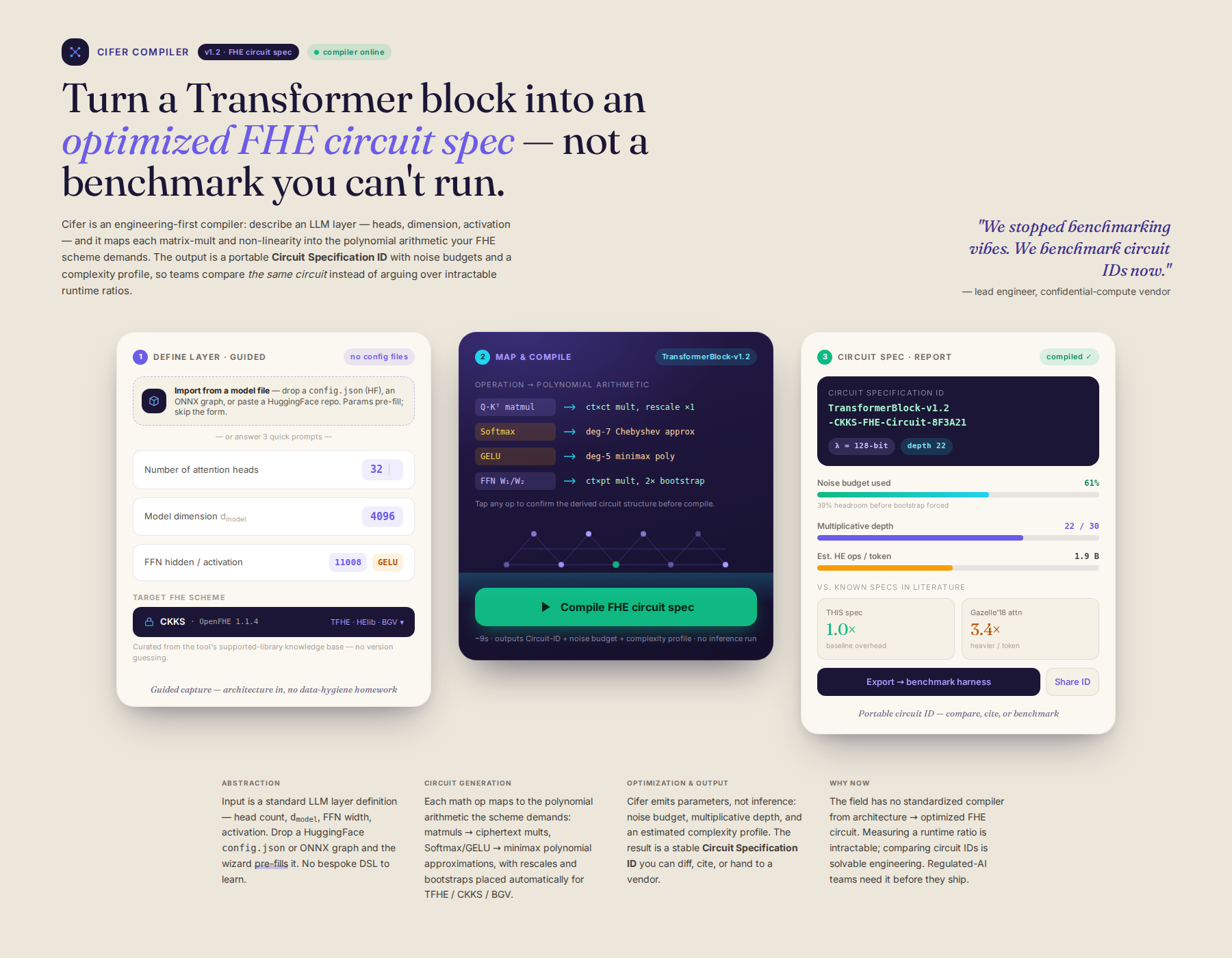
Process flow
Who it's for
AI infrastructure teams, confidential computing vendors, and advanced research labs building regulated AI systems.
Why they need it
The industry needs a standardized, actionable way to estimate the computational cost of running LLMs under cryptographic privacy constraints. Current methods are either too theoretical or too manual, preventing the adoption of private AI workflows.
What it is
A modular compiler/tooling layer that takes an LLM architecture definition (e.g., Transformer block parameters) and outputs the optimized, low-level FHE circuit specification required for execution on a target homomorphic encryption library.
How it works
- Abstraction: Define the compiler input to accept a standard LLM layer definition (e.g., number of heads, dimension size).
- Circuit Generation: Implement logic to map the mathematical operations of the LLM layer (matrix multiplications, non-linear activations) into the corresponding polynomial arithmetic required by the chosen FHE scheme (e.g., TFHE/HElib).
- Optimization & Output: The compiler outputs the optimized circuit parameters, including required noise budgets and the estimated computational complexity profile, rather than running the inference itself.
- Benchmarking: This output feeds into a standardized benchmarking harness to measure the potential overhead, solving the measurement ambiguity.
Differentiation
This shifts the focus from measuring an intractable runtime ratio to creating a solvable, engineering abstraction. It moves beyond general benchmarking by providing a 'Circuit Specification ID' for common LLM components (e.g., 'TransformerBlock-v1.2-FHE-Circuit-ID-XYZ'), which can be compared against existing, known circuit specifications in academic literature or proprietary vendor toolkits. The gap is the lack of a standardized, automated compiler layer that translates high-level model architecture into low-level, optimized FHE circuit requirements.
Implementation sketch
- Develop a proof-of-concept Python class that accepts a simplified Transformer block definition (e.g., input size, hidden size) and outputs a structured JSON object detailing the necessary operations (e.g., 'MatrixMul(A, B)', 'Activation(X)') mapped to FHE primitives.
- Integrate a dependency on a specific FHE library's API (e.g., using TFHE's matrix multiplication wrappers) to validate the mathematical feasibility of the generated circuit structure.
- Design a simple comparison dashboard that visualizes the estimated circuit complexity (e.g., polynomial degree, required security level) for different model sizes.
First step: Select one specific, small component of a standard LLM (e.g., the GELU activation function or a single attention head calculation) and write a Python script that successfully maps its mathematical operations into the input format required by the chosen FHE library's core matrix multiplication function, documenting the required noise budget.
Remaining risks
- The 'Compiler' abstraction might fail to capture necessary non-linearities or complex dependencies in modern LLMs (e.g., residual connections, specialized normalization layers) that are not purely polynomial, leading to an incomplete or mathematically unsound circuit specification. — Focus initial implementation on the simplest, most mathematically constrained components (e.g., simple linear layers or basic element-wise operations like ReLU/Sigmoid approximations) to prove the compiler's core mapping logic before tackling the full Transformer block.
- The output circuit specification, while technically correct, may be too abstract or too complex for adoption by the target user base (AI infrastructure teams), who might prefer black-box APIs or existing framework integrations over reading raw circuit JSON. — Develop a secondary, high-level 'Compatibility Layer' that consumes the raw circuit specification and outputs ready-to-use configuration files or wrappers compatible with existing ML frameworks (e.g., PyTorch/JAX custom operator definitions), thus increasing perceived usability.
- The required computational overhead for the compiler itself (i.e., the time/compute needed to generate the circuit specification) might become prohibitively long or resource-intensive, making the tool impractical for rapid prototyping or large-scale model assessment. — Implement aggressive caching mechanisms based on the input model architecture hash. Furthermore, scope the initial tool to only generate specifications for the most frequently used or most computationally expensive components, rather than attempting to compile the entire model at once.
Watch for: Any industry announcement or academic paper that proposes a general-purpose, high-level compiler for secure computation over arbitrary deep learning graphs, as this would immediately de-risk the core technical gap. Kill criterion: If a major, well-funded vendor (e.g., Google, Microsoft, IBM) releases a public SDK or tool that demonstrates the ability to automatically compile a full, modern Transformer model (including attention mechanisms) into an optimized, executable FHE circuit with documented performance metrics.