
Agent Model Benchmark Router: Robust Extraction Auditor (R-EA)
A specialized SDK middleware that benchmarks and audits the cost and performance of structured data extraction, specifically focusing on model robustness against variable, noisy, or degraded real-world inputs (e.g., OCR errors, varied document layouts).
How do I know which LLM will stay accurate on messy scanned documents, not just clean test data?
Benchmark models against a curated suite of degraded inputs—OCR noise, poor layout, corrupted text—not just clean samples, since accuracy on tidy test data doesn't predict production reliability. An SDK middleware layer runs a defined extraction schema across 3-5 models on both clean and artificially corrupted documents, then scores each on Pydantic validation success rate, hallucination rate, and cost under degradation. It's built for founders of enterprise AI applications handling unstructured inputs like invoices or reports, where extraction accuracy is mission-critical and model choice carries real financial risk.
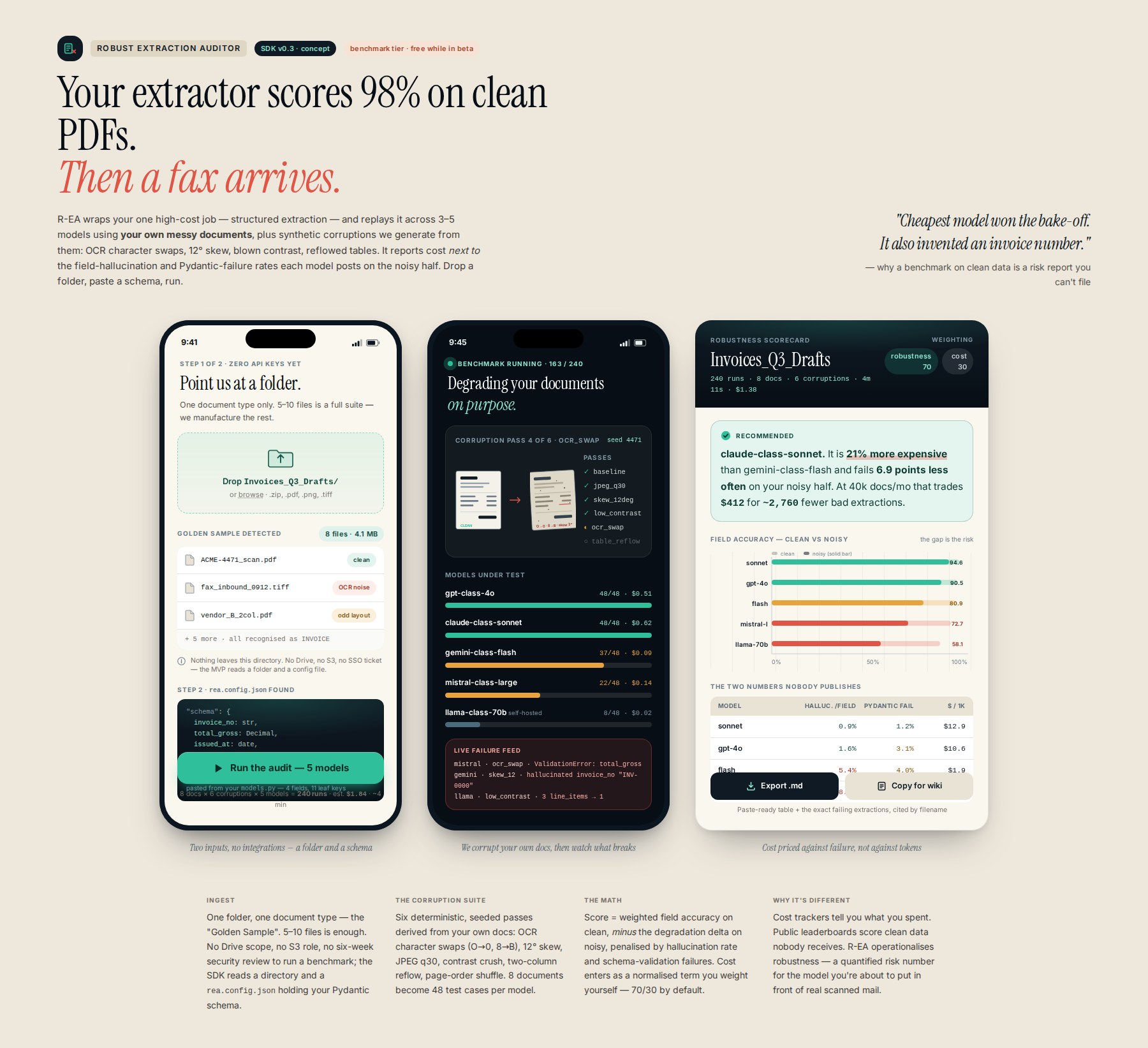
Process flow
Who it's for
Founders of enterprise AI applications dealing with unstructured, messy data inputs (e.g., scanned invoices, poorly formatted reports) where data extraction accuracy is mission-critical and costs are variable.
Why they need it
The primary pain point is not just model choice, but the reliability of that choice when faced with production-grade data variability. Current tools fail to provide a verifiable 'Robustness Cost/Performance Scorecard' that dictates which model maintains high accuracy (e.g., >95% Pydantic validation success) while minimizing cost, even when the input document quality is degraded.
What it is
The Robust Extraction Auditor (REA) is an SDK layer that wraps a defined, high-cost use case (structured data extraction). It executes this task against 3-5 specified models using a curated, variable test suite (including artificially corrupted inputs). It outputs a 'Robustness Scorecard' that weights cost alongside quantifiable failure metrics (e.g., average field hallucination rate, Pydantic validation failure rate across the entire test suite).
How it works
- Define Use Case & Test Suite: Developer defines the required JSON schema and provides a set of 10-20 diverse, messy input documents (e.g., clean, OCR-noisy, poor layout).
- Benchmark Execution: The SDK runs the task concurrently across specified models (OpenAI, Anthropic, etc.).
- Robustness Capture: For each run, it captures cost, and crucially, evaluates both the success rate on clean inputs AND the degradation/failure rate on noisy inputs.
- Scorecard Generation: The final scorecard provides a weighted recommendation, allowing the developer to select the optimal model based on the required balance between Cost and Robustness (e.g., 'Model X is 20% cheaper but fails 5% more often on noisy inputs than Model Y').
Differentiation
Existing solutions (like s1 or s3) focus on tracking overall cost or general benchmarking on clean data. The REA fills the critical gap of operationalizing robustness. It moves beyond simple cost calculation by explicitly benchmarking model performance against the variability of real-world data, providing a quantifiable risk assessment that mitigates the financial risk of deploying a model that performs well in theory but fails in practice due to input noise.
Implementation sketch
- Develop a Python SDK module accepting a fixed Pydantic schema and a directory of sample 'dirty' documents.
- Implement the concurrent API calling mechanism, ensuring proper token/cost tracking for each model run.
- Build a simple CSV/JSON output that maps 'Model Name' -> 'Avg. Cost' -> 'Clean Success Rate' -> 'Noisy Success Rate' -> 'Recommended Priority'.
- MVP Focus: Limit the initial scope to benchmarking only structured extraction (Pydantic validation) using only three target models (GPT-4, Claude 3, Llama 3).
First step: Create a small Python script that takes 5 sample documents (e.g., clean PDF text, lightly OCR-corrupted text, badly formatted HTML) and runs a simple Pydantic extraction task against OpenAI and Anthropic, collecting the cost and the boolean success/failure status for each model/document pair. This proves the core data flow and metric aggregation.
Remaining risks
- The 'Dirty Data' Definition Problem: The value of the entire tool hinges on the quality and variability of the input test suite. If the developer cannot reliably curate a test suite that accurately models the full spectrum of production data degradation (e.g., specific combinations of OCR noise, layout shifts, and language variations), the resulting 'Robustness Scorecard' will be based on an artificial, incomplete reality. The tool becomes a sophisticated academic benchmark, not a production risk mitigator. — The MVP must include a standardized, open-source dataset of 'hard' documents (e.g., public domain forms, medical reports) and provide explicit guidance on how to programmatically generate controlled noise (e.g., Gaussian blur, random character corruption) to make the test suite replicable and auditable.
- Integration Friction and Workflow Inertia: The solution requires developers to pause their workflow, gather a corpus of documents, and run a dedicated benchmarking job before deployment. This adds a mandatory, non-trivial step to the development lifecycle. If the developer's immediate pain is 'getting the first version running quickly,' the overhead of using the REA will be perceived as a costly drag, leading to low adoption. — The SDK must offer a 'quick-win' mode that allows developers to run the benchmark against a minimal, pre-loaded set of 5 highly representative documents, providing immediate, actionable feedback without requiring a massive data ingestion pipeline upfront.
- The 'Black Box' Model Drift: LLM providers frequently update their models (e.g., GPT-4 to GPT-4o). These updates often involve internal prompt engineering or fine-tuning that changes the model's behavior, reliability, or cost structure, even if the API signature remains the same. The REA must maintain an extremely high level of maintenance overhead to accurately track these subtle, non-API-breaking shifts in model capability and cost, which is a constant battle against the providers themselves. — __
Watch for: A strong, public signal that the market prefers to solve data variability by investing in better upstream data cleaning/pre-processing layers (e.g., dedicated document parsers or image enhancement APIs) rather than relying on the LLM model itself to handle the noise. This would de-emphasize the need for the REA's core functionality. Kill criterion: If the primary pain point cited by potential users is not the cost or robustness of the model, but the latency or integration complexity of the entire benchmarking process. If the time taken to generate the scorecard exceeds the time saved by choosing the optimal model, the tool is fundamentally flawed.