
Predictive Overhead Reduction for Context-Heavy RAG Pipelines
A dedicated simulation framework that quantifies and models the compute overhead associated with context retrieval, memory write patterns, and iterative self-correction in enterprise RAG pipelines, aiming to provide actionable targets for cost reduction and latency improvement.
What's driving my RAG pipeline's unexpected costs and latency?
A simulation framework quantifies and models compute overhead associated with context retrieval and memory patterns in enterprise RAG pipelines. By orchestrating a workflow and instrumenting Vector DB lookups and serialization costs, it maps infrastructure overhead directly to estimated cloud cost per query. Unlike general LLM evaluation tools, it focuses on plumbing (chunking strategy, vector store choice) rather than model performance, enabling architectural optimization.
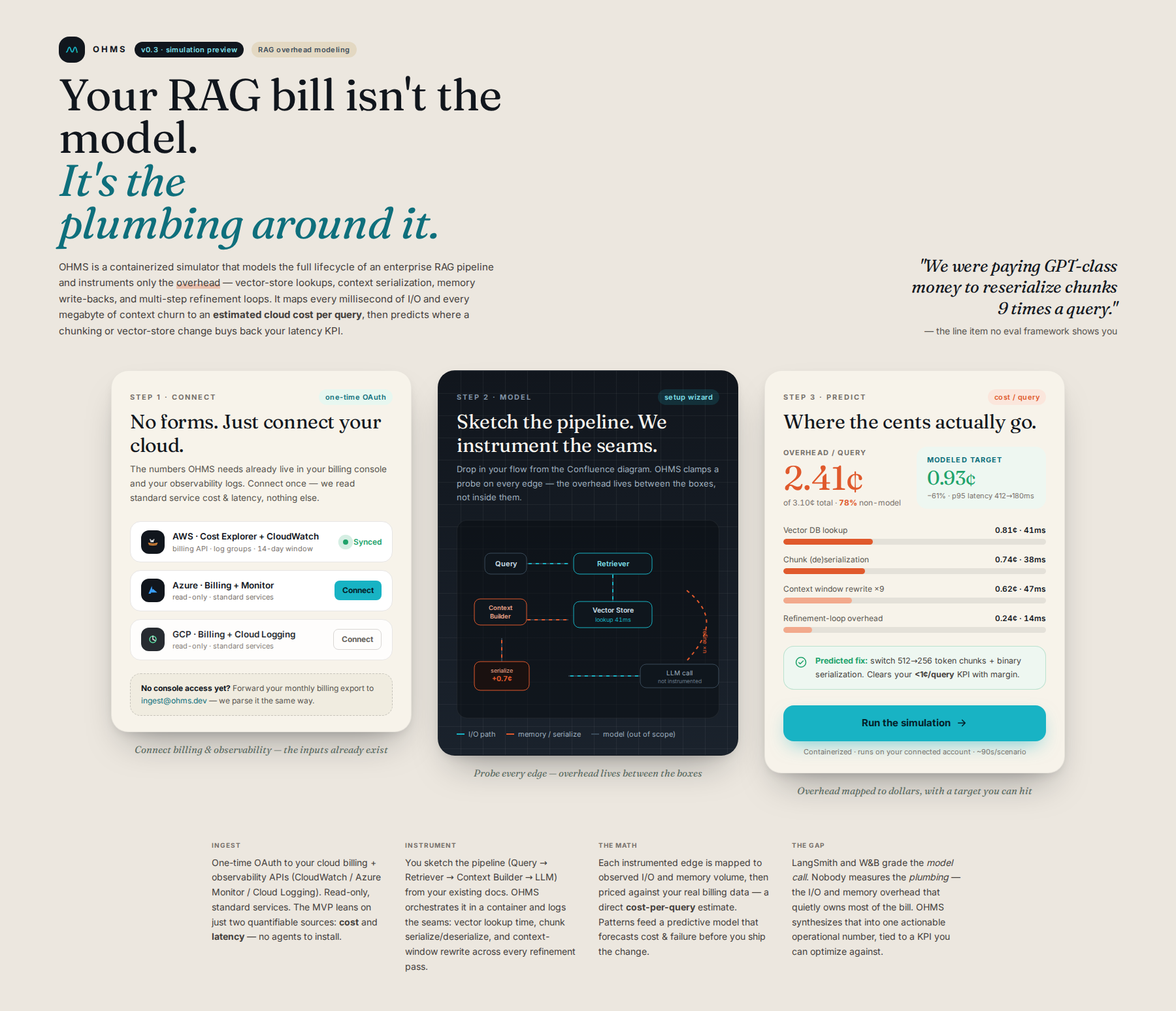
Process flow
Who it's for
ML Infra Directors, Head of AI Operations (MLOps), CTOs overseeing LLM deployment.
Why they need it
Current RAG implementations suffer from unpredictable scaling costs and latency spikes due to the non-linear overhead of context management (retrieval, embedding write-backs, context window expansion). We move beyond simple token counting to target the operational cost of context handling, which is a direct concern for CTOs and ML Infra VPs.
What it is
A specialized, containerized simulation environment that models the full lifecycle of an enterprise RAG workflow. It specifically instruments the cost and latency associated with vector store interactions, context memory write-backs, and the overhead incurred during multi-step agent refinement loops.
How it works
Users define a target RAG pipeline structure (e.g., Query -> Retriever -> Context Builder -> LLM). The system orchestrates the workflow, logging granular metrics: Vector DB lookup time, context chunk serialization/deserialization time, and the computational cost associated with context window resizing/rewriting across iterations. Results are mapped directly to estimated cloud compute cost per query.
Differentiation
Unlike general LLM evaluation frameworks (e.g., LangSmith, Weights & Biases), this tool focuses exclusively on the overhead components of RAG—the infrastructure plumbing, not the model call itself. We provide predictive failure/cost modeling based on observed memory and I/O patterns, allowing teams to optimize the underlying architecture (e.g., chunking strategy, vector store choice) to hit specific cost/latency KPIs. The gap is the lack of standardized, measurable tooling that synthesizes I/O/memory overhead into a direct, actionable operational cost estimate.
Implementation sketch
- Phase 1: Build a minimal proof-of-concept RAG graph using Python and a simple workflow engine (e.g., Prefect/Dagster) to model the sequence: Query -> Retriever -> Context Builder -> LLM.
- Phase 2: Instrument the Retriever step to log mock/simulated latency for vector DB interaction (read/write) and context chunk serialization time.
- Phase 3: Develop the visualization layer to plot total simulated cost/latency vs. 3 key hyperparameters: context size, retrieval depth, and chunk overlap percentage.
First step: Build a minimal PoC workflow in Python using a simple state graph (e.g., using basic Python classes/functions) to pass mock context objects between 3 defined stages: Retrieval, Context Assembly, and LLM Call. Focus only on logging the size of the context object at each transition point.
Remaining risks
- The 'operational cost' model relies on accurate, predictable cost curves for underlying services (e.g., vector DB API calls, cloud compute time). If the actual cost structure of major providers (Pinecone, specialized cloud ML services) changes rapidly or is opaque, the simulation's core value proposition—predictive cost modeling—becomes instantly obsolete or inaccurate. — Build the cost model layer as an explicit, pluggable abstraction. Instead of hardcoding cost assumptions, require users to input the current pricing structure (e.g., 'X cost per 1k reads', 'Y cost per GB-sec') for the specific backend they intend to use. This turns the risk from technical failure to configuration management.
- The technical complexity of simulating cross-layer I/O and memory overhead (context serialization, chunking) is immense. If the initial PoC (Phase 1) proves too difficult to instrument beyond simple object size logging, the project stalls in 'research' mode, unable to deliver the promised 'actionable' metrics. — De-scope the initial MVP to focus solely on the combinatorial impact of hyperparameters on a single, measurable proxy metric (e.g., 'Total simulated context token count growth vs. retrieval depth'). Treat the cost/latency simulation as a V2 feature, ensuring the initial deliverable is a robust, demonstrable graph that proves the workflow orchestration concept, even if the metrics are simplified placeholders.
- The market may prefer a solution that optimizes the input (better prompts, better chunking logic) rather than the plumbing (overhead). If the target user base is more concerned with prompt engineering or retrieval quality than infrastructure plumbing, the tool will be seen as overly academic and difficult to integrate into standard MLOps pipelines. — Develop a 'Diagnostic Mode' that surfaces the overhead cost relative to the retrieval/prompt quality. For instance, showing: 'If you improve retrieval quality by Z, the cost savings from reducing context size outweighs the cost of the improved retrieval step.' This frames the overhead measurement as a lever for improving the upstream components, making the tool indispensable to the entire RAG stack.
Watch for: If early feedback from potential users focuses heavily on the difficulty of setting up the simulation environment or the abstractness of the output metrics, rather than the potential savings shown in the visualization. Kill criterion: If, after demonstrating the PoC, the primary technical blocker remains the inability to reliably simulate or measure the latency/cost of a specific, non-standardized component (e.g., a specific vector DB's internal indexing mechanism) that is deemed mission-critical by the target user.