Standardized Protocol for Verifiable Multi-Agent Checkpointing
A vendor-agnostic, standardized protocol defining the serialization, versioning, and checkpointing mechanism for the collective state of complex, long-horizon multi-agent simulations, ensuring verifiable continuity across disparate AI frameworks.
How can multi-agent AI simulations share verifiable state across different frameworks?
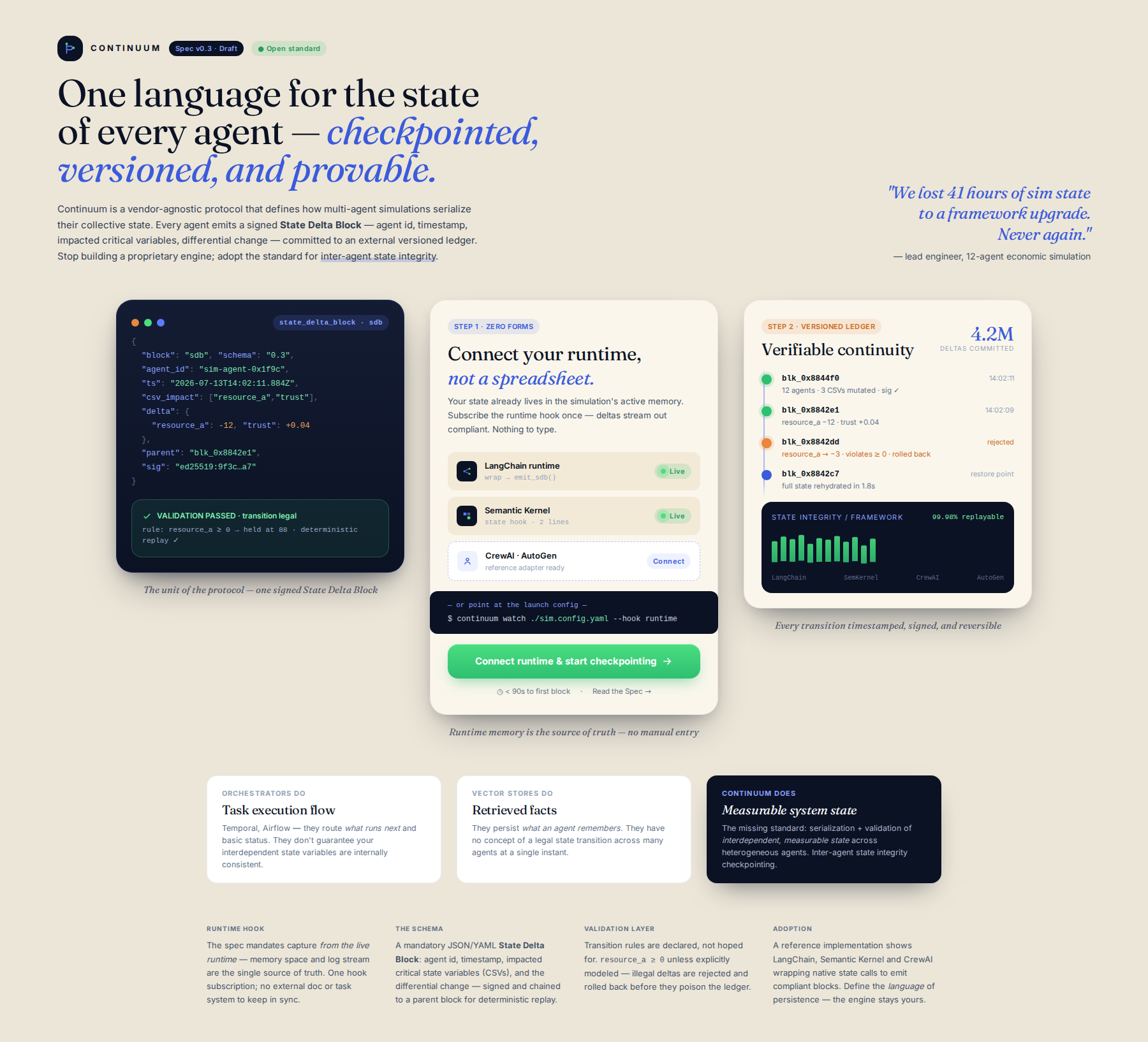
A standardized checkpointing protocol lets multi-agent simulations serialize and verify state independent of the underlying framework. It defines a 'State Delta Block' schema capturing agent IDs, timestamps, and critical state variable changes, plus validation rules ensuring transitions stay physically consistent (e.g., resources can't go negative without cause). Reference wrappers let frameworks like LangChain or Semantic Kernel emit compliant deltas without rebuilding their engines. It targets AI research teams and large-scale simulation developers whose current framework-specific state saving is brittle and non-portable.”
Process flow
Who it's for
AI research teams and large-scale simulation developers building complex agentic workflows.
Why they need it
Current agent frameworks lack a standardized, verifiable protocol for checkpointing the measurable, critical state of an entire system. This forces developers to implement brittle, framework-specific state saving, leading to non-portable, non-verifiable, and brittle simulations that fail when context or state integrity is lost.
What it is
A specification (Protocol Spec) detailing how agent deltas, critical state variables (CSVs), and global simulation parameters must be serialized, time-stamped, and committed to an external, versioned ledger. This shifts the focus from building a proprietary 'Engine' to defining the language of state persistence.
How it works
- Protocol Definition: Define the mandatory JSON/YAML schema for a 'State Delta Block' containing agent ID, timestamp, impacted CSVs, and the differential change.
- Validation Layer Specification: Specify the rules for validating state transitions (e.g., ensuring Resource A cannot drop below zero unless explicitly modeled).
- Adoption Layer: Create a reference implementation demonstrating how major frameworks (e.g., LangChain, Semantic Kernel) can wrap their native state management calls to output a compliant State Delta Block.
Differentiation
Unlike general workflow orchestrators (e.g., Temporal, Airflow) which manage task execution flow and basic state transitions, or standard vector stores which manage retrieved facts, this protocol specifically mandates the serialization and validation of measurable, interdependent system state across multiple heterogeneous agents. The gap is the lack of a universal standard for Inter-Agent State Integrity Checkpointing across diverse ML frameworks.
Implementation sketch
- Draft the initial 'State Delta Block' JSON schema, defining mandatory fields for CSVs and delta signatures.
- Identify and document the top 3 state management functions in LangChain/Semantic Kernel that would need to be intercepted/wrapped to emit a compliant delta.
- Develop a minimal Python proof-of-concept that takes two arbitrary state snapshots and validates if the transition between them adheres to the defined protocol rules.
First step: Draft the initial 'State Delta Block' JSON schema, defining mandatory fields for CSVs and delta signatures, and circulate this draft to the Analyst/Critic for immediate structural feedback.
Remaining risks
- Protocol Adoption Inertia/Vendor Lock-in Risk — The protocol must be presented as a lightweight, non-invasive specification rather than a required product. Success hinges on demonstrating that major frameworks can adopt it with minimal effort (e.g., a simple wrapper function) to avoid creating a new, proprietary standard that requires massive buy-in.
- Semantic Ambiguity of 'Critical State Variable' (CSV) — The definition of a CSV is inherently subjective. The risk is that different research domains will define 'critical' differently (e.g., 'Resource A' in economics vs. 'Attention Weight' in NLP). Mitigation requires building an extensible taxonomy or a meta-layer that allows domain experts to declare which variables are critical, rather than the protocol enforcing what they are.
- Performance Overhead of Mandatory Serialization/Validation — Adding mandatory serialization, versioning, and validation for every state delta introduces significant computational overhead. If the overhead slows down the simulation significantly, researchers will revert to simpler, less rigorous methods. Mitigation requires proving near-zero latency impact on the core simulation loop.
Watch for: A major framework (e.g., OpenAI, Google, HuggingFace) releasing a native, standardized state checkpointing feature that directly addresses the 'Inter-Agent State Integrity' gap without requiring external protocol adherence. Kill criterion: If the core assumption that all major ML/Agent frameworks lack a standardized checkpointing mechanism proves false, or if the required performance overhead is shown to exceed 5% of the simulation runtime.