
Local Documentation Drift Detector for Technical Stacks
A local, specialized agent system that ingests project documentation exports and local roadmap files to automatically detect and report inconsistencies (drift) between stated project plans and the actual written documentation.
How can I detect when documentation falls out of sync with roadmaps?
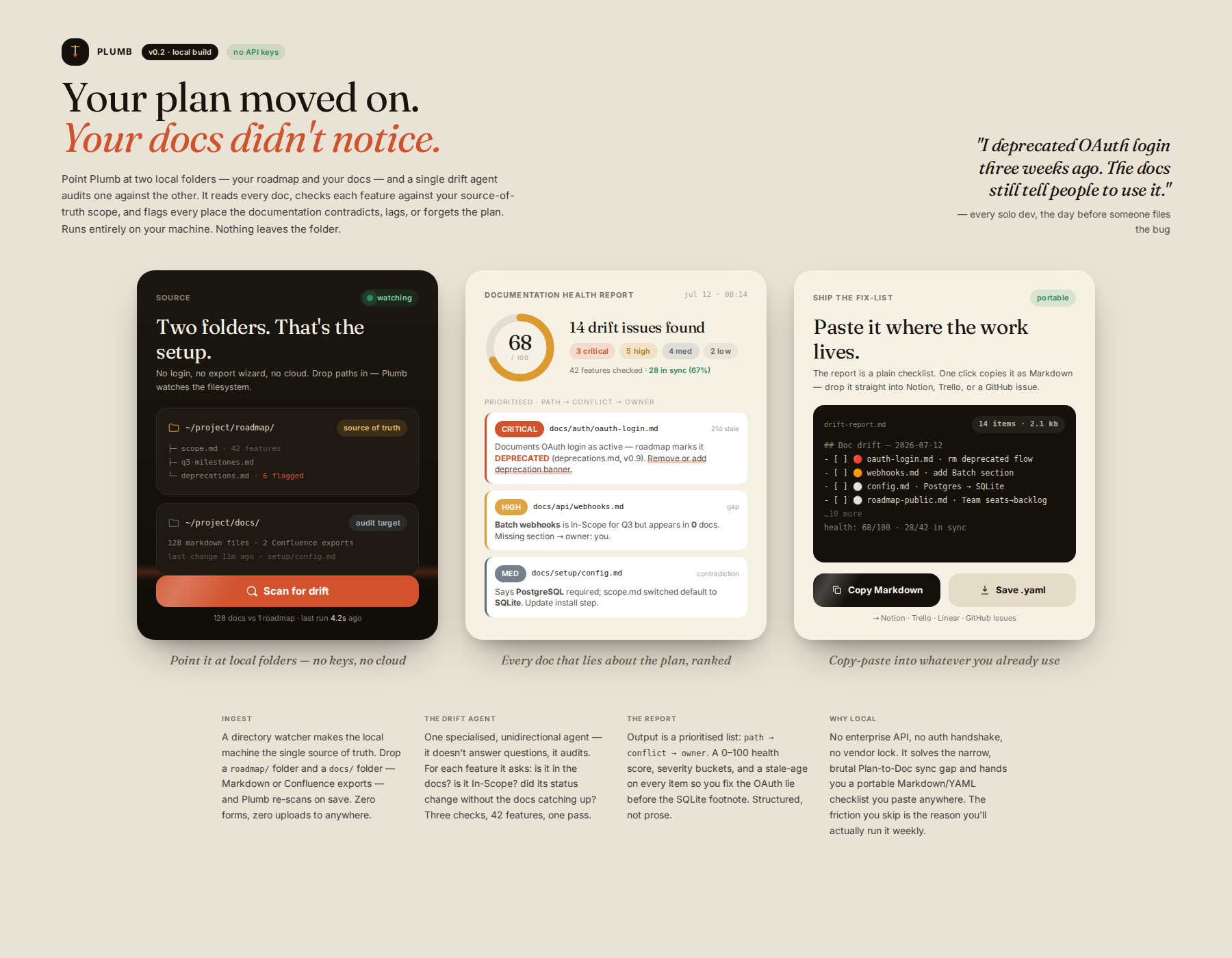
A local agent system ingests a project's roadmap (Markdown) and documentation exports, then audits whether feature status changes are reflected in the docs. By comparing structured scope definitions against unstructured documentation, the system flags omissions and contradictions—e.g., deprecated endpoints still documented as active or planned features not yet mentioned. The output is a prioritized 'Drift Report' with specific sections needing updates and suggested actions for remediation.
Process flow
Who it's for
Solo developer managing multiple aspects of a side project
Why they need it
The primary pain is 'Documentation Drift': when project plans or feature scopes change, the corresponding technical documentation often lags behind, leading to developer confusion and incorrect customer onboarding. Users need a single source of truth that automatically audits the documentation against the defined scope, without requiring live API connections.
What it is
A focused, local AI orchestration layer that consumes structured project data (e.g., local Markdown files representing roadmaps/scope) and technical documentation (Markdown/Confluence exports). It generates a 'Documentation Health Report' that flags specific sections of documentation that contradict or fail to reference necessary updates in the project plan.
How it works
- Ingest Structured Data: Ingest local files representing the current scope/roadmap (e.g., a master Markdown file).
- Ingest Unstructured Data: Ingest the core documentation set (Markdown/Confluence exports).
- Specialized Agent Focus (Drift Agent): Run a dedicated agent that compares elements: a) Does the documentation mention Feature X? b) Is Feature X marked as 'In Scope' in the local roadmap file? c) If the status changed (e.g., from planned to deprecated), does the documentation reflect the change?
- Synthesis: The output is a prioritized 'Drift Report' detailing: [Documentation Path] -> [Contradictory Element/Gap] -> [Suggested Action/Owner].
Differentiation
Unlike general knowledge graph tools or simple documentation search engines, this system is unidirectional and critical. It doesn't just answer questions; it audits the completeness and accuracy of the documentation against the source of truth (the local plan). It solves the 'Plan-to-Doc' synchronization gap, a problem far more specific and immediately actionable than general cross-domain synthesis. This bypasses the need for enterprise API integration, focusing on the core logic gap.
Implementation sketch
- Prototype the ingestion pipeline for a single structured source (e.g., a master Markdown roadmap file) and local Markdown documents.
- Implement a single, focused 'Drift Agent' loop: [Parse Roadmap for Feature X Status] -> [Query Local Vector Store for Feature X Docs] -> [Compare & Report Discrepancy].
- Develop the final output formatter to present findings as high-priority, actionable 'Drift' tickets/reports, minimizing narrative fluff.
First step: Create a small, controlled test corpus: 1) A 5-line 'Roadmap.md' defining 3 features (A, B, C). 2) Two associated 'Docs.md' files (one correctly covering A, B; one outdated, only covering A). Run the basic ingestion pipeline to confirm the agent can read both the structured and unstructured inputs.
Remaining risks
- The 'Source of Truth' ambiguity remains, even with local files. If the developer maintains multiple local sources (e.g., a 'Draft Roadmap.md' and a 'Final Roadmap.md'), the system has no inherent mechanism to determine which file represents the current definitive scope, leading to false negatives or positives. — Implement a mandatory, explicit 'Scope Lock' mechanism where the user must select and commit a single, versioned 'Master Scope File' before running the audit. The system should treat all other roadmap files as secondary, advisory inputs.
- The 'Drift' definition is too narrow. It only detects omission (Doc missing reference to Plan) or contradiction (Doc says X, Plan says Y). It fails to detect semantic drift—where the documentation uses outdated terminology or slightly incorrect conceptual models that are technically consistent with the plan but functionally wrong in practice. — Augment the Drift Agent with a secondary 'Terminology Validation Agent.' This agent would require a small, curated glossary of domain-specific terms (sourced from the initial corpus) and flag any usage that deviates from the established vocabulary, requiring manual review.
- The system's utility is limited to the export format. If the user's actual workflow involves tools that do not easily export to clean, structured Markdown (e.g., a complex diagramming tool or a highly proprietary CMS), the entire premise of 'local ingestion' collapses, forcing the developer back toward the API integration problem. — Develop a modular 'Data Adapter' layer. Instead of assuming Markdown, build lightweight, specialized parsers for 1-2 other common export types (e.g., exporting diagrams as Mermaid syntax or basic JSON/YAML structure) to increase the perceived breadth of supported inputs without increasing core complexity.
Watch for: If the initial test corpus (Roadmap.md vs. Docs.md) requires manual, pre-processing cleanup (e.g., renaming sections, manually extracting feature lists) before the agent can even run, it indicates the input data structure is too messy for the 'local' promise to be valuable. Kill criterion: If the core logic proves that the only way to reliably detect drift is by integrating with a live, controlled source of truth (like Jira/Confluence APIs), it means the local-first pivot was insufficient, and the project requires a fundamental shift in scope away from 'auditing' towards 'workflow enforcement' (which is a much larger undertaking).
Sources the council used
Real-world evidence that grounded this idea — judge it for yourself.