
Verifiable Resource-Gated Multi-Agent Runtime (VRG-MAR)
A secure, local-first runtime orchestrator that guarantees measurable resource budget adherence and auditable state transitions between multiple, independent AI agents running on private edge hardware.
How can I ensure AI agents don't interfere with each other's resource allocation?
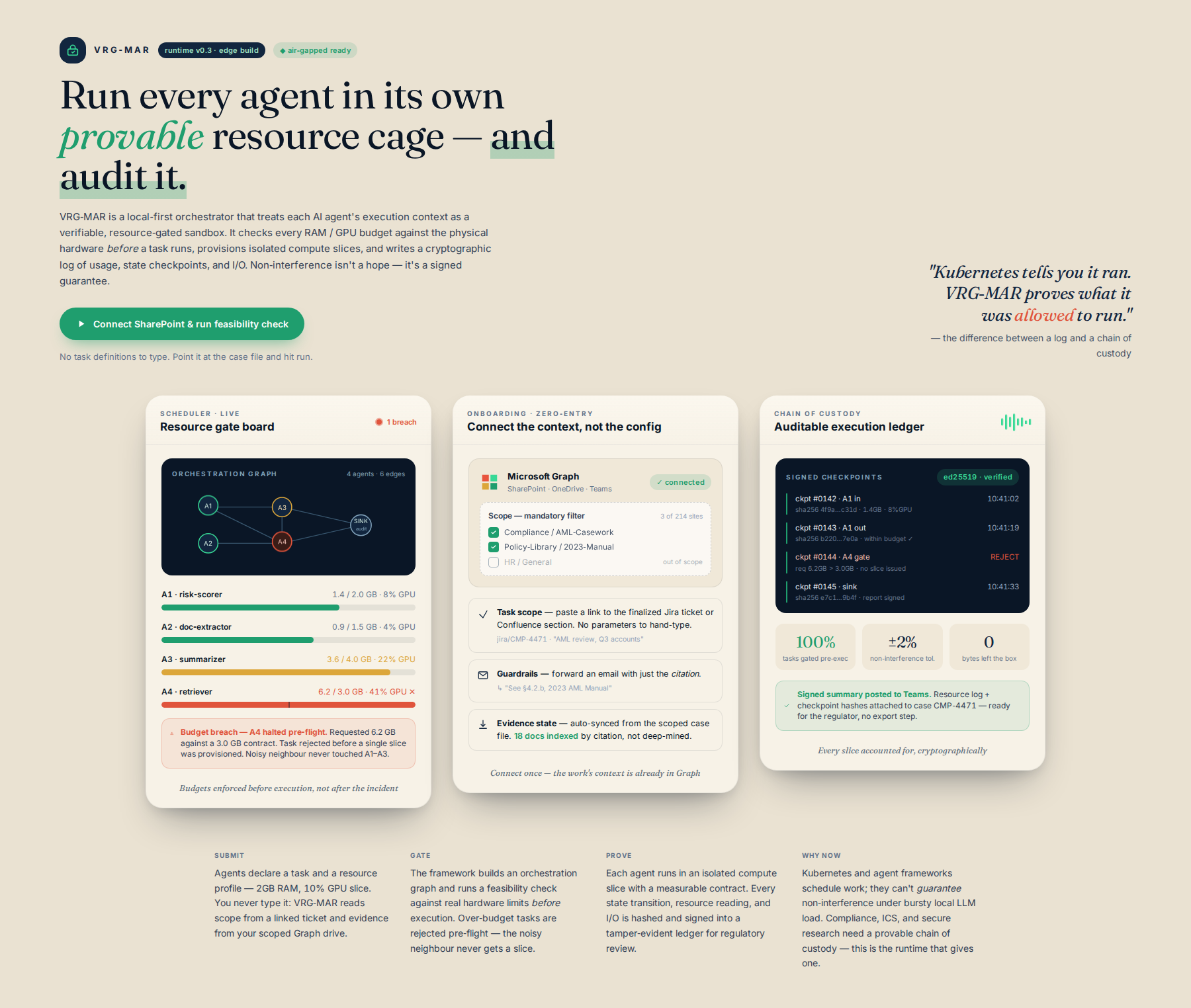
A resource-gated runtime enforces measurable compute budgets before agent execution, preventing resource contention from causing unpredictable inference drift. Each agent declares required memory, GPU time, and processing overhead; the system validates feasibility, provisions isolated compute slices, and monitors real-time usage against the declared budget. If an agent exceeds its allocation, execution halts with an auditable error log—critical for regulated compliance and fraud detection systems.
Process flow
Who it's for
Financial services compliance departments, critical industrial control systems (ICS), or high-security research environments requiring provable separation of computation.
Why they need it
In high-stakes local deployments, running multiple LLMs concurrently creates unacceptable risk due to resource contention leading to unpredictable inference drift. VRG-MAR moves from abstract 'coordination' to 'guaranteed isolation' by enforcing measurable resource budgets, providing an auditable chain of custody for computation that standard orchestrators cannot guarantee under load.
What it is
A deterministic runtime environment that treats each agent's execution context as a verifiable, resource-gated sandbox. It manages state, allocates compute slices, and enforces explicit resource budgets before execution, guaranteeing non-interference within defined tolerances.
How it works
- Task Submission: Agents submit tasks and required resource profiles (e.g., 2GB RAM, 10% GPU time slice) to the VRG-MAR.
- Graphing & Bidding: The framework builds an orchestration graph and runs a resource feasibility check against the physical hardware constraints.
- Budgeted Scheduling: It provisions isolated compute slices and enforces execution based on measurable resource contracts, flagging any breach immediately.
- Auditable Execution: It executes agents, providing a cryptographic log of resource usage, state checkpoints, and input/output for regulatory review.
Differentiation
Unlike existing multi-agent frameworks (e.g., agentcollective) or general orchestrators (e.g., Kubernetes), VRG-MAR's core value is its measurable guarantee of non-interference via verifiable resource gating. It solves the 'noisy neighbor' problem in localized LLM inference by enforcing resource budgets, providing an auditable chain of custody for computation that standard schedulers cannot guarantee under bursty LLM load.
Implementation sketch
- Develop a resource-profiling agent contract defining required resource boundaries (min/max/average) for execution.
- Build a scheduling abstraction layer to map logical resource needs (e.g., 'low latency inference') to physical hardware guarantees (e.g., 'reserved GPU memory block').
- Implement a scheduler hook that monitors hardware counters (e.g., NVML, cgroup) during execution and triggers a verifiable failure state if a budget is breached.
First step: Prototype the resource-profiling agent contract by creating a simple JSON schema that forces the agent developer to declare required GPU memory bandwidth usage bounds, and write a minimal Python script using psutil or a hardware library to read and enforce a hard memory ceiling on a dummy process.
Remaining risks
- Vendor Lock-in/Hardware Dependency: — Abstract the resource monitoring and scheduling layer behind a standardized Hardware Abstraction Layer (HAL) interface. Initial implementation can target one vendor (e.g., NVIDIA/CUDA) but the API must be designed to swap out the underlying counter/API calls (e.g., NVML, direct PCIe monitoring) with minimal changes.
- Agent Contract Evasion/Gaming: — Implement a 'challenge-response' mechanism during profiling. The scheduler should run the agent under controlled stress tests designed to provoke resource spikes (e.g., rapid context switching, high-volume I/O) and verify that the agent's reported resource usage remains within the declared budget under stress, not just idle load.
- State Complexity Explosion: — Instead of trying to checkpoint the entire LLM state, focus the checkpointing mechanism on the inputs and intermediate decision vectors that are critical for auditability. Treat the LLM's internal weights/activations as opaque, trusted computation, and only verify the I/O contract.
Watch for: Any major industry shift towards fully managed, cloud-native LLM services (e.g., specialized cloud instances for inference) that offer guaranteed resource isolation at scale, thereby removing the necessity for a local, self-managed runtime. Kill criterion: If a major cloud provider or specialized hardware vendor releases a standardized, open-source, and easily accessible SDK/API that provides verifiable, deterministic, and auditable resource isolation guarantees for LLM inference across multiple processes on commodity hardware.