
Local RAG Benchmarker & Comparative Evaluation Tool
A focused, desktop GUI tool that allows ML Engineers to benchmark the performance (latency, context recall, coherence) of 2-3 different local LLMs on standardized RAG workflows, quantifying model selection risk.
How do I benchmark different local LLMs for a RAG pipeline before picking one?
A dedicated local-first desktop tool lets ML engineers register 2-3 local models via Ollama, run them against the same document corpus and query set, and compare results side by side. It executes the full retrieve-contextualize-generate flow per model, then reports latency and token counts (with adherence/relevance scoring planned for later) in a structured comparison report. This targets ML engineers and researchers who need to validate model choice for a production RAG task without spending days on manual, ad hoc comparison scripts.
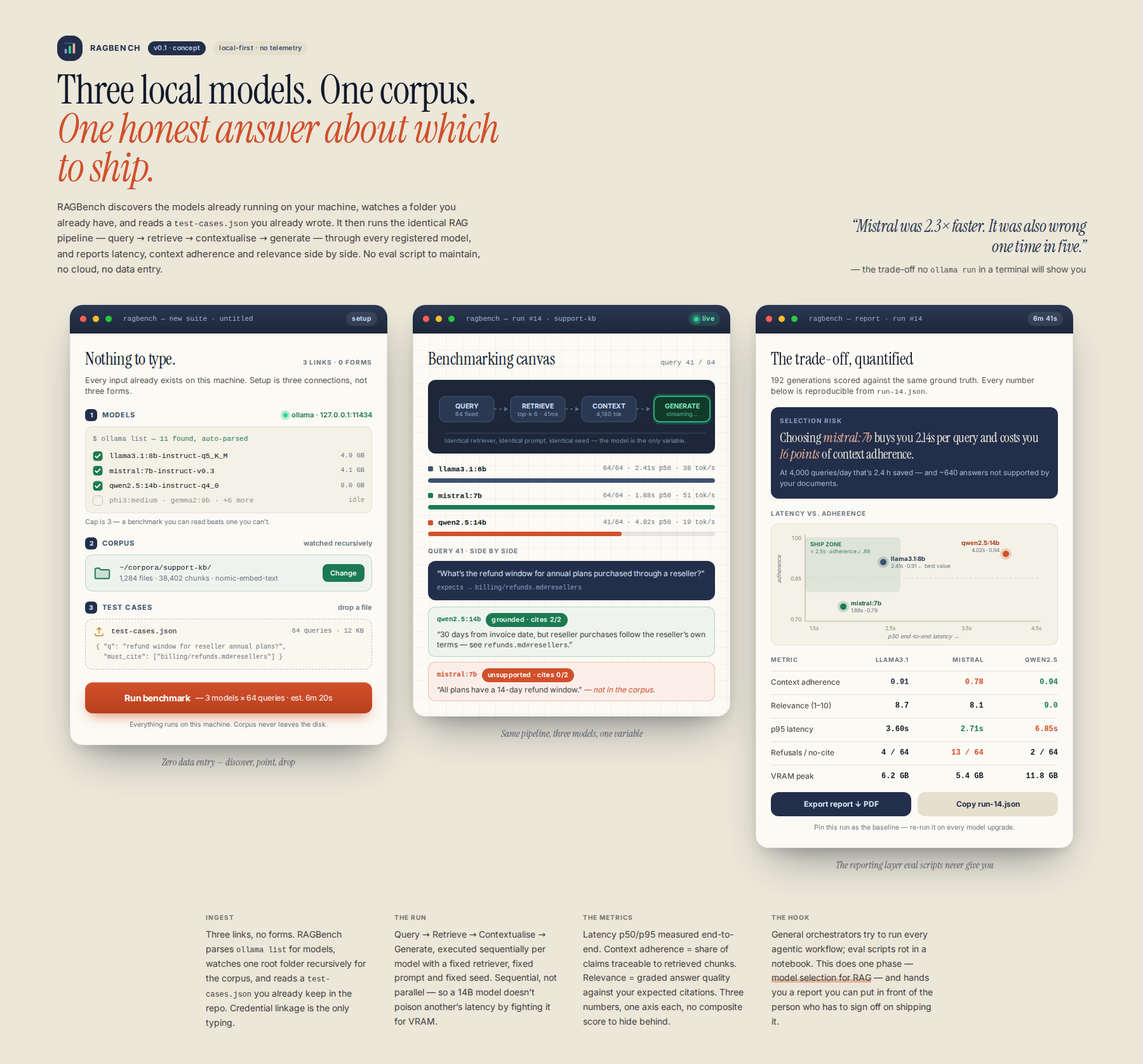
Process flow
Who it's for
ML Engineers and AI Researchers who must select the optimal local LLM for a specific, repeatable, production-grade task.
Why they need it
The critical bottleneck in local LLM adoption is model selection. Manually running and comparing multiple model combinations to validate a single RAG pipeline costs expert teams days of engineering time. This tool solves the selection problem by providing immediate, side-by-side, quantitative performance data on a defined workflow, drastically reducing validation time and risk.
What it is
A dedicated, local-first desktop application focusing narrowly on creating, running, and comparing results for RAG pipelines across selected local backends.
How it works
- Model Selection: User registers 2-3 specific local models (e.g., Llama 3, Mistral) and confirms local endpoint availability (Ollama integration).
- Data/Tool Setup: User uploads a single, standardized document corpus and defines the retrieval tool/vector store connection.
- Benchmarking Canvas: The GUI executes the RAG process (Query -> Retrieve -> Contextualize -> Generate) sequentially for each registered model.
- Comparative Report: Generates a structured report comparing models based on key metrics: Latency (total time), Context Adherence Score, and Relevance Score.
Differentiation
Unlike general orchestrators (like those attempting to manage all agentic workflows) or code-based evaluation scripts, this tool is hyper-focused on the Model Selection/Benchmarking phase for a single, high-value pattern (RAG). The gap is the lack of a visual, comparative, and standardized reporting layer that quantifies the trade-offs between multiple local models on a specific, complex task.
Implementation sketch
- Phase 1 (MVP Focus): Build the UI shell and the RAG execution graph for one fixed workflow (RAG).
- Phase 2: Implement standardized connectors for 2-3 major local backends (e.g., Ollama) to run the RAG pipeline.
- Phase 3: Develop the structured result comparison UI and metrics calculation engine (latency, etc.).
First step: Prototype the core API abstraction layer in Python that accepts a standardized run_inference(model_name, prompt, context) function, and write a test harness that successfully calls this abstraction layer against a local Ollama instance for a fixed RAG prompt, regardless of the underlying API quirks.
Remaining risks
- The abstraction layer connecting the standardized workflow to disparate local backends (Ollama, vLLM, etc.) will prove brittle and require constant, high-effort maintenance as these backends update their APIs. — Initially scope the MVP to support only one, highly stable local backend (e.g., Ollama) and treat multi-backend support as a V2 feature, focusing all initial engineering effort on perfecting the RAG benchmarking workflow for that single connection.
- The 'structured reporting' metrics (Context Adherence Score, Relevance Score) are subjective and difficult to automate reliably without deep, domain-specific evaluation models, leading to user distrust in the quantitative results. — For the MVP, limit the comparative metrics to purely objective, measurable outputs: Total Latency (ms) and Token Count. Reserve the subjective scores for V2, perhaps requiring the user to input manual scoring guidelines initially.
- The target user (ML Engineers) might prefer to build custom evaluation scripts using existing SDKs (e.g., LangChain/LlamaIndex) rather than adopting a GUI tool, viewing the GUI as an unnecessary abstraction layer. — Embed a 'Code Export' feature in the final report that generates the necessary Python/pseudo-code snippet required to replicate the exact benchmark run using the underlying SDKs, thus providing value to the power user who prefers code over GUI.
Watch for: If early user feedback shows that the time spent setting up the benchmark (corpus ingestion, defining the prompt template) outweighs the time saved by the comparative reporting, the value proposition is flawed. Kill criterion: If the core technical proof-of-concept (Phase 1/2) cannot reliably execute a fixed RAG benchmark across two different, stable local model endpoints (e.g., Ollama and a local vLLM deployment) with minimal manual intervention, the project lacks the necessary foundational stability.
Sources the council used
Real-world evidence that grounded this idea — judge it for yourself.