
Protocol Interoperability Agent for Cross-Chain Execution
A specialized middleware agent that solves deep infrastructure failure points by reliably mediating and executing complex, multi-protocol transactions across disparate blockchain environments (e.g., L2 to L1, or asset bridge failures), making advanced cross-chain functionality seamless for developers and users.
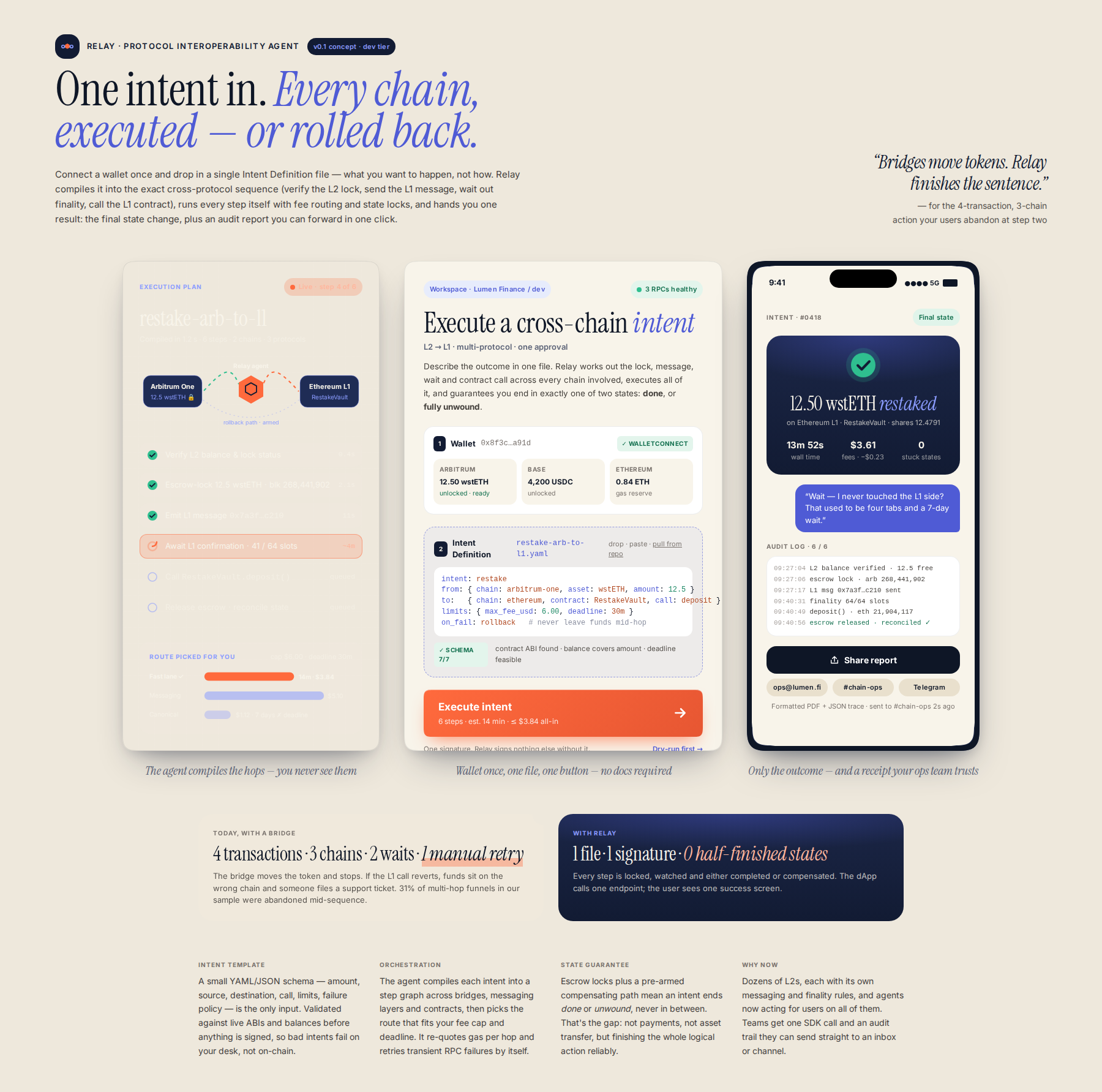
Process flow
Who it's for
Devs/Protocols building cross-chain applications and sophisticated user funnels that rely on multiple, incompatible blockchain layers.
Why they need it
The current state of Web3 interoperability is fragmented, relying on brittle, manual, or single-protocol bridges. Developers face massive overhead trying to chain together state-dependent actions across L1/L2/sidechains. This creates 'protocol failure points' where transactions fail due to mismatched state requirements, timing, or incompatible contract standards. This is an infrastructure failure, not a UX failure.
What it is
A 'Protocol Agent' that sits between the user/dApp and the blockchain environment, abstracting the necessary sequence of cross-protocol calls, state locking, and asset movement required to complete a single, complex logical action.
How it works
- The user initiates a cross-chain action (e.g., staking an L2 asset that needs to be used in an L1 contract).
- The Agent identifies the required multi-step protocol sequence (e.g., verify L2 lock -> initiate L1 message -> wait for confirmation -> trigger L1 contract).
- The Agent executes this entire sequence autonomously, handling gas/fee optimization and state management across the different chains.
- The user only interacts with the agent's simple interface and sees the final successful state change, not the underlying chain-hopping complexity.
Differentiation
Existing solutions focus on payment/settlement rails, and current bridges focus only on asset transfer. Our solution fills the gap of Protocol Execution Reliability. We are not a payment gateway, nor are we a bridge; we are a transaction orchestrator agent that guarantees the successful, multi-step execution of a logical action across incompatible protocols, solving the deep technical failure point of cross-chain state consistency.
Implementation sketch
- Define the MVP scope: Focus on a single, high-complexity cross-chain action (e.g., locking an asset on an L2 and triggering a state-dependent minting function on L1).
- Develop the core agent logic to parse and model the required multi-step, state-dependent execution flow across two specific, incompatible chains (e.g., Arbitrum/Ethereum).
- Build the minimal front-end gateway that submits the intent to the Agent, which then manages the sequential transaction calls, gas optimization, and failure recovery across the defined protocols.
First step: Select a specific, high-profile cross-chain use case (e.g., a specific L2-to-L1 staking mechanism) and write a detailed, step-by-step state diagram mapping every required transaction and state change across the two protocols. This diagram will be the blueprint for the agent's parser.
Remaining risks
- The State Explosion Problem (Unforeseen Interoperability Failure Modes) — The agent's model must account for the combinatorial explosion of failure states (e.g., timing attacks, unexpected contract upgrades, partial state commitment, conflicting L2/L1 consensus). Even if the MVP handles one path, the agent must prove it can dynamically model and recover from any combination of failure states, which is computationally and logically intractable to guarantee.
- Protocol Standardization and Developer Inertia — The solution requires developers to adopt a new, complex middleware layer for a problem they currently solve (poorly) using existing, albeit brittle, tools. If major protocols or developer toolkits (like Hardhat or Foundry) do not natively integrate or champion this agent's methodology, the value proposition remains an isolated, specialized niche, hindering mass adoption.
- The 'Trusted Orchestrator' Single Point of Failure — By centralizing the complex state management and execution logic into a single agent, the system becomes a maximal-value target for exploits. A successful attack on the agent's parsing logic or internal state rails would not just fail a transaction; it could theoretically compromise the integrity of multiple, unrelated cross-chain assets and protocols simultaneously.
Watch for: Any indication that the core difficulty of cross-chain execution is actually solved by a simpler, non-agentic protocol mechanism (e.g., a major L1/L2 upgrade that natively solves the state consistency problem). If the complexity decreases, the need for the agent diminishes. Kill criterion: If a major, established L1 or L2 ecosystem (e.g., Ethereum Foundation, Arbitrum, Polygon) announces a native, protocol-level upgrade that fundamentally solves the state consistency and multi-step execution problem without requiring external middleware, the market for this agent collapses.
Sources the council used
Real-world evidence that grounded this idea — judge it for yourself.