
AI Compute Resource Broker and Optimization Layer
A multi-backend proxy service that intelligently routes demanding AI workloads to the most cost-effective compute resources, providing reliable resource allocation and advanced financial auditing capabilities.
How can AI teams cut GPU and compute costs without sacrificing reliability across cloud providers?
A compute resource broker addresses this by acting as a smart proxy that benchmarks live pricing and capacity across multiple backends (AWS, decentralized GPU networks, specialized clouds) in real time. It calculates the lowest-cost resource mix meeting a job's performance requirements and budget cap, then presents the plan for approval before executing and settling billing across vendors. This suits AI SaaS developers, research teams, and enterprise compute consumers who need a single point of truth for multi-vendor spending and auditable financial reporting.
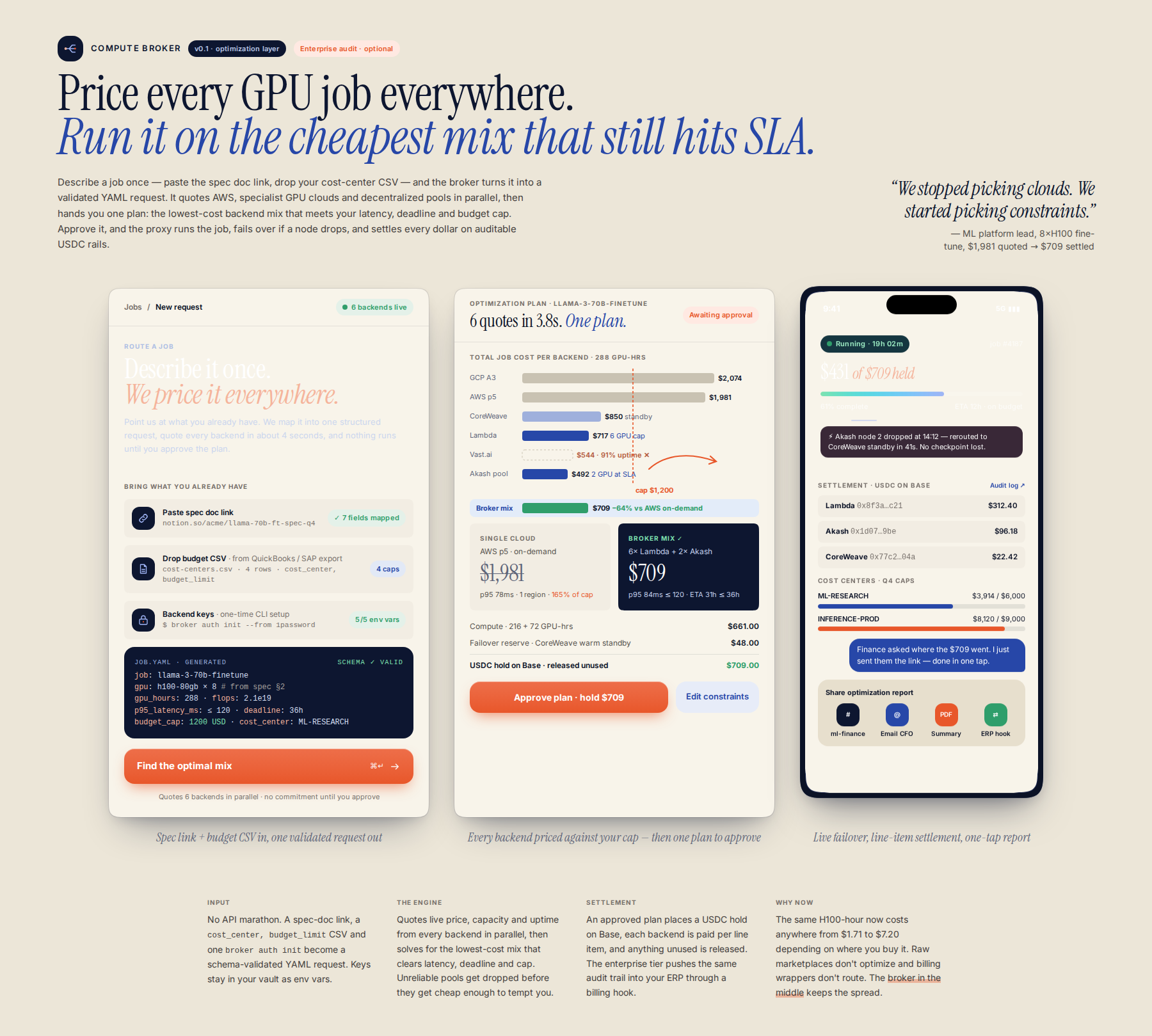
Process flow
Who it's for
AI SaaS Developers, Research Teams, and Enterprise Compute Consumers
Why they need it
Developers require scalable, reliable access to diverse compute power (Cloud, decentralized, specialized) while needing to maximize their limited budget through proactive cost optimization. They need a single point of truth for resource allocation and financial reporting, minimizing the risk associated with multi-vendor cloud spending.
What it is
A Service/Platform that acts as a smart proxy wrapper. It analyzes a job's requirements and benchmarks it against multiple live compute backends, selecting the optimal resource combination that meets performance needs while staying within the client's defined cost constraints. Financial control is offered as an optional, enterprise-grade compliance layer.
How it works
- The user submits a job request (compute requirements, desired performance metrics, and optional budget cap).
- The API Proxy triggers an Optimization Engine that concurrently queries live rates and capacity from multiple sources (e.g., AWS, specialized GPU networks, decentralized pools).
- The Engine calculates the optimal, lowest-cost resource mix that meets the job requirements. This optimized plan is presented to the user for approval.
- Upon approval, the proxy executes the job across the selected backends, managing resource lifecycle and billing settlement. Financial control is executed via robust, auditable settlement rails (USDC/Base) and is designed to integrate with dedicated accounting systems (e.g., requiring an enterprise billing API hook).
Differentiation
Existing solutions offer either raw compute access (lacking intelligence/reliability) or simple usage-based billing wrappers (lacking optimization). Our platform is unique because it unifies advanced cost-optimization routing and multi-backend reliability. We shift the focus from being a proprietary 'guaranteed financial proxy' (high risk) to being the indispensable 'optimization broker' that provides reliability and superior cost management across disparate infrastructure sources. The gap is reliable, proactive, multi-vendor optimization combined with enterprise-grade financial reporting.
Implementation sketch
- Develop a core API proxy service that accepts job parameters and desired budget range.
- Build the Optimization Engine (Microservice 1): This service must ingest real-time rate data from 3+ distinct compute backends (e.g., simulating API calls to AWS spot pricing, a decentralized network API, and a specialized cloud provider).
- Develop the Resource Orchestration Layer (Microservice 2): This layer handles the job execution across the selected backends, managing resource lifecycle and dependencies.
- Integrate a financial settlement layer: Focus initially on generating detailed, auditable cost reports based on usage, rather than building proprietary pre-payment enforcement rails. This minimizes systemic risk while providing core value.
First step: Build a proof-of-concept (PoC) for the Optimization Engine by integrating rate data endpoints from two distinct, accessible compute APIs (e.g., a public cloud API and a simulated decentralized network API). The goal is to prove the ability to calculate and compare the total cost for a fixed workload (e.g., 4x A100 for 2 hours) across the two sources.
Remaining risks
- Data Staleness and Volatility (The Optimization Engine's Achilles' Heel). The core value relies on real-time, accurate rate data from multiple, independent, and highly volatile compute backends. If the rate data sources (APIs) are slow, inconsistent, or provide stale pricing, the Optimization Engine will recommend suboptimal or impossible plans, leading to immediate user mistrust and failure. — Implement a tiered data ingestion strategy: 1) Primary real-time API calls, 2) Robust cache layers with strict, visible Time-To-Live (TTL) SLAs, and 3) A 'sanity check' fallback mechanism that defaults to a known, stable, premium provider if the market data variance exceeds a defined threshold (e.g., 20% deviation from the historical average).
- The 'Orchestration Tax' (Integration Complexity). The sheer technical difficulty of consistently executing a job across fundamentally different API paradigms (e.g., AWS spot instances vs. decentralized token-gated compute vs. specialized cloud endpoints) is monumental. The overhead of managing resource lifecycle, failure recovery, and dependency mapping across these disparate systems (the 'Orchestration Tax') may negate any savings achieved through optimization. — Start with a highly constrained scope. Instead of aiming for multi-backend reliability immediately, focus the PoC on reliably orchestrating one specific, complex workload type (e.g., fine-tuning a specific model size) across two distinct backends. Prove the orchestration pattern before attempting horizontal scaling of backends.
- Adoption Gap: The Black Box Problem. By abstracting the process into a 'smart proxy,' the system risks becoming a 'black box.' If the user cannot easily understand why the engine chose a specific resource mix or if the cost savings are not transparently auditable, the user will revert to manually selecting the provider they trust, eliminating the need for the broker. — The UI/UX must be designed for maximum transparency. Do not just present the final cost; present the comparison. Show the user the three best alternatives (A, B, and C) with a clear, side-by-side breakdown of the required resources, the cost, and the projected performance metrics, allowing the user to understand the trade-offs the engine made.
Watch for: Any sustained period where the system's ability to demonstrate quantifiable, reliable cost savings (measured against industry benchmarks or manual selection) drops below 15%. If the optimization intelligence cannot consistently beat the best-case manual effort, the core value proposition collapses. Kill criterion: Failure to secure verifiable, enterprise-level API access to a minimum of three distinct, high-capacity compute backends (e.g., major cloud provider, decentralized network, specialized hardware provider) within 6 months. Without diverse, reliable inputs, the optimization engine is purely theoretical.
Sources the council used
Real-world evidence that grounded this idea — judge it for yourself.