
LLM Token Standardizer Proxy & Usage Ledger
A developer-focused middleware proxy that intercepts, standardizes, and logs the complex, multi-vendor LLM token usage across autonomous AI agents, creating a single, auditable data contract for predictable resource management.
How can I track and standardize LLM token usage across multiple AI providers like OpenAI and Anthropic?
A standardization proxy sits between an agent's execution environment and every external LLM API, intercepting each call to normalize vendor-specific token metadata into one unified schema. It extracts raw usage metrics (input tokens, output tokens, model ID), maps them to standardized fields regardless of vendor nomenclature, then forwards the request and logs both raw and standardized usage to an immutable, auditable ledger. This is aimed at developers and agencies running multi-vendor AI agent stacks who need a single source of truth for resource allocation and cost tracking instead of reconciling incompatible per-vendor usage data.
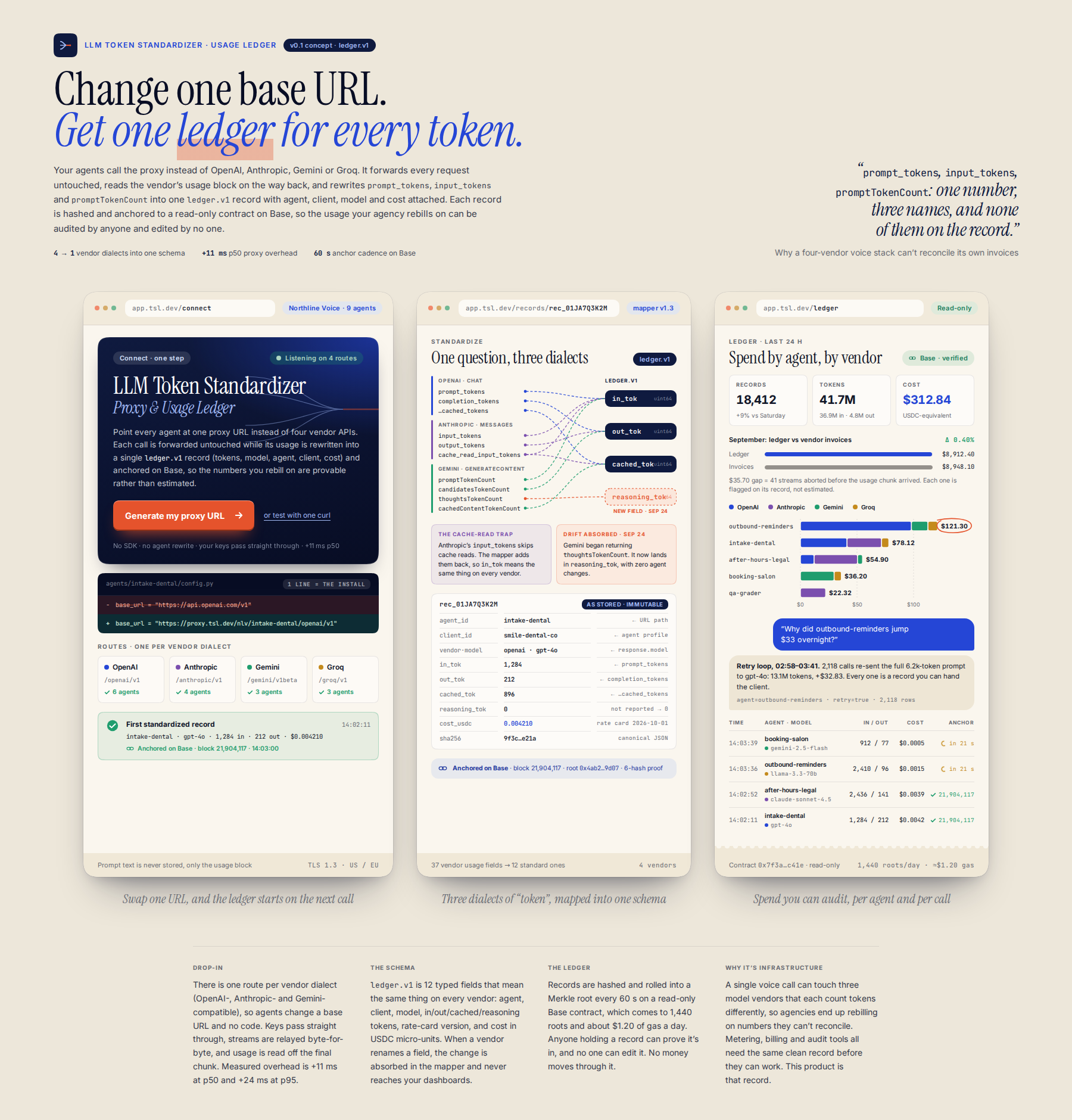
Process flow
Who it's for
AI voice agency owner/developer building multi-API agent stacks
Why they need it
The primary pain is the unmanageable complexity of LLM token usage across diverse, proprietary vendor APIs (Anthropic, OpenAI, etc.). Developers need a single source of truth and a standardized data contract for consumption that is independent of vendor nomenclature, making reliable resource allocation and future monetization possible.
What it is
A 'Standardization Proxy' service that is deployed as a mandatory layer between an agent's execution environment and every external LLM API. Its core function is to act as a real-time data sink, standardizing proprietary usage metadata into a unified, immutable ledger schema.
How it works
- The Agent calls the Standardization Proxy URL instead of the external LLM API (e.g., Proxy/OpenAI).
- The Proxy intercepts the request, extracts the raw usage metrics (Input Tokens, Output Tokens, Model ID), and maps them to a standardized internal schema.
- It forwards the request to the target API.
- Upon receiving the response, the Proxy logs the raw usage, the standardized metrics, and the calculated cost to a transparent, read-only public ledger (e.g., a dedicated Base/USDC smart contract). This validates the core data contract without requiring real-time financial compliance.
Differentiation
Unlike general metering tools or rigid enterprise solutions, our proxy focuses specifically on 'LLM Token Data Standardization.' We solve the foundational data problem—creating a standardized, unified, and immutable data contract from heterogeneous, ad-hoc AI agent usage. The product is not the billing mechanism, but the standardized metadata schema itself, making us an infrastructure prerequisite for any scalable, multi-vendor AI agency.
Implementation sketch
- Develop the API Gateway/Proxy service that accepts the target LLM API endpoint and client credentials.
- Implement the core standardization logic: mapping proprietary token counts (e.g., Anthropic's tokens vs. OpenAI's tokens) into a standardized schema (Input_Tokens, Output_Tokens, Model_ID).
- Focus MVP validation solely on read-only logging and data integrity to a smart contract, deferring complex payment rail integration until the data standardization problem is fully validated.
First step: Write a simple Python/FastAPI script that acts as a local proxy for a single model (e.g., OpenAI). This script should intercept a request, print the raw input/output token counts, and then log a standardized JSON object (containing only the token counts and provider name) to a local file/database, proving the data capture and normalization logic without touching blockchain or payments.
Remaining risks
- Semantic Drift and Maintenance Overhead — The core value—the standardization logic—is a moving target. Every time a major vendor (OpenAI, Anthropic) releases a new model or changes its tokenization rules, the standardization logic must be updated. This turns the MVP from a product into a perpetually maintained, deep domain expertise data pipeline, creating unsustainable operational costs.
- Developer Friction and Adoption Barrier — The proxy introduces a mandatory, complex middleware layer into the developer's critical path. Developers are inherently resistant to adding mandatory, non-functional infrastructure components. Adoption will stall if the integration effort (the 'developer tax') outweighs the perceived value of the standardized ledger.
- Data Siloing and Utility Gap — The standardized data is only valuable if the downstream consumer (the agent owner) knows how to query it and integrate it into their workflow (e.g., credit checks, budgeting tools). If the ledger becomes an academic curiosity—a perfect record that nobody uses—the product fails to deliver business value.
Watch for: If developers begin to complain that the standardized data contract is too complex or rigid for their actual agent logic, or if they prefer to manage cost tracking using simpler, non-standardized methods (e.g., manual spreadsheet tracking or simple billing APIs) that bypass the proxy. Kill criterion: If the market proves that the primary pain point is not the standardization of usage data, but rather the predictability of cost budgeting, and a simple, non-proxy-based credit/metering system (e.g., a simple pre-paid credit API wrapper) can solve the problem with significantly less technical complexity.
Sources the council used
Real-world evidence that grounded this idea — judge it for yourself.