
Proof-of-Utility Layer for Specialized Agent APIs (PoU-Layer)
A decentralized, opt-in cryptographic reputation layer designed for high-stakes, mission-critical agent dependencies. It requires verifiable computation proofs (VAPs) only within specific, high-value vertical domains, making the utility score a cryptographically proven asset.
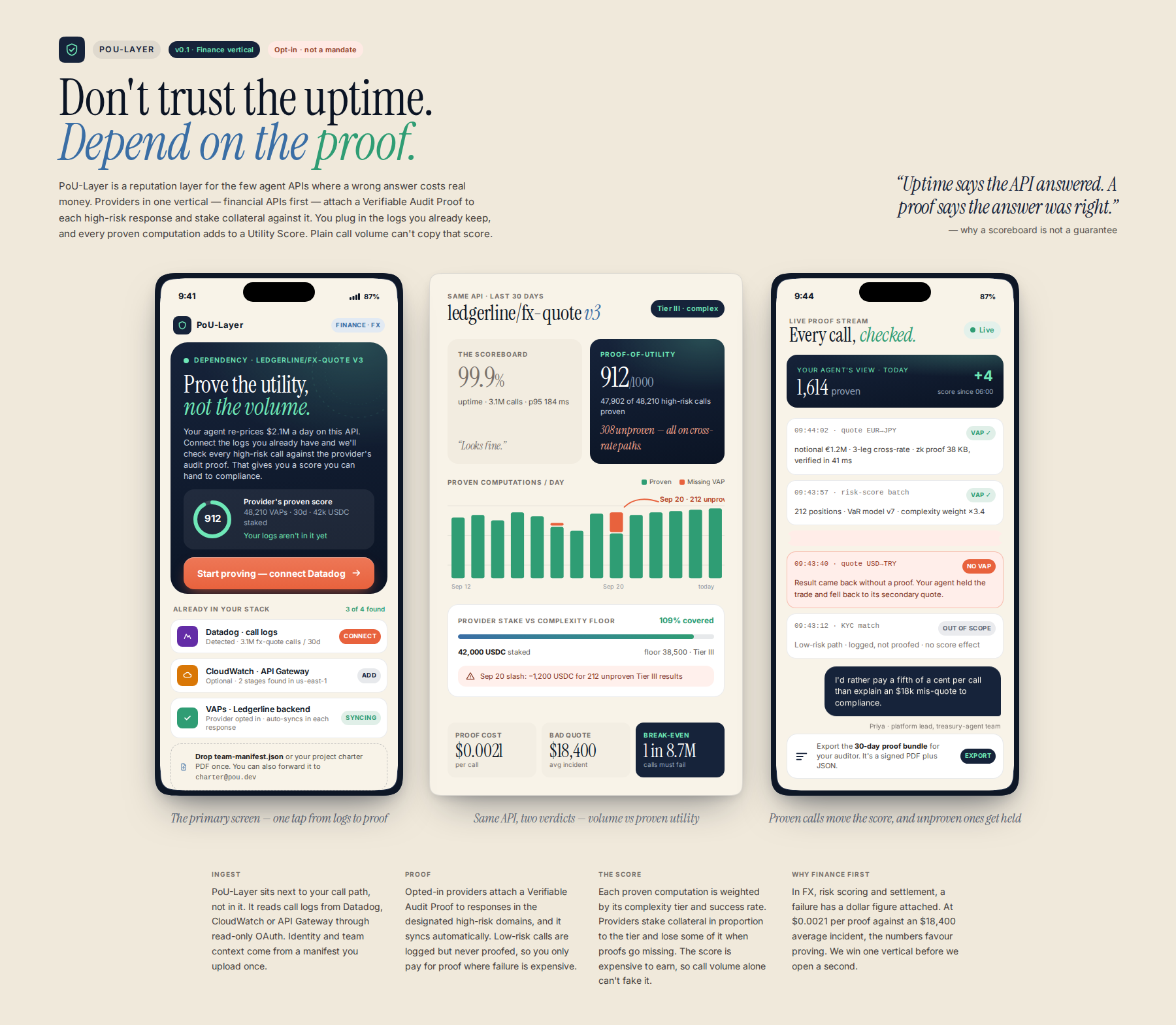
Process flow
Who it's for
Developers building high-value, monetized AI agents and enterprise systems where the cost of an API failure or unverified logic is demonstrably higher than the cost of cryptographic proof generation.
Why they need it
As agents tackle high-stakes, monetized tasks (e.g., financial modeling, complex state management), reliance on unverified APIs is unacceptable. General-purpose scoring is insufficient. We must guarantee operational integrity and verifiable utility where the economic cost of failure is catastrophic. This layer moves beyond simple uptime metrics to prove that the API executed its logic correctly.
What it is
The PoU-Layer is a specialized protocol that mandates the submission of a 'Verifiable Audit Proof' (VAP) for usage within designated, high-risk domains. The Utility Score is derived from the aggregation of these verifiable proofs, making the score a high-cost, verifiable asset that guarantees the operational integrity of the dependency.
How it works
- Vertical Focus: The system initially deploys within a single, high-value vertical (e.g., financial APIs) where the cost of failure is quantifiable and high.
- Opt-in Proofing: API providers in this vertical voluntarily integrate proof generation (VAPs).
- Audit & Score: The PoU-Layer proxy intercepts calls and requires the VAP. The score is updated based on the complexity and success rate of the proven computations.
- Staking: Providers must stake collateral proportional to the complexity of the proofs they generate, creating a strong economic incentive to maintain verifiable operational excellence within the defined vertical.
Differentiation
Existing solutions track volume and simple uptime metrics (transactional rails like 'ba254c7ef6e5ec78'). Our differentiation is the shift from a passive 'Scoreboard' to an active, Proof-of-Utility layer. By requiring verifiable computation proofs (VAPs), we solve the novelty and feasibility critiques by limiting scope. We are not a universal mandate; we are a specialized, opt-in audit layer that proves utility rather than just reporting volume, making the score a high-cost, verifiable artifact that cannot be replicated by simple metric aggregation.
Implementation sketch
- Week 1: Define the initial target vertical (e.g., DeFi state management). Create a minimal API contract template that mandates a VAP payload structure.
- Week 2: Build a simulation environment (mock proxy) that accepts and validates a simplified VAP format (e.g., using pre-generated proof placeholders) and calculates a rudimentary Utility Score based on proof weight.
- Week 3: Develop the staking contract logic on-chain. Implement the penalty mechanism: if a VAP fails verification or is missing, the provider's stake is penalized, demonstrating the economic incentive.
First step: Draft a whitepaper section detailing the use case selection methodology: how to quantify the 'cost of failure' to justify the overhead of VAP generation for a specific vertical (e.g., calculating the expected loss from a faulty financial model vs. the cost of a ZK-SNARK proof).
Remaining risks
- The 'Niche Trap' and Scope Limitation: Over-reliance on the initial high-value vertical. If the chosen vertical (e.g., DeFi) experiences a downturn or if the market expands faster than anticipated, the PoU-Layer's highly specialized, opt-in nature becomes a crippling limitation, preventing necessary general utility adoption. — Develop a modular, phased expansion roadmap that allows the core cryptographic mechanism (VAP validation) to be applied to adjacent, related verticals with minimal re-engineering, proving the utility of the methodology rather than just the vertical.
- The Cold Start Problem (Network Effect Failure): The system requires both API providers and consuming agents to adopt the complex VAP mechanism simultaneously. If one side fails to achieve critical mass adoption, the entire layer stalls, regardless of technical perfection. — Focus initial incentives on the consumer side (the agents). Build a superior, verifiable API discovery tool that only works with PoU-Layer APIs, thereby creating immediate, undeniable demand and forcing providers to adopt the standard to access the user base.
- Protocol Lock-in and Interoperability: By establishing a proprietary, complex cryptographic standard (VAP), the system risks becoming a highly effective but closed ecosystem. This could alienate major players who prefer to integrate with established, less restrictive, general-purpose infrastructure. — Design the VAP contract and scoring logic to be highly abstracted and compatible with existing industry standards (e.g., established verifiable computation proof formats or common API specifications), ensuring that the layer is seen as an enhancement to, not a replacement for, existing infrastructure.
Watch for: Early signals that the cost of generating and validating the Verifiable Audit Proof (VAP) begins to approach or exceed the perceived value of the transaction in the target vertical. This indicates that the overhead is becoming a friction point rather than a feature. Kill criterion: If the core development team cannot demonstrate a clear, quantifiable mechanism to incentivize the adoption of VAP generation from a critical mass of providers without relying on external, unsustainable subsidies or grants.