
Agent Compute Rail Protocol (ACRP): The Compliant, Quantifiable Standard for Agent Monetization
A verifiable, compliant protocol layer that standardizes and optimizes the financial and regulatory exchange for all agent-to-agent API calls, offering API providers a measurable and superior alternative to current ad-hoc payment and compliance rails.
How can API providers handle KYC/AML compliance for agent-to-agent payments automatically?
A compliance-embedded protocol layer can automate KYC/AML and settlement for agent-to-agent API calls by acting as a gateway that intercepts each request, authenticates the caller, and pre-authorizes funds before routing it to the provider. It then meters usage, debits and credits wallets, logs KYC/AML and data-provenance metadata, and finalizes settlement with T+0 guarantees plus a cryptographically verifiable Proof of Interaction ledger entry. This targets major AI API providers and enterprise infrastructure platforms that need auditable, regulation-ready monetization rather than ad-hoc billing with manual compliance overhead.
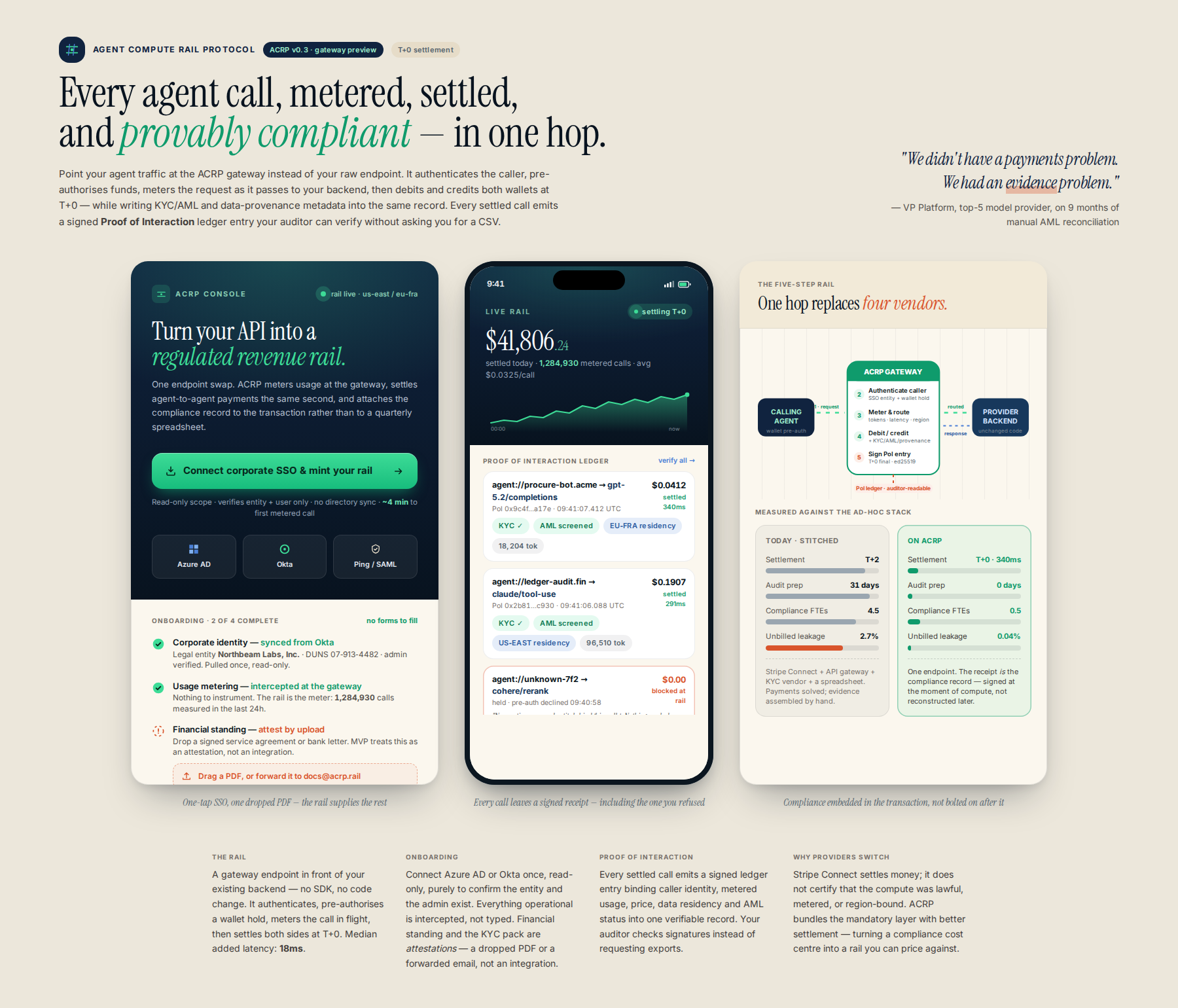
Process flow
Who it's for
Major AI API Providers (e.g., OpenAI, Anthropic, Cohere) and Enterprise Infrastructure Platforms who require a scalable, auditable, and regulatory-compliant method for monetizing agent compute and minimizing operational financial risk.
Why they need it
The exponential growth of agent economies creates immense revenue opportunity, but current monetization methods are fragmented, lack standardization, and critically fail to address the increasing regulatory burden (KYC, AML, data sovereignty) and settlement risk required by enterprise clients. The core need is moving from high-risk, manual billing to a single, verifiable, and financially superior protocol standard that minimizes legal and financial overhead for providers.
What it is
A decentralized infrastructure service (Agent Compute Rail) that acts as a universal meter, transaction router, and compliance intermediary. It handles payment settlement, cost calculation, and generates a cryptographically verifiable Proof of Interaction (PoI) ledger, effectively wrapping compliance and finance around the compute layer.
How it works
- The calling agent sends a request to the ACRP gateway endpoint.
- The ACRP gateway intercepts the request, authenticates the caller, and pre-authorizes funds.
- The gateway measures the usage and routes the request to the provider's backend.
- Upon success, the gateway calculates the usage cost, debits the caller's wallet, and credits the provider's wallet, while simultaneously logging all necessary KYC/AML/data provenance metadata.
- The transaction is finalized with superior settlement guarantees (T+0) and generates a verifiable PoI ledger entry.
Differentiation
Existing solutions (e.g., Stripe Connect, dedicated API management platforms) handle payments but treat compliance and settlement as secondary, often requiring high operational overhead and failing to provide a unified, automated, compute-centric compliance layer. ACRP is not just a payment gateway; it is a compliance-embedded financial protocol. It solves the quantifiable gap: the lack of a standardized, automated, and verifiable rail that bundles mandatory regulatory compliance (KYC/AML/Data Sovereignty) with superior, auditable settlement guarantees, making the decision purely financially and legally compelling for major providers.
Implementation sketch
- Phase 1 (MVP Focus): Develop a Proof-of-Concept (PoC) smart contract simulation (on local dev chain) that models the financial flow, incorporating mock smart checks for KYC/AML status and data provenance tracking metadata, proving the compliance layer is possible.
- Phase 2 (Gateway Logic): Build a simple cloud worker service (FastAPI/Cloudflare) that simulates the API interception, focusing solely on logging the input/output parameters and generating the verifiable PoI ledger entry, proving the metering capability.
- Phase 3 (Value Proposition): Create a comparative financial model (a simple spreadsheet/dashboard) that quantitatively compares the total cost of compliance and settlement (including time delay and legal overhead) using current ad-hoc rails vs. the modeled ACRP flow. This model is the core sales tool.
First step: Conduct deep market research to gather publicly available data points (or reputable estimates) comparing the operational costs, settlement timelines, and compliance overhead (KYC/AML requirements) of the top 3 existing payment rails (e.g., Stripe, PayPal, specialized payment processor) against the theoretical ACRP model. This data is required to build the mandatory quantitative comparison tool.
Remaining risks
- Regulatory Arbitrage and Jurisdiction Risk. Even if ACRP solves current KYC/AML requirements, the global regulatory landscape is constantly shifting (e.g., new data sovereignty laws, changes in digital asset classification). A single jurisdiction could legally invalidate the PoI ledger structure or mandate a different compliance mechanism, requiring a full, expensive overhaul of the core protocol. — Design the compliance layer to be modular and jurisdiction-agnostic, treating compliance requirements as pluggable modules rather than hardcoded rules. Maintain continuous, deep legal counsel in target regions and build in mechanisms for rapid protocol forks or localized gateway adaptations.
- Core Infrastructure Concentration Risk. The entire system relies on the stability and continued viability of the underlying smart contract platform (Base/USDC) and the cloud worker service provider (e.g., Cloudflare). A major failure, exploit, or policy change in any single foundational layer could instantly halt the entire billing and settlement mechanism. — Implement a multi-chain and multi-cloud strategy from day one. The smart contract layer must be designed for interoperability, and the gateway logic must be containerized and deployable across multiple major cloud providers to avoid single points of failure.
- The 'Invisible' Competition from Incumbents. Large, established financial institutions (e.g., Visa, Mastercard, major payment processors) have deep relationships and regulatory exemptions that are difficult to replicate. They could develop a competing, closed-loop system that offers similar compliance and settlement guarantees without the transparency or openness of a decentralized protocol, effectively trapping the market with superior, non-protocol solutions. — Focus on making the ACRP data (the PoI ledger) the most valuable, verifiable, and easily consumable data point in the industry, creating a data standard that even competitors must reference or pay to access.
Watch for: If major, non-AI enterprise clients (e.g., banks, large SaaS platforms) begin to build their own internal, proprietary 'agent compute rails' that bypass ACRP, it signals that the market views the solution as a niche payment tool rather than an essential, universal compliance standard. Kill criterion: The formal public announcement by a major, established payment processor (e.g., Stripe, Adyen) that they have successfully integrated a verifiable, automated, and regulatory-compliant compute billing layer, thereby eliminating the need for a third-party protocol layer like ACRP.