
Standardized Agent Output Attestation Protocol (SAOAP)
A lightweight, standardized protocol defining the minimal required data schema and consensus mechanism for cross-framework verification of AI agent task outputs, establishing verifiable interoperability for mission-critical decision pipelines.
How can a downstream system trust an AI agent's output without knowing how the agent works internally?
A standardized attestation protocol solves this by requiring agents to produce a signed 'Attestation Block' containing the input hash, agent ID, output hash, and signatures from a validator set confirming the input-output transformation's integrity. Downstream systems verify this block against a shared attestation registry without needing insight into the upstream agent's internal logic. This targets enterprise AI governance teams and system integrators running multi-stage, high-stakes workflows across frameworks like LangChain or custom internal services, where unverifiable outputs create unquantifiable risk.
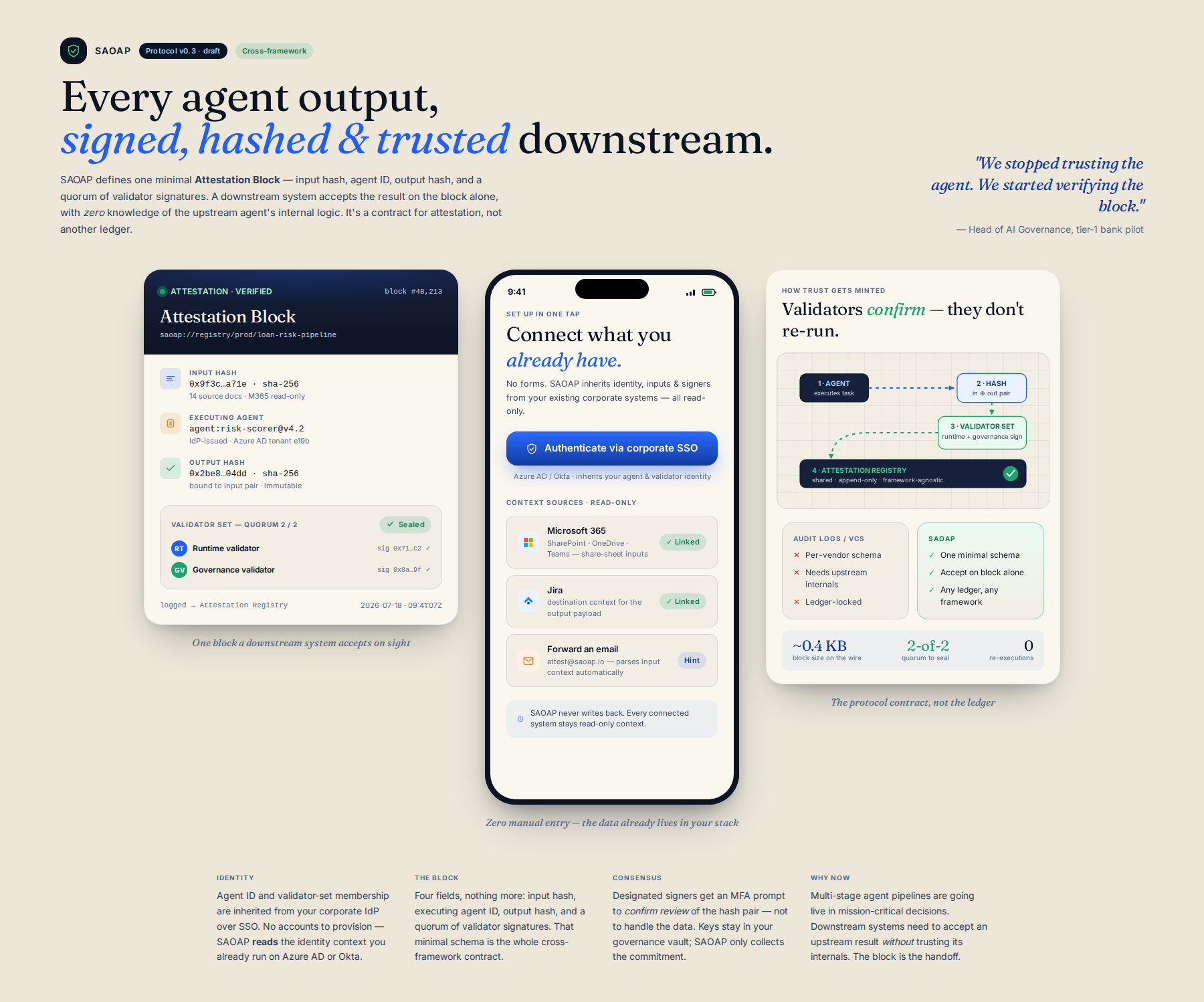
Process flow
Who it's for
Enterprise AI Governance Teams and System Integrators building multi-stage, high-stakes agent workflows.
Why they need it
Current multi-agent systems suffer from integration friction and unquantifiable risk when outputs from proprietary or diverse orchestration frameworks (e.g., LangChain, custom internal services) must be trusted by a downstream, critical system. The gap is the lack of a universal, machine-readable contract for output verification.
What it is
A protocol (SAOAP) that mandates the structure of an 'Attestation Block,' containing the input hash, the executing agent's ID, the output hash, and a minimal set of consensus signatures confirming the integrity of the input-output transformation.
How it works
- Agent executes a task, consuming inputs and calling services.
- The system calculates the final output hash (Output Hash).
- A designated 'Validator Set' (e.g., a runtime environment validator and a governance validator) signs a commitment to the (Input Hash, Output Hash) pair.
- These signed components are bundled into the Attestation Block and logged to a designated, shared Attestation Registry.
Differentiation
SAOAP differs from existing solutions by focusing on the protocol contract for attestation rather than the underlying ledger technology. While existing systems use general logging/auditing (e.g., service meshes, proprietary audit logs) or general verifiable credentials (VCs), SAOAP specifically solves the gap of cross-framework agreement on the minimum necessary verifiable output schema required for a downstream system to accept the result without needing deep knowledge of the upstream agent's internal logic.
Implementation sketch
- Define the minimal Attestation Block JSON/Schema standard (InputHash, AgentID, OutputHash, ValidatorSignatures[]).
- Build a minimal Python service that accepts a dictionary matching the schema and generates a cryptographically signed JSON Web Signature (JWS) payload, simulating the Attestation Block creation.
- Develop a simple consumer script that verifies the JWS signature against a mock public key registry, proving the schema's utility.
First step: Define the Attestation Block schema in a formal language (e.g., JSON Schema Draft 2020-12) and create a Python module that generates a verifiable, time-stamped JWS object based on that schema.
Remaining risks
- Adoption Inertia/Protocol Lock-in: The protocol, while standardized, requires mandatory adoption by multiple, powerful, and often competing orchestration frameworks (LangChain, etc.). These frameworks have vested interests in their existing, proprietary integration points and will resist adopting a third-party, mandatory standard, leading to a fragmented ecosystem where SAOAP is only useful in niche, non-standardized corners. — Initially target a single, high-stakes vertical (e.g., pharmaceutical R&D or financial compliance) where regulatory mandates force the adoption of a standard, bypassing the general framework resistance. Frame SAOAP as a regulatory compliance requirement, not a technical best practice.
- The 'Validator Set' Authority Problem: The system relies on a 'Validator Set' to sign off on the Attestation Block. If the governance or runtime validator itself becomes a single point of failure, compromised, or subject to regulatory capture (i.e., the entity controlling the validators), the entire protocol's integrity collapses, rendering the 'verifiable' aspect meaningless. — Design the validator set to be cryptographically distributed across multiple, non-affiliated, and geographically diverse entities (e.g., consortium members, academic institutions, or competing industry bodies). The signature aggregation mechanism must require a threshold signature (e.g., 3 of 5 required) from these independent parties.
- Over-Specification and Scope Creep: The protocol definition itself could become overly complex by attempting to account for every possible type of agent input, service call, or output modality (e.g., multimedia, complex state changes). This complexity will bog down the 'minimal' nature of the protocol, leading to implementation paralysis and technical debt. — Strictly limit the scope of the initial schema to the most basic, measurable data types (e.g., text/hash/boolean) and mandate that any extension (e.g., image attestation) requires a formal, versioned 'SAOAP Extension' that is treated as a separate, opt-in protocol layer, keeping the core simple.
Watch for: Any industry group or major enterprise attempting to build an internal, proprietary 'Attestation Layer' that successfully mimics the core functionality of SAOAP without acknowledging the need for a standardized schema. This signals that the market recognizes the gap but is unwilling to adopt external standards. Kill criterion: If the initial proof-of-concept cannot demonstrate the validation of an Attestation Block across two fundamentally different and already mature software stacks (e.g., one built on Python/LangChain and one built on Java/Spring Boot) using only the defined schema, the concept is too coupled to implementation details and needs to pivot to a purely theoretical specification.