
Local Agent Sandbox for Single-Process SME Optimization (Consultant-Deployed Model)
A specialized, white-label, containerized sandbox that empowers technical consultants/agencies to deploy automated, data-driven optimization workflows for SMEs on-premise, mitigating data lock-in and providing immediate ROI without requiring the SME to manage complex IT infrastructure.
How can small businesses get data-driven optimization without hiring a data scientist?
Small businesses can get data-driven optimization without hiring a data scientist by having a technical consultant deploy a containerized, on-premise sandbox that runs one predefined workflow, such as a competitive price-gap analysis, on the SME's own data. The consultant connects local sources like POS records, runs the workflow with local, secure LLMs, and hands back a simple actionable report, with no in-house IT management required. Built for technical consultants and digital agencies serving SMEs, who sell the outcome rather than the underlying tool.
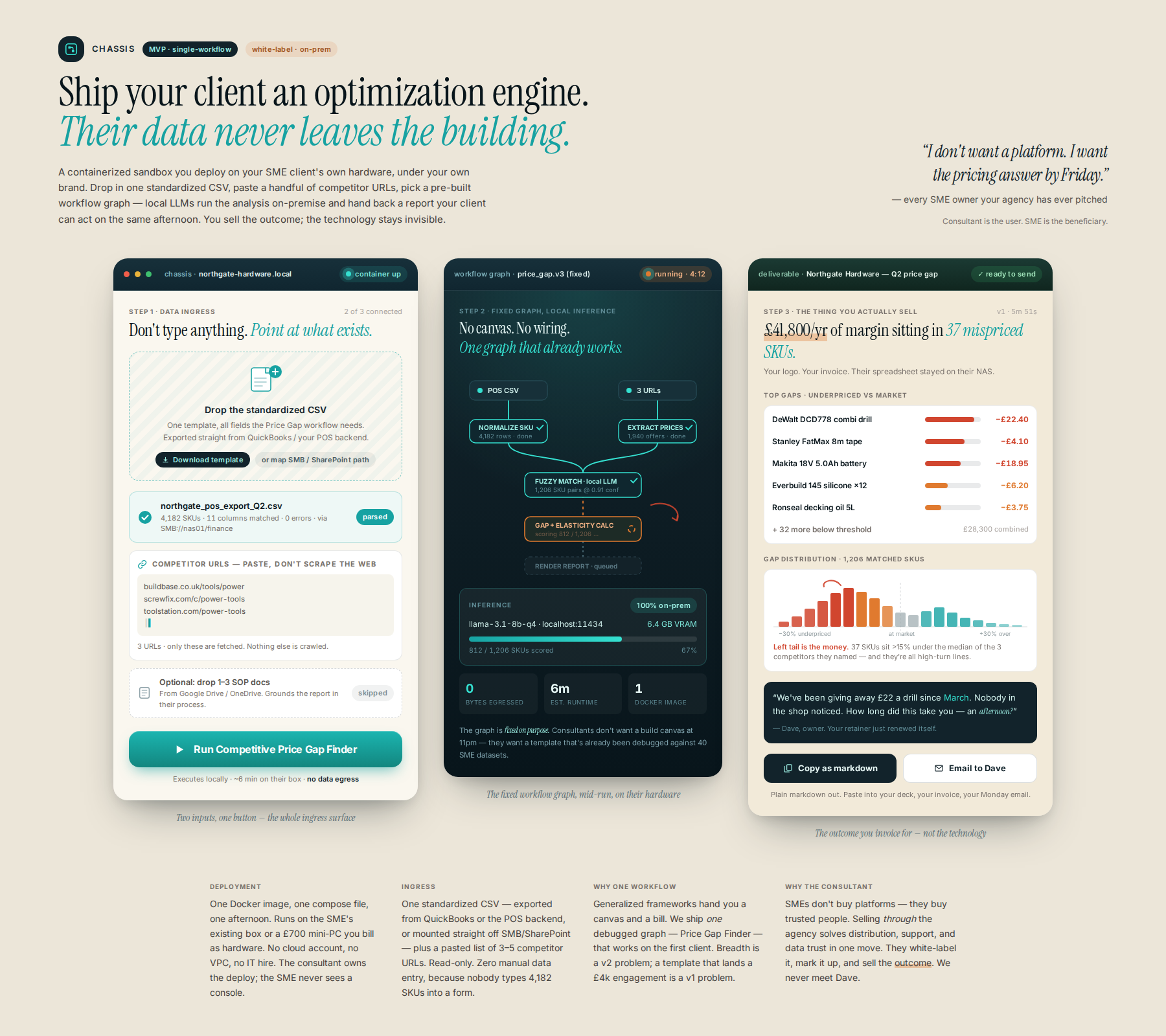
Process flow
Who it's for
Technical Consultants and Digital Agencies serving SMEs.
Why they need it
SMEs are underserved by high-cost data science expertise. By targeting the consultant, we solve the adoption friction: the consultant handles the complex setup (local-first deployment), while the SME benefits from the outcome. This directly addresses the pain that 'Pricing realities of why SMEs cannot afford data-scientists or analytics will become very clear, very quickly.'.
What it is
A minimal viable product (MVP) containerized platform focused on executing one predefined, end-to-end workflow template (e.g., Competitive Price Gap Finder) using the SME's local data, packaged for easy deployment by a technical partner.
How it works
- The Consultant connects the SME's local data sources (e.g., POS data, local web scrapes) to the platform.
- The Consultant selects the pre-built workflow template for the target process.
- The system executes the fixed workflow graph using local/secure LLMs.
- The platform generates a simple, actionable report for the SME, showing immediate optimization opportunities.
- The core value is the 'Managed Deployment' capability for the consultant, who sells the outcome, not the technology.
Differentiation
Unlike generalized visualization tools like 's1' (Earth's Pulse), which are for global, public data, or general LLM frameworks that only manage APIs ('s2', 's3'), our differentiation is twofold: 1) We are purpose-built for proprietary, closed-loop SME data. 2) Crucially, we target the Consultant as the initial user, solving the SME's operational friction by providing a managed, white-label deployment mechanism. We fill the GAP of providing a low-overhead, deployable, multi-agent analytics sandbox through a trusted third party.
Implementation sketch
- Develop a standardized, containerized data connector layer supporting the initial target data source (e.g., SQL/CSV).
- Build a fixed, expert-designed workflow template for the MVP use case (e.g., 3-step pricing analysis: Fetch -> Analyze -> Report).
- Develop a 'Deployment Package' artifact that encapsulates the entire stack, making it deployable by a non-AI engineer (i.e., the consultant).
First step: Draft the technical specification for the 'Deployment Package' artifact. This must define the necessary dependencies and the simplified, single-command execution sequence that a consultant needs to run on a client's machine.
Remaining risks
- The 'Consultant' persona, while solving adoption friction, introduces a significant dependency on the quality and willingness of the third-party technical partner. If consultants are slow to adopt, or if they view the tool as 'just another thing to learn,' the entire go-to-market strategy stalls. — Develop a robust, high-touch onboarding program for the first 10-20 target agencies, providing dedicated technical support and co-developing initial use-case templates with them to build initial trust and proof points.
- The 'Local-First' requirement, even when managed by a consultant, still forces the SME client into managing local compute resources, which can lead to performance instability, dependency hell, or unexpected maintenance costs, eroding the 'low-overhead' promise. — Focus initial deployment on containerization that abstracts away OS-level complexity (e.g., using standardized virtualization layers) and provide a 'Health Dashboard' for the consultant that preemptively flags potential local resource bottlenecks before they impact the client.
- The scope is still narrowly focused on a 'single process' (e.g., Pricing). If the SME's actual highest ROI problem is complex and requires integrating multiple, disparate, non-standard data types (e.g., combining local POS data with manual inventory counts and unstructured supplier emails), the fixed workflow template will fail to capture the true pain point. — Develop a modular 'Data Ingestion Audit' module that, instead of building a full graph, simply maps out all available data sources and flags the necessary connections and transformations required for the target process, thus generating a highly accurate, paid-for 'Next-Stage Blueprint' for the consultant.
Watch for: If initial pilot deployments show that the time required for the consultant to successfully deploy the 'Deployment Package' exceeds 4 hours, the operational overhead is too high, suggesting the technical complexity is still too high for the intended partner. Kill criterion: If the first three paying pilot customers (via different agencies) cannot articulate a clear, measurable ROI improvement directly attributable to the workflow execution (i.e., they attribute success to the consultant's manual expertise rather than the tool's automation), the core value proposition is weak.
Sources the council used
Real-world evidence that grounded this idea — judge it for yourself.