
Local Mesh File Sync for SMBs: Secure Handshake Accelerator (SMB Focus)
A self-contained, local mesh network tool that significantly simplifies the initial connection and secure credential exchange between two or more unmanaged local machines for file sharing, focusing initially on the dominant SMB protocol for small businesses.
How can a small business set up secure file sharing between two computers without manual SMB setup?
A lightweight peer-to-peer sync client can automate the discovery, handshake, and credential exchange between local machines, removing the manual setup burden. It uses mDNS/broadcast to find SMB-capable nodes on the subnet, guides the user through a one-time credential entry stored in an encrypted local vault, and manages the connection and retry logic automatically. This targets small business IT staff managing under 20 users who otherwise face error-prone manual SMB configuration or fall back to insecure cloud workarounds.
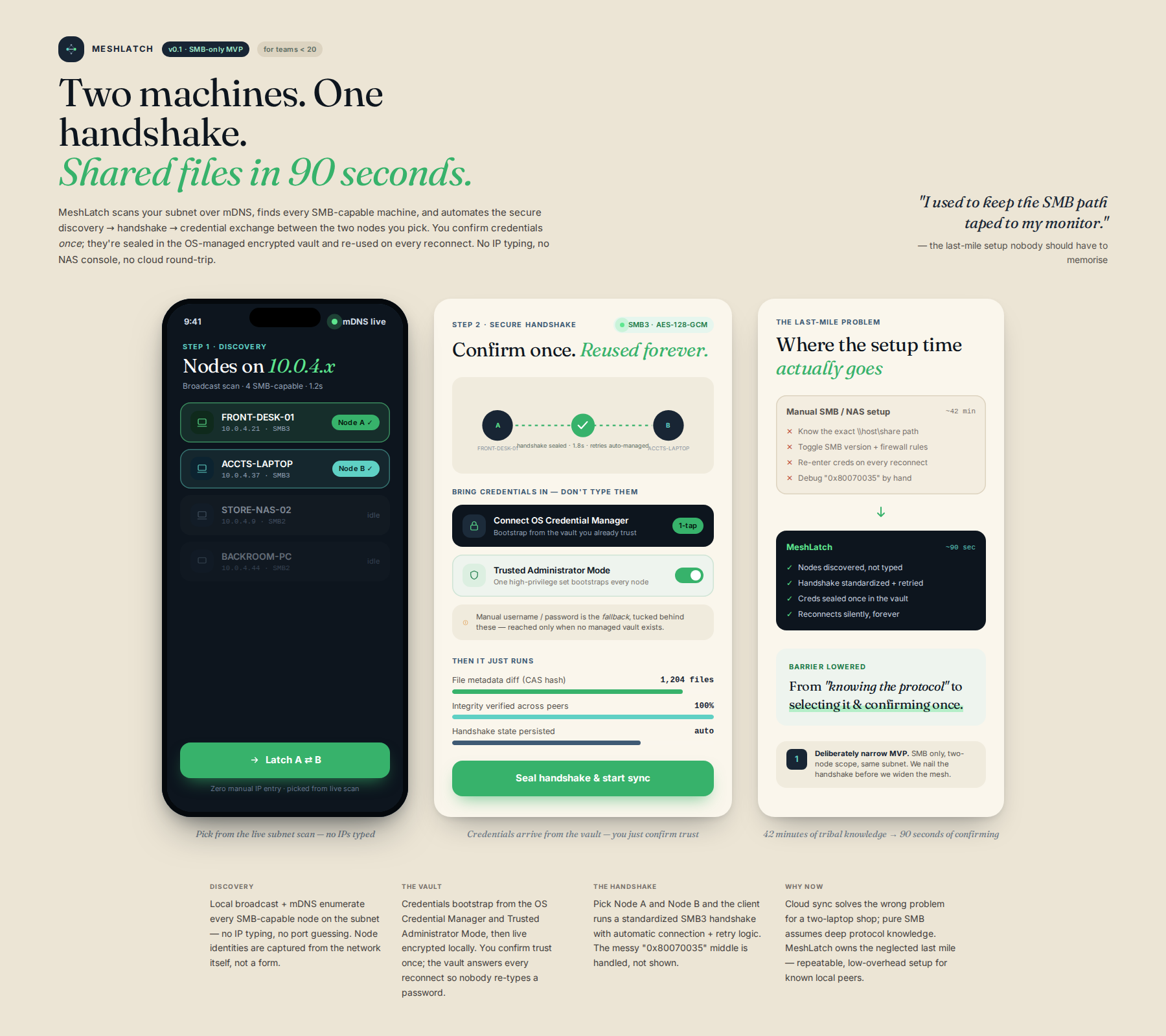
Process flow
Who it's for
Small business IT personnel (<20 users) frustrated by manual, error-prone setup processes for local file sharing.
Why they need it
Users struggle with the initial difficulty of establishing a secure, authorized connection between endpoints—whether it's forgotten credentials or complex pathing—leading to delays and reliance on insecure cloud methods.
What it is
A lightweight, peer-to-peer synchronization client that focuses exclusively on automating the secure discovery, handshake, and credential negotiation between a limited set of known nodes (e.g., two laptops on the same subnet) using SMB as the primary connection method.
How it works
- Scope Reduction: The MVP is strictly limited to SMB connectivity.
- Discovery: Uses local network broadcast/mDNS to discover available SMB-capable nodes on the local subnet.
- Handshake Focus: When a user selects Node A and Node B, the client initiates a standardized handshake.
- Automation: The client guides the user to input SMB credentials once, securely stores them locally (encrypted vault), and manages the connection attempt/retry logic for SMB.
- Transfer: Once the connection is established via SMB, the client wraps the synchronization logic, managing CAS hashing and ensuring data integrity across peers.
Differentiation
Existing solutions are either utility-based cloud sync services or require deep, manual infrastructure knowledge (pure SMB/NAS setup). This tool solves the 'last mile' problem: the secure, repeatable, low-overhead initial setup and credential management for known local connections. It lowers the barrier to entry from 'knowing the protocol' to 'selecting the protocol and confirming credentials once.'
Implementation sketch
- Develop the local discovery mechanism (mDNS/Broadcast) to identify available endpoints on the subnet.
- Build the secure, encrypted local credential vault structure, designed to store SMB credentials.
- Implement the guided handshake flow: User selects Node A and Node B, confirms SMB, inputs credentials, and the client executes the SMB connection attempt/auth sequence, managing failure states.
- Integrate the CAS hashing layer to wrap the established SMB connection for synchronization.
First step: Focus entirely on the credential vault and the SMB discovery/connection attempt. Use Python's smbprotocol library (or similar) to build a minimal proof-of-concept that successfully connects and lists shares between two known IP addresses on the local network, bypassing all UI/UX for this first step.
Remaining risks
- The SMB/Windows authentication model is inherently complex and stateful. Even with a guided wrapper, unexpected network configurations (e.g., firewalls, network segmentation, mixed OS environments) will cause authentication failures that are difficult to diagnose or programmatically recover from. — Limit the initial target environment to a controlled, homogenous subnet (e.g., all Windows 10/11 machines) and focus the MVP solely on the successful credential storage and single-attempt connection flow, deferring complex retry logic and diverse network failure handling.
- The core pain points are derived from low-trust, anecdotal sources (Reddit). This suggests the user need is 'advice' or 'consultation' rather than a specific piece of software, meaning market adoption might stall at the 'too complex to set up' stage. — Do not market this as a standalone product initially. Instead, position it as a specialized diagnostic tool or proof-of-concept utility that IT consultants can use to quickly map out a client's existing network weaknesses, thus monetizing the expertise gap rather than the software itself.
- The synchronization layer (CAS hashing) is only useful if the underlying connection is stable and reliable. If the connection frequently drops or requires re-authentication mid-sync, the CAS layer will fail to maintain state integrity, rendering the entire synchronization feature useless. — De-scope the synchronization feature entirely for V1. The goal must be solely 'Connect and Verify Credentials.' Once stable connection is proven, the next phase must be a simple, single-file transfer confirmation, not full CAS sync.
Watch for: If initial testing reveals that the time spent debugging network connectivity/authentication issues exceeds the time saved by the tool's automation, the technical overhead outweighs the user benefit.
Kill criterion: If the first concrete step (minimal PoC using smbprotocol) fails to establish a connection between two known, standard IP addresses on a standard home/small office network segment without significant, non-trivial workarounds (e.g., needing custom firewall rules or domain joining), the project should be halted and re-evaluated as a consulting service.
Sources the council used
Real-world evidence that grounded this idea — judge it for yourself.