
Intent-Driven Operational Orchestrator for Regulated SMB Workflows
How can AI automate mandatory compliance workflows without errors?
Define your intended outcome (e.g., 'Complete AML client check per KYC guidelines') and let an agent decompose it into discrete, verifiable steps across your core systems. The orchestrator runs the workflow, validates data at each handoff, and generates an audit log proving compliance. This pre-emptive, workflow-level validation ensures mandatory sequences complete correctly without manual coordination.
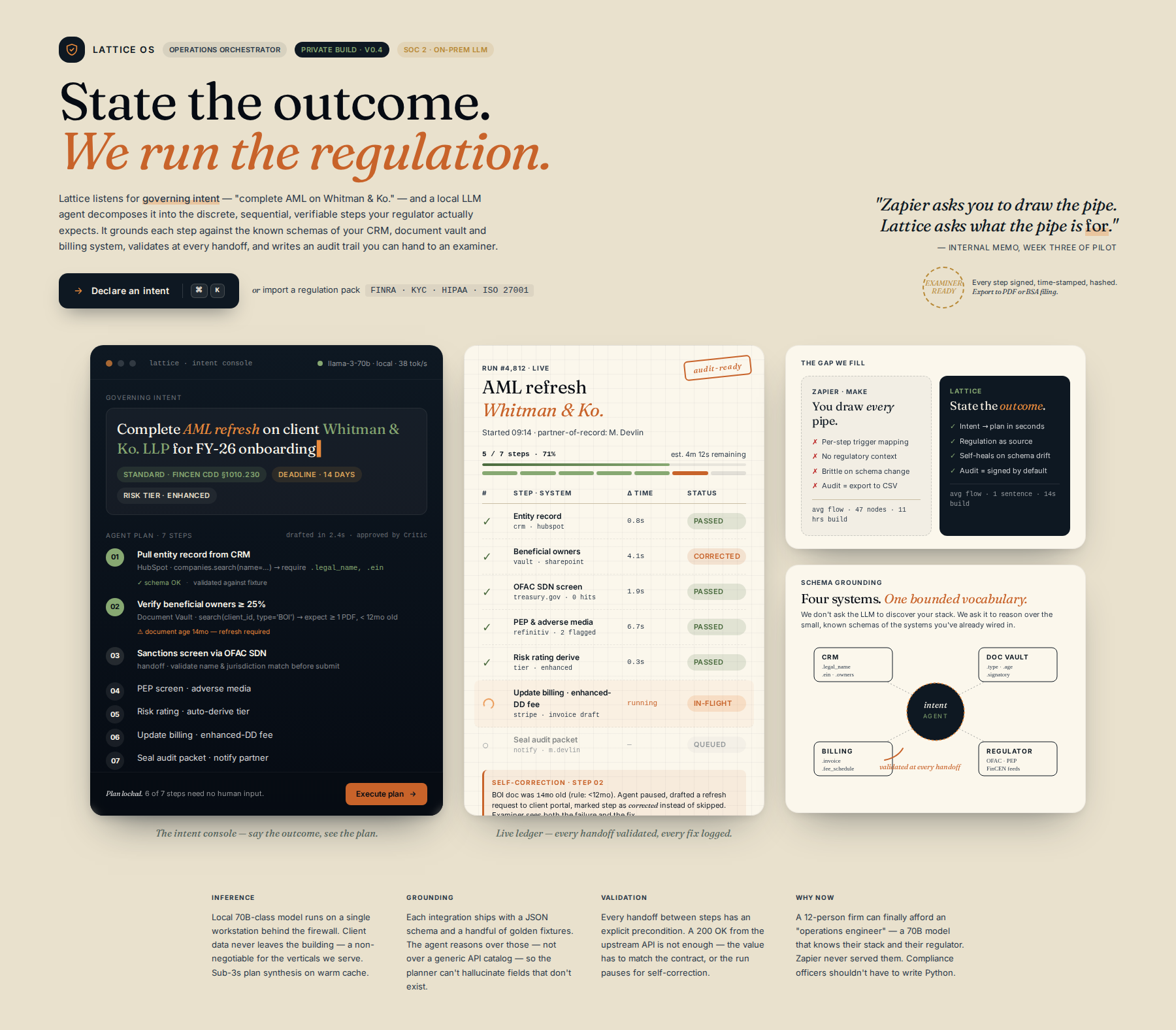
Process flow
Who it's for
Small to medium businesses operating in regulated or highly process-driven industries (e.g., specialized consulting, niche legal, financial services).
Why they need it
These businesses face critical, high-stakes workflows (like compliance reporting or client risk assessment) that require perfect, sequential data validation across multiple systems. Failure leads to regulatory fines or immediate loss of client trust, a pain point more acute than general inefficiency.
What it is
A focused 'AI Operations Orchestrator' that uses local LLM agents to model, plan, and execute mandatory, sequential business workflows defined by regulatory or compliance requirements, abstracting away complex API mapping.
How it works
- User defines the desired outcome and the governing standard (e.g., 'Complete AML Check for Client X' based on KYC guidelines). 2. The system prompts a local LLM agent to decompose this into discrete, verifiable steps. 3. The agent uses natural language grounding over the known, limited schemas of 3-4 core integrated systems (CRM, Document Vault, Billing) to construct the sequence, prioritizing data validation checks at every handoff. 4. The system emphasizes audit logging and self-correction based on explicit validation failure, not just successful API calls.
Differentiation
Unlike general automation tools (Zapier/Make) that require the user to map every step and connection, or general AI wrappers, our system operates on the governing intent ('comply with X regulation') and uses agentic reasoning to build the necessary, industry-specific, verifiable flow dynamically. We solve the problem of mandatory process integrity within a constrained, high-value vertical, filling the gap where general tools lack regulatory context and structured validation.
Implementation sketch
- Select a single, high-stakes, mandatory workflow: 'New Client Onboarding Compliance Check' for a defined niche (e.g., Mortgage Brokers).
- Identify the 3-4 core systems and their required data exchange points for this single workflow.
- Develop the agent layer to plan/execute against these limited schemas, focusing 80% of development effort on robust failure detection and audit trail generation, rather than breadth of connectivity.
- Build the 'Goal Definition' interface to accept the regulation name and client identifier as primary inputs.
First step: Research the specific API documentation/schema requirements for a single, highly regulated process (e.g., KYC verification for a small law firm) to create a highly constrained, demonstrable proof-of-concept workflow map.
Remaining risks
- The 'governing standard' input is too abstract for the agent to reliably interpret into executable steps. If the regulation (e.g., 'KYC guidelines') is complex or ambiguous, the LLM agent may hallucinate required data fields or sequence steps that do not map to reality, leading to a critical compliance failure. — Restrict the initial MVP scope to a single, highly documented, and narrow regulatory checklist (e.g., 'State X's specific requirement for mortgage broker client intake'). The system must fail gracefully and require manual input/confirmation for any step derived from ambiguous regulatory text.
- The reliance on 'local LLMs' for complex reasoning is resource-intensive and slow, leading to poor user experience (UX). SMBs, especially those dealing with time-sensitive compliance, will abandon the tool if the response time is noticeable or if the local model fails to run reliably on standard SMB hardware. — Initially abstract the LLM component behind a managed, cloud-based endpoint for the core reasoning/planning layer, even if the execution layer remains local. This decouples the high-compute reasoning from the deployment hardware constraints, improving perceived performance and reliability for the MVP.
- The '3-4 core integrated systems' assumption is too optimistic. In reality, regulated SMBs often use a patchwork of legacy, poorly documented, or proprietary systems (e.g., old accounting software, niche document repositories) that have no modern, accessible API schema for the agent to ground itself on. — Shift the initial technical focus away from API integration and toward a data ingestion/schema normalization layer. The agent should first ingest and model the required data structure from the source, and then attempt to map it to the target system, treating the integration as a data transformation problem rather than a direct API call sequence.
Watch for: Any signal that the target SMBs are more concerned with the data input (e.g., manual document uploads, PDF parsing) than the workflow orchestration itself. If they are willing to solve the data collection problem manually, the value proposition of the 'orchestrator' diminishes. Kill criterion: If the first three pilot customers cannot articulate a single, mandatory, sequential workflow that involves at least three distinct, modern, API-accessible systems, the core premise of 'orchestration' fails, and the product must pivot to a pure data validation/audit tool.
Sources the council used
Real-world evidence that grounded this idea — judge it for yourself.