
Contextual Workflow Planning Engine for Niche Professional Services (MVP)
A specialized AI layer that ingests a single vertical's operational data and proactively *plans* the next best automation workflow, moving beyond simple task connections by building a deep, localized operational context graph.
How can a single-vertical business automate multi-step operational workflows across siloed SaaS tools?
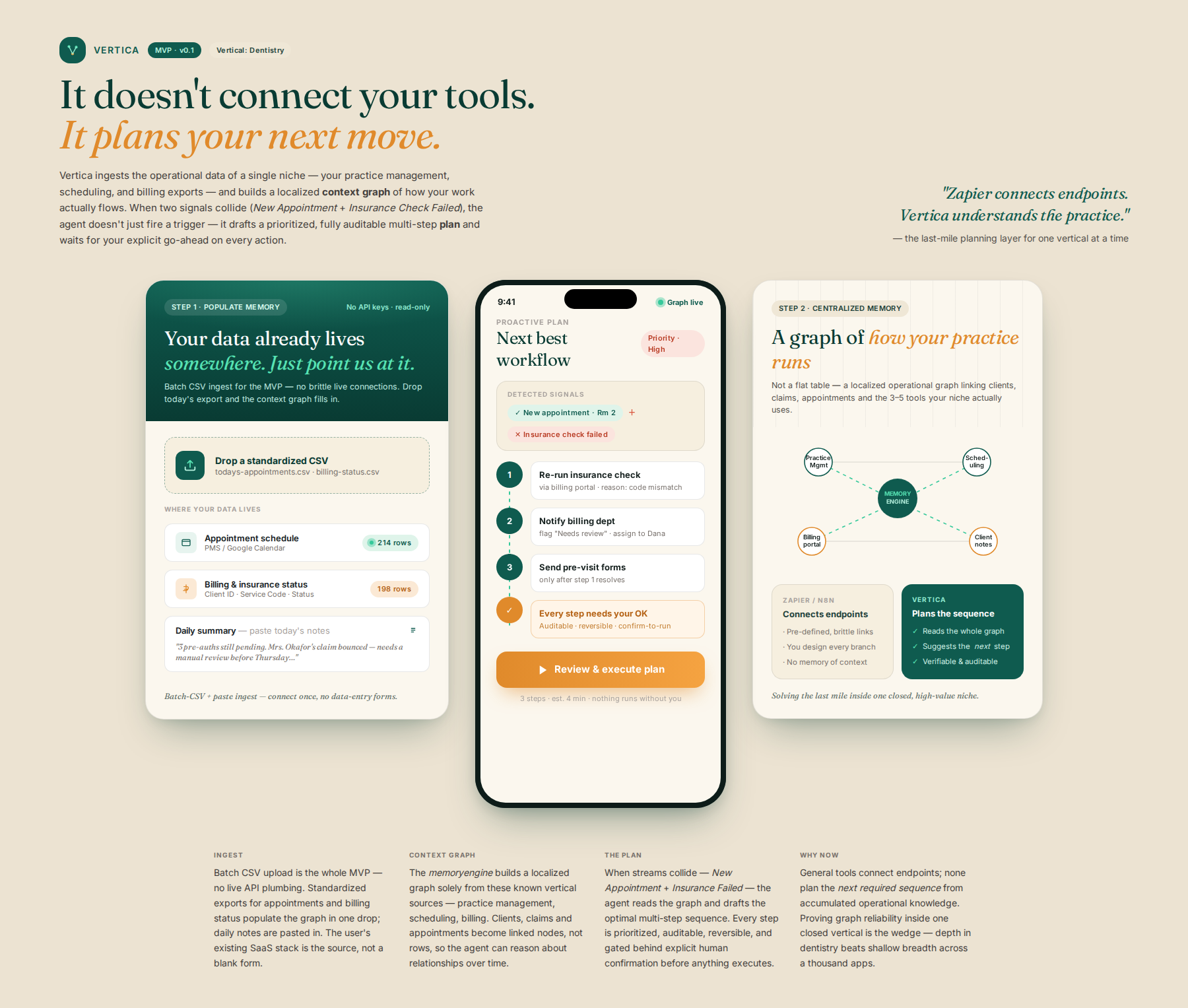
A domain-specific AI planning layer can do this by building a 'context graph' from read-only integrations with the 3-5 core tools a niche already uses (e.g., practice management, scheduling, billing software). It watches for event combinations like a new appointment plus a failed insurance check, then proposes a prioritized, auditable multi-step workflow requiring explicit user confirmation at each stage. This targets small operators in tightly defined niches, such as independent dental practices or local real estate firms, whose processes are too specific for general automation tools like Zapier.
Process flow
Who it's for
Small business owner/operator within a highly defined, interconnected niche (e.g., independent dental practices, local real estate firms).
Why they need it
These niche businesses have complex, multi-stage operational processes that are currently managed via siloed tools. They need guidance on optimizing their entire workflow lifecycle, but existing general tools are too broad and lack the deep contextual understanding of their specific industry needs.
What it is
A focused, context-aware orchestration engine designed for a single vertical. It connects the core SaaS tools used only within that niche, forming a 'Centralized Memory' of industry-specific processes and past client interactions.
How it works
- Vertical Focus: Select one high-signal vertical (e.g., dentistry). Identify the 3-5 core, interconnected SaaS tools used by that vertical (e.g., Practice Management Software, Scheduling, Billing).
- Integration MVP: Build deep, bespoke read-only integrations for these known tools to pull data into the context graph.
- Memory & Agent: Use the 'memoryengine' to build the context graph solely from these known sources. The agent analyzes incoming data streams (e.g., 'New Appointment Scheduled' + 'Insurance Check Failed') against the graph.
- Proactive Plan Generation: The agent determines the optimal, multi-step workflow (e.g., 'Check Insurance -> Notify Billing Dept -> Send Pre-Visit Forms') and generates a prioritized, fully auditable plan that requires explicit, multi-step user confirmation for every action.
Differentiation
Unlike general-purpose tools (Zapier/n8n) that require pre-defined, brittle connections, or directory listings, this system acts as an intelligent, domain-specific process planner. It solves the 'last mile' problem by proving context graph reliability within a closed, high-value ecosystem. The gap is the lack of a proactive, verifiable planning layer that interprets accumulated operational knowledge to suggest the next required sequence of steps, rather than just connecting existing endpoints.
Implementation sketch
- Phase 1 MVP: Select the Dental vertical. Integrate with 3 known PMS tools to pull read-only data. Build the memory graph for 'Patient Intake to Treatment Plan Generation'.
- Phase 2: Develop the agent to generate a prioritized, multi-step plan based on graph triggers, presenting it to the user for explicit confirmation.
- Phase 3: Build a dashboard visualizing process bottlenecks and suggesting optimal workflow modifications based on historical data patterns.
First step: Identify 3-5 key, documented data endpoints (APIs or CSV exports) from the target niche's primary SaaS tools (e.g., the top 3 PMS systems for dentists) and map out the data flow for a single, critical user journey (e.g., 'New Appointment booked').
Remaining risks
- Data Schema Drift and Maintenance Overhead (Technical Debt) — Establish a formal, paid 'Data Integration Audit' service as a premium tier. Instead of treating integrations as a fixed cost, price them as ongoing maintenance contracts based on the complexity and rate of change of the connected SaaS APIs. This turns a technical liability into a predictable, recurring revenue stream.
- User Inertia and Over-Reliance on Manual Confirmation (Adoption Risk) — Design the UI/UX to guide the user toward trusting the system over time. Implement a 'Confidence Score' or 'Automation Maturity Level' dashboard that visually shows how many times the system has successfully predicted the next step correctly. Gamify the process of accepting suggestions to build habit and reduce cognitive load over time.
- Niche Specificity Trap (Scalability Ceiling) — Develop a 'Meta-Integration Layer' or 'Integration Blueprint' module. Instead of building bespoke code for every new vertical, build a framework that requires the client to provide a standardized data dictionary and a small set of sample data, allowing the system to generate the initial integration scaffolding for a new vertical much faster than building from scratch.
Watch for: If the target niche users consistently bypass the plan generation feature and revert to manual, external process mapping tools (e.g., flowcharts on paper or spreadsheets) when the system suggests a plan, it indicates the perceived value of the suggestion is lower than the effort required to validate it. Kill criterion: If, after 6 months of focused development on the MVP niche, the system cannot reliably generate a plausible, multi-step plan (even if requiring user confirmation) for the core 'Patient Intake to Treatment Plan Generation' journey due to fundamental, unresolvable data gaps between the 3-5 core SaaS tools.
Sources the council used
Real-world evidence that grounded this idea — judge it for yourself.