AI-Driven Specification Refinement Engine for Multi-Agent Workflows
A specialized, state-managing platform that elevates the development workflow by autonomously generating precise, minimal, and necessary requirement specifications derived directly from observed code failures.
Why do AI coding agents keep patching code instead of fixing the actual requirement?
Because most agent workflows treat every test failure as a code bug, when many failures actually reveal an incomplete or ambiguous specification. A specification refinement approach addresses this by having a dedicated agent read the failure evidence (e.g., a stack trace) against the current spec and output a precise amendment, such as a missing null-input constraint, which then flows back to update the canonical requirements before the workflow re-runs. This is aimed at developers building multi-agent systems who waste cycles debugging symptoms instead of correcting the root requirement gap.
Process flow
Who it's for
Developers building complex, multi-agent AI systems who struggle to translate runtime failures back into precise, actionable engineering specifications.
Why they need it
Current agent workflows fail because the gap between 'code failure' and 'root cause specification' is too large. Developers waste time debugging code when they actually need to refine the initial understanding or requirements that led to the failure.
What it is
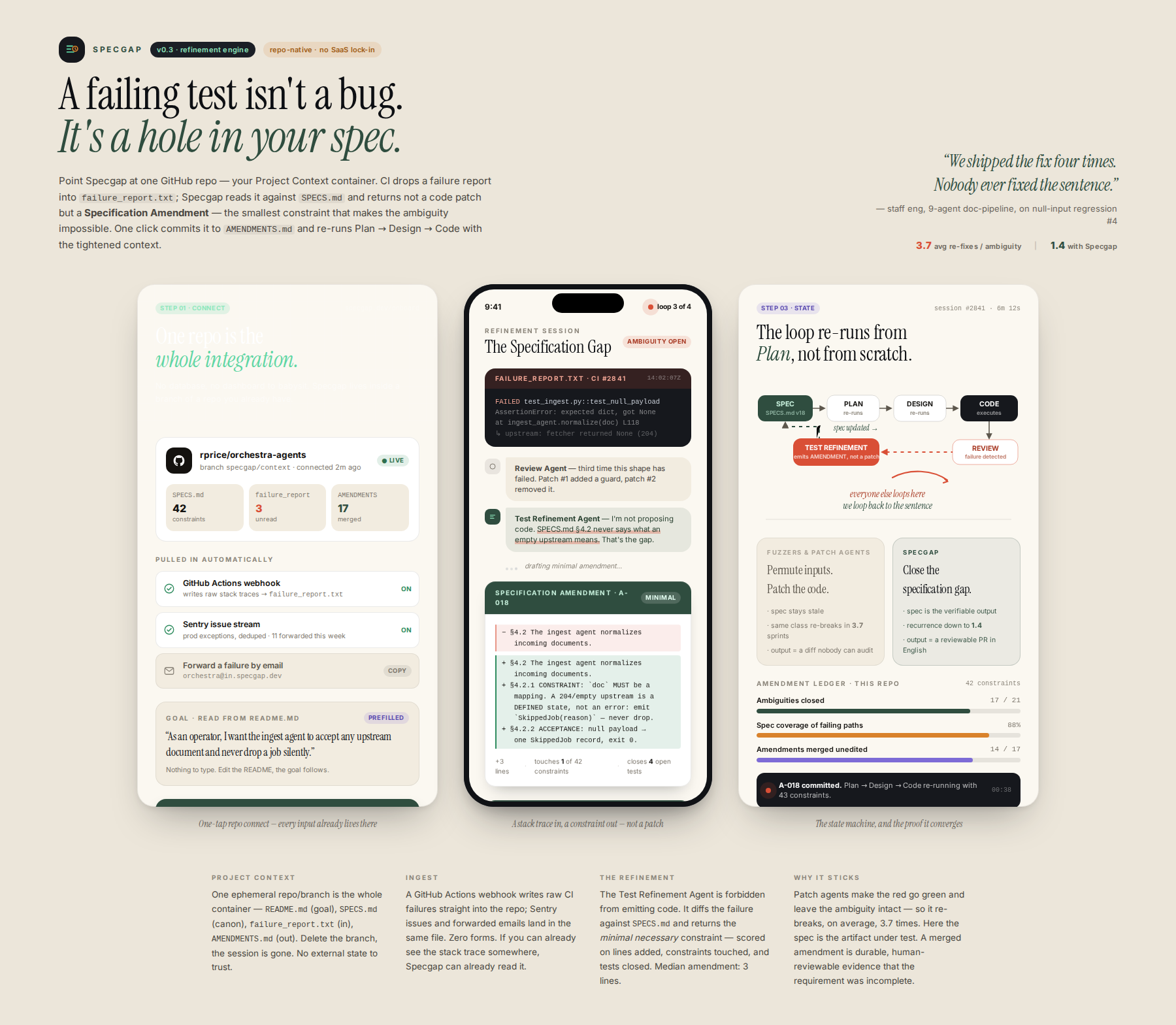
A visual, stateful environment that ingests a failure report (e.g., a stack trace or failed assertion) and iteratively generates the most precise, minimal, and necessary specification update required to resolve the underlying ambiguity, effectively closing the loop between testing and requirement definition.
How it works
- User inputs a high-level goal/User Story.
- The system runs the initial workflow (Spec -> Plan -> Design -> Code) to generate an initial artifact.
- The Code Agent executes, and the Review Agent detects a failure (e.g., 'Function fails when input is null').
- (CORE FOCUS) The Test Refinement Agent ingests the failure report and the current specification, and instead of suggesting a code fix, it outputs a Specification Amendment (e.g., 'Constraint: Input X must never be null; Update Spec: Add validation for null inputs').
- This Amendment is fed back to the Spec Agent, which updates the canonical requirements, causing the entire workflow to re-run from the Plan/Design stage with the refined context. This cycle continues until the test passes or the ambiguity is deemed resolved by the user.
Differentiation
Unlike general purpose SDLC tools or traditional fuzzing engines, which focus on input permutation or code patching, this platform focuses exclusively on the Specification Gap. It bridges the gap between runtime failure and specification ambiguity. It surpasses current state-of-the-art agents by treating failure not as a bug to be fixed, but as direct, verifiable evidence of an incomplete or flawed initial requirement, thus making the specification itself the primary, verifiable output of the refinement loop.
Implementation sketch
- Build the foundational state machine, ensuring the state tracks not only code versions but also the 'Current Canonical Specification' and 'Failure Evidence Log.'
- Develop the Test Refinement Agent: Train/prompt it specifically on the task of translating structured failure data (stack trace + input) into formal, unambiguous natural language constraints.
- Create a simple web UI visualizing the feedback loop: [Failure Report] -> [Agent Output: Spec Amendment] -> [Workflow Rerun] -> [Success/New Failure].
- Initial Focus: Build a proof-of-concept that takes a simple Python function failing on a single edge case (e.g., division by zero) and outputs the precise requirement amendment needed to prevent it.
First step: Implement a minimal Python module where a hardcoded function fails deterministically (e.g., 1/0). Write a prompt chain that takes the traceback object and outputs a single, precise requirement sentence that, if added to the function's docstring/preamble, would prevent the failure.
Remaining risks
- The 'Specification Amendment' agent may hallucinate or generate specifications that are technically correct but logically contradictory or impossible to implement within the existing system constraints. — Implement a secondary 'Plausibility Checker' agent that cross-references the proposed amendment against the existing Plan/Design artifacts and known system constraints (e.g., 'This constraint requires a database schema change, but the Plan Agent hasn't been triggered to update the schema').
- The system's state management becomes brittle and computationally expensive. As the refinement loop iterates, the context window bloats with failure reports, previous specifications, and amendments, leading to context drift and degraded performance. — Implement aggressive, state-aware summarization techniques (e.g., recursive summarization or memory compression) that distill the net change in the specification and the cumulative failure pattern rather than retaining every single piece of evidence.
- The system fails to distinguish between a true specification gap (ambiguity) and a genuine implementation bug (a coding error). If the Test Refinement Agent cannot reliably classify the failure source, the entire loop breaks into unproductive cycles. — Require human sign-off or a specific 'Classification Confidence Score' from the Test Refinement Agent. If the confidence score is below a threshold, the system must halt and force the user to manually classify the failure source (Bug vs. Ambiguity).
Watch for: If the initial, simple PoC (e.g., division by zero) requires more than two iterations to generate a specification that passes the test, the complexity of the underlying reasoning gap is likely too large for the current prompt engineering approach. Kill criterion: If the system requires the user to manually correct the output format of the Specification Amendment agent more than 30% of the time, it indicates the agent is not mastering the translation from structured failure evidence to formal specification language.
Sources the council used
Real-world evidence that grounded this idea — judge it for yourself.