
Weekly Research Vector Digest Agent
An autonomous agent system that ingests, filters, and synthesizes deep, actionable insights from Hacker News streams, structuring them into potential research vectors for deep work.
How can researchers keep up with fast-moving technical discussions across niche communities like Hacker News?
A weekly digest agent can synthesize scattered technical discussions into structured research directions rather than simple summaries. It ingests Hacker News threads over a set period, extracts entities and relationships (e.g., 'X conflicts with Y,' 'Z enables A') using an agent pipeline paired with a clustering-focused memory engine, then outputs 3-5 'research vectors' highlighting gaps, contradictions, and cross-domain connections worth investigating. It's built for researchers, engineers, and domain experts who need to synthesize cross-disciplinary signal from high-volume, unstructured sources without manually reading every thread.
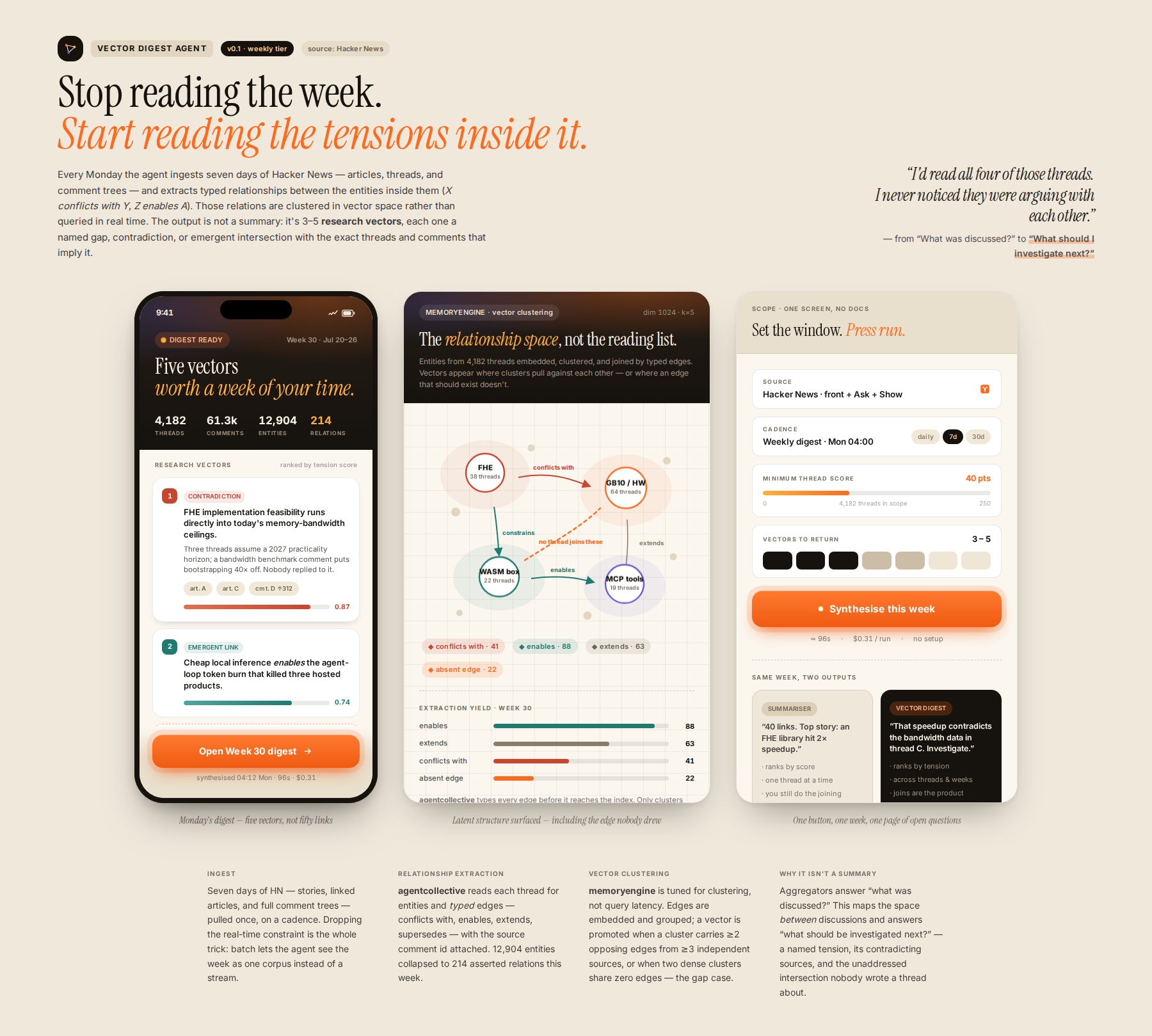
Process flow
Who it's for
Researchers, engineers, and technical domain experts who need to synthesize cross-disciplinary knowledge from high-volume, unstructured sources.
Why they need it
Experts are overwhelmed by the sheer volume of niche, high-signal technical discussions on HN, making it difficult to track emerging, cross-domain research trends. They need a structured digest that synthesizes potential next steps or conflicting research angles, not just summaries.
What it is
A 'Research Vector Digest Agent' that processes HN content over a defined period (e.g., weekly), builds a conceptual map of intersecting topics, and outputs a digest focused on synthesizing 'potential research vectors'—identifying gaps, contradictions, and emergent connections between disparate discussions.
How it works
- Scope Reduction: The agent operates on a digest cadence (e.g., weekly), removing the 'real-time' constraint.
- Focus Shift: The goal shifts from real-time knowledge graph maintenance to structuring latent connections.
- Process: The agent ingests articles/threads, uses 'agentcollective' to extract key entities and relationship types (e.g., 'X conflicts with Y,' 'Z enables A'), and feeds this into a 'memoryengine' optimized for vector clustering and relationship extraction, rather than real-time querying.
- Output: The digest explicitly presents 3-5 'Research Vectors': 'Vector 1: The tension between FHE implementation feasibility and current hardware constraints (Articles A, C, and comment D suggest this).' This is a structured, actionable synthesis, not a summary.
Differentiation
Unlike simple aggregation tools or basic summarizers (e.g., s1), this agent focuses on structural synthesis. It doesn't just tell you what was said; it proactively maps the relationship space between topics discussed across multiple articles/timeframes, identifying emergent research tensions and unaddressed intersections. We move from 'What was discussed?' to 'What should be investigated next?' by structuring the relationships, a capability beyond mere summarization.
Implementation sketch
- Adapt 'agentcollective' to consume and process content in batch/weekly cycles, allowing for deep, computationally intensive graph construction.
- Refine 'memoryengine' to specialize in relationship extraction (triples) and clustering across diverse, time-separated inputs, rather than real-time state tracking.
- Develop a scoring mechanism focused on Structural Significance: Weight = (Number of unique intersecting entities) * (Degree of conceptual conflict identified) / (Entropy of sources). High scores flag potential research vectors.
First step: This week, prototype the entity extraction pipeline by running the 'agentcollective' logic against a fixed, small corpus of 20 high-signal, related HN threads (e.g., all threads tagged 'FHE' from the last month) and manually defining the desired output structure (e.g., JSON triples: {Entity A, Relationship, Entity B}). This validates the relationship extraction component without needing the full streaming architecture.
Remaining risks
- The structural significance scoring mechanism is brittle and over-engineered. The defined formula (Weight = (Number of unique intersecting entities) * (Degree of conceptual conflict identified) / (Entropy of sources)) is highly subjective, difficult to tune, and may fail to capture genuine, subtle connections that a human expert would intuitively grasp. — Instead of optimizing for a complex, multi-variable score, initially constrain the output to a simpler, verifiable metric: 'Top 3 most frequently co-occurring, but not explicitly linked, entity pairs' derived from the corpus, providing a clear, measurable starting point for validation.
- The core value proposition relies on the assumption that 'conceptual conflict' is a consistently identifiable pattern in unstructured text. If the source material (HN) is predominantly descriptive or merely reporting on established facts, the agent will generate spurious 'vectors' based on weak linguistic correlations, leading to user distrust. — Implement a mandatory 'Conflict Confidence Score' alongside the vector output. If the agent cannot confidently assign a conflict or gap (e.g., score < 0.7), it must default to presenting the topic as 'Emergent Cluster' (a list of related concepts) rather than a 'Tension Vector,' managing user expectations.
- The 'Who' target audience (Researchers/Engineers) is highly specialized and requires extremely high signal-to-noise ratios. If the initial corpus testing (the first concrete step) reveals that the signal is too diffuse or requires too much manual post-processing, the entire premise collapses under the weight of required human effort. — Pivot the initial target use case from 'general research synthesis' to a single, narrow, high-signal domain (e.g., 'LLM Fine-Tuning for Scientific Text') for the first 3 months. This limits the scope of the knowledge graph build, making the initial success metric achievable and demonstrable.
Watch for: If early user feedback repeatedly suggests the digest is 'interesting but requires manual cross-referencing anyway,' it indicates the structural synthesis is merely a sophisticated summary, not a true insight generator. Kill criterion: If the agent consistently fails to improve the user's time-to-insight compared to a human expert reading the raw HN threads (measured by a dedicated user study), the concept lacks sufficient technical moat and should be re-scoped to a pure content filtering tool.
Sources the council used
Real-world evidence that grounded this idea — judge it for yourself.