
Automated Parameter Mapping for Niche Benchmark Validation
A specialized, local-first agent pipeline that automatically extracts required input parameters and constraints from academic papers and maps them directly into the standardized API/input schema of a single, established, open-source benchmark suite (e.g., a specific lattice sampling routine).
How do I validate cryptographic claims against benchmarks automatically?
A CLI pipeline extracts required input parameters from academic papers and maps them directly into standardized benchmark APIs. Instead of manually formatting parameters for API calls, the system uses fine-tuned agents to identify numerical parameters and schema-map them to exact JSON required by benchmark endpoints. The output is a fully formed, validated payload ready for benchmark execution, automating the entire Text→Parameter→API pipeline.
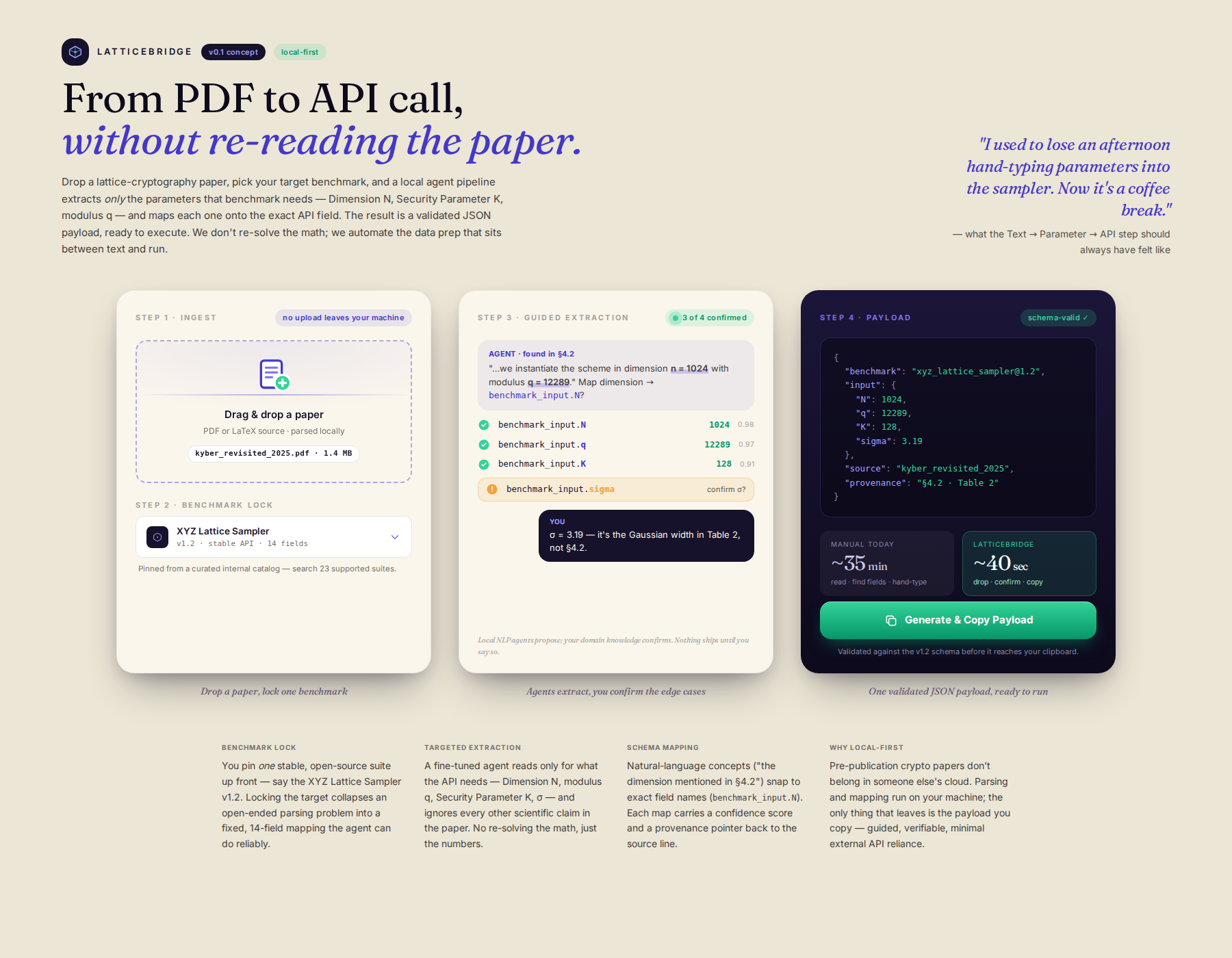
Process flow
Who it's for
AI Security Researchers, Cryptography Teams, and Academia focused on Quantum-Resistant Algorithms.
Why they need it
Validating novel cryptographic claims requires executing against established, reproducible benchmarks. The gap is the manual, error-prone process of translating abstract parameter sets described in PDF text into the precise, structured inputs required by existing, complex, domain-specific benchmark APIs.
What it is
A focused agent framework that ingests papers, uses targeted NLP/LLM agents to identify numerical parameters and constraints relevant to a pre-selected benchmark (e.g., 'Dimension N', 'Security Parameter K'), and then structures this data into a verifiable JSON payload ready for execution against the target benchmark's API.
How it works
- Benchmark Lock: Select one specific, stable, open-source benchmark (e.g., the 'XYZ Lattice Sampler v1.2' API). 2. Targeted Extraction: Fine-tune an agent to read the paper and output only the parameters needed for the XYZ API, ignoring all other scientific context. 3. Schema Mapping: Implement a structured module that maps the extracted natural language concepts (e.g., 'the dimension mentioned') to the exact field names required by the benchmark API (e.g.,
benchmark_input.N). 4. Pipeline Output: The final output is a fully formed, validated JSON payload ready to be passed directly to the external benchmark execution environment.
Differentiation
Unlike general literature review tools, our system does not attempt to re-solve the math; it automates the data preparation step. Existing solutions require the researcher to manually read the paper, identify the benchmark, and then manually format the parameters into the required API call. Our system automates the entire 'Text $ ightarrow$ Parameter $ ightarrow$ API Call' pipeline.
Implementation sketch
- Select and fully document the input schema and API requirements for one target benchmark (e.g., XYZ Lattice Sampler).
- Develop a small, highly constrained fine-tuning dataset of 10-20 examples pairing 'Text Snippet' $ ightarrow$ 'Required JSON Parameter Set' for that single benchmark.
- Build a basic pipeline wrapper that accepts a PDF path and attempts to generate the required JSON payload by querying the fine-tuned model.
First step: Select the single target benchmark (e.g., 'XYZ Lattice Sampler v1.2') and obtain its official, documented API specification (JSON schema required).
Remaining risks
- Ambiguity in Parameter Extraction: Even with a locked benchmark, the natural language descriptions of parameters in academic papers can be inherently ambiguous, vague, or use non-standard terminology that the fine-tuned model cannot resolve into the exact required JSON schema values. — Develop a confidence scoring layer that flags any extracted parameter whose semantic context is not strongly correlated with the target schema. This forces the output to be 'Uncertain' rather than generating a potentially incorrect, but syntactically correct, JSON payload.
- API/Schema Drift: The target benchmark suite (XYZ Lattice Sampler) is external and maintained by others. If the benchmark provider updates its API schema, changes required data types, or deprecates fields, the entire system breaks immediately without warning. — Build a robust 'Schema Watchdog' module that periodically attempts to validate the connection against the documented API endpoint. The MVP must include a manual, documented process for updating the schema mapping layer when drift is detected.
- Contextual Dependency Failure: The paper might mention a parameter that is logically necessary for the benchmark but is described in a context that is too far removed or too complex for the current targeted NLP model to link correctly (e.g., 'Given the security context established in Section 3.1, the dimension must be...'). — Instead of solely relying on the LLM to extract parameters, integrate a preliminary, lightweight graph-based dependency checker that maps explicit cross-references (e.g., 'as shown in Figure 2') to potential parameter sources, reducing the reliance on pure semantic extraction.
Watch for: Any instance where the required parameter for the target benchmark (XYZ) is described using analogies, conceptual arguments, or mathematical proofs rather than explicit, quantifiable statements (e.g., 'The complexity scales with $N^3$'). This indicates the input source is too far from the required structured data. Kill criterion: If the system fails to successfully map parameters from three different, high-quality, peer-reviewed papers targeting the same benchmark API, it indicates that the gap is not merely 'automation' but a fundamental, unresolvable gap in the semantic structure of the source material relative to the target API.