
Local Agent Platform for Causal Hypothesis Generation in Drug Repurposing
A local-first, intelligent agent framework designed to autonomously map and validate complex causal pathways between disparate findings in unstructured biomedical literature, directly addressing manual bottlenecking in drug discovery.
How can I map causal drug mechanisms across research papers?
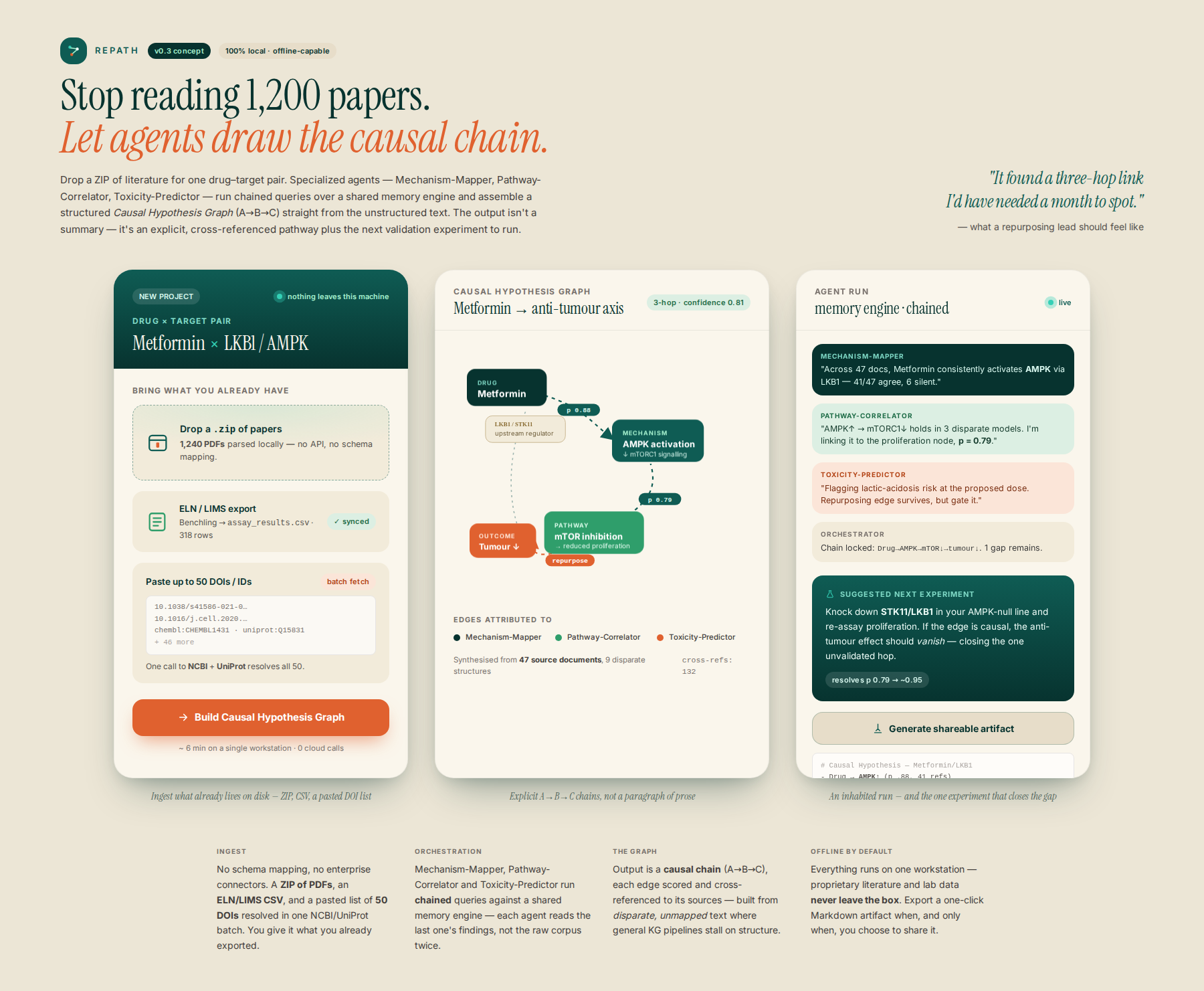
A local-first agent platform autonomously maps complex causal pathways between disparate biomedical literature findings, eliminating the 40+ hours of manual cross-referencing per hypothesis set. Specialized agents extract entities and relationships from raw papers, constructing structured Causal Hypothesis Graphs that visualize drug repurposing links. The output includes suggested validation experiments, transforming literature review into structured, actionable hypothesis generation.
Process flow
Who it's for
Senior computational biologists and pharmaceutical R&D teams utilizing structured lab informatics (ELN/LIMS).
Why they need it
To eliminate the massive, unquantified bottleneck of manually cross-referencing mechanistic data points across multiple papers to build testable hypothesis graphs, which currently consumes dozens of senior scientist hours per project.
What it is
A modular, offline-capable agent orchestration platform specialized for deep relational extraction. It moves beyond mere summarization to construct structured, cross-referenced 'Causal Hypothesis Graphs' detailing potential drug repurposing links.
How it works
Users upload raw papers (PDFs, articles) related to a specific drug/target pair. Specialized agents (e.g., 'Mechanism-Mapper', 'Pathway-Correlator', 'Toxicity-Predictor') execute targeted, chained queries using a 'memoryengine' context. The output is a visual, structured graph that explicitly maps the required causal links and suggests the next necessary validation experiment, rather than just text summaries.
Differentiation
Our focus is on computational hypothesis generation by deriving causal chains ($ ext{A} ightarrow ext{B} ightarrow ext{C}$) from disparate, unstructured text inputs. Unlike general knowledge graph databases or commercial KG ingestion pipelines (which require structured schema mapping), our agents are specifically prompted to build these chains directly from raw literature, addressing the gap where existing tools fail to synthesize relationships across fundamentally different, unmapped source document structures. (Cites gap relative to general KG solutions).
Implementation sketch
- Week 1: Prototype the core 'Agent Collective' workflow on the drug repurposing domain (Mechanism $ ightarrow$ Target) using a small, controlled dataset of 3-5 papers.
- Week 2: Integrate the 'memoryengine' to maintain context across 10+ documents while tracking specific causal assertions, focusing on structured output parsing.
- Week 3: Develop the Causal Hypothesis Graph visualization, including flagging weak links and suggesting next validation steps.
- Week 4: Develop a minimal API wrapper prototype demonstrating ingestion and visualization hooks for a standard ELN/LIMS system to prove immediate operational integration potential.
First step: Identify 3-5 academic papers related to the '3eb41e5d35fe9cf3' vault item. Use a local LLM instance to run a small-scale, multi-agent extraction test to map 3 explicit causal links, documenting the exact prompt engineering required for the 'Mechanism-Mapper' agent.
Remaining risks
- Regulatory/Compliance Overhead: Operating within regulated environments (Pharma R&D) requires stringent validation, data provenance tracking, and audit trails (e.g., FDA/GxP compliance). The current 'local-first' focus, while addressing data privacy, might fail to account for the necessary, complex, and time-consuming validation documentation required for regulated use. — From the outset, architect the system to generate a 'Compliance Manifest' alongside the Hypothesis Graph. This manifest must automatically log the provenance (which agent, which prompt, which input chunk) for every derived causal link, mapping directly to standard audit requirements.
- Domain Specificity Drift: The current focus is highly specialized (Drug Repurposing $ ext{A} ightarrow ext{B}$). If the system is later applied to a slightly different domain (e.g., toxicology screening or metabolic pathway analysis), the specialized agents might fail due to subtle shifts in terminology or required causal logic, leading to brittle performance. — Implement a meta-agent 'Domain Adaptor' layer. This agent's sole job is to ingest the target domain's core ontology (e.g., GO terms, KEGG pathways) and dynamically adjust the prompt templates and extraction rules for the specialized agents before running the primary workflow.
- Integration Friction at Scale: While the plan addresses API hooks, the actual integration into legacy, proprietary lab informatics systems (ELN/LIMS) often involves undocumented APIs, decades-old infrastructure, and non-standard data formats that are resistant to modern wrappers. The integration effort could balloon far beyond the budgeted 'Week 4' scope. — De-risk the integration by focusing the initial pilot not on full integration, but on data exchange simulation. Prove the ability to export the structured graph data into the exact format (e.g., CSV, JSON schema) that the target LIMS system expects to receive, minimizing the need for deep, real-time bidirectional API calls initially.
Watch for: If the initial 3-5 paper test reveals that the necessary causal links are inherently contradictory across sources, or if the agents cannot resolve these contradictions into a clear 'Weak Link' flag, the core value proposition of 'validation' collapses into mere 'reporting of conflict.' Kill criterion: If the specialized agents consistently fail to derive a novel causal chain ($ ext{A} ightarrow ext{B} ightarrow ext{C}$) that is not already explicitly stated or trivially derivable from the input documents, the system is merely an advanced search/summarization tool, not a true hypothesis generator.