
Local LLM Sandbox for Adversarial Hypothesis Generation in Vulnerability Disclosure
How do I identify more attack vectors when analyzing security vulnerabilities?
An AI agent can systematically generate testable hypotheses by analyzing vulnerability proof-of-concepts and mapping related attack surfaces. The system synthesizes structured, plausible next steps for expert human validation, saving time spent manually mapping adjacent failure modes. This complements traditional tools like formal verification by augmenting human expertise with structured hypothesis generation.
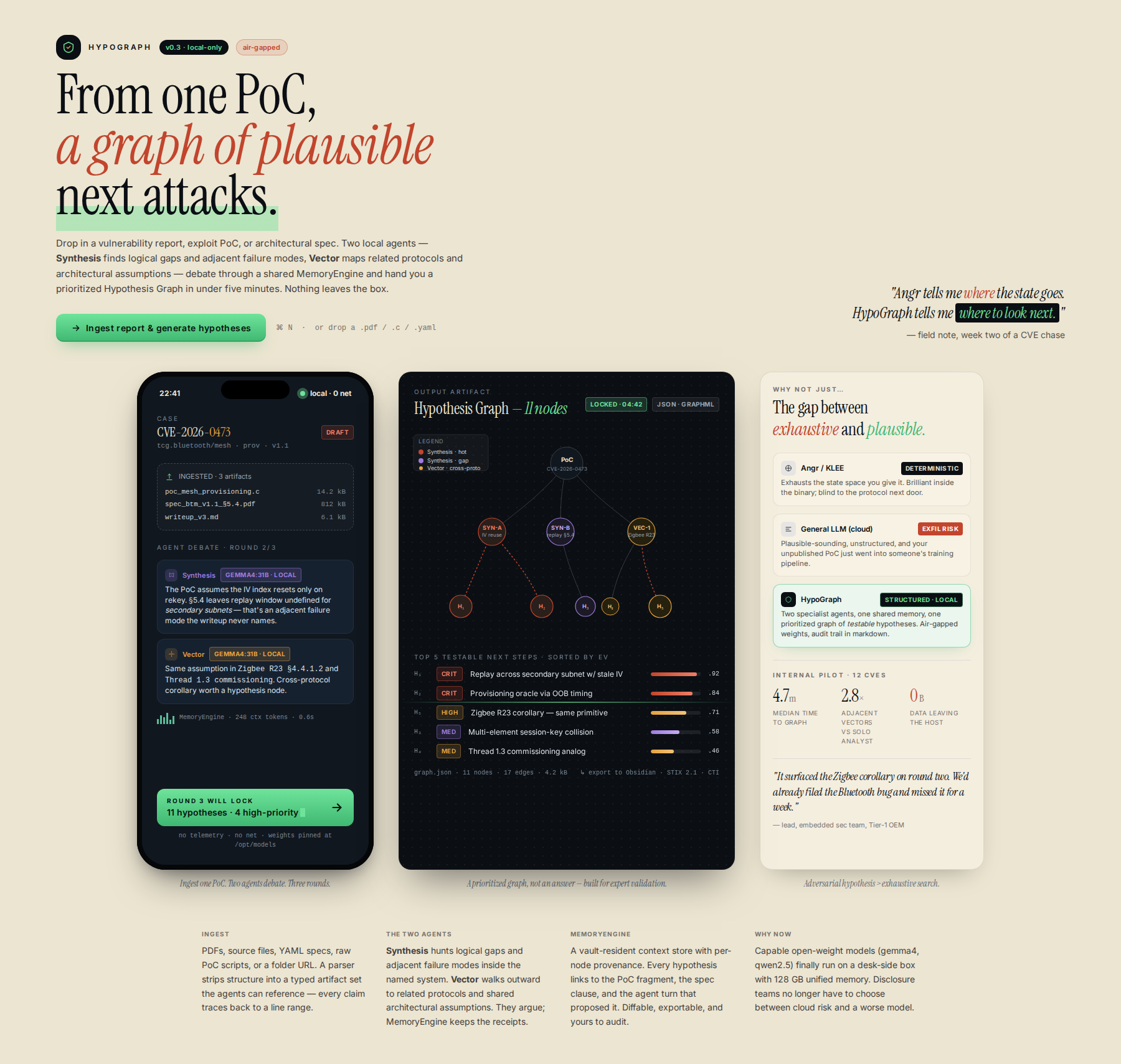
Process flow
Who it's for
Security researchers and academic vulnerability disclosure teams.
Why they need it
Complex hardware/firmware security analysis is bottlenecked by the sheer volume of related, unexamined attack vectors. This tool reduces the cognitive load on experts by systematically synthesizing potential next steps that human analysts must validate, accelerating the triage process.
What it is
A specialized local execution environment that ingests vulnerability reports (PoCs, architectural specs) and runs multiple specialized, local LLM agents to systematically generate a prioritized, structured list of potential failure modes and related attack vectors.
How it works
- Ingest vulnerability report/PoC data. 2. Route data through specialized 'Synthesis Agent' (identifying logical gaps/adjacent failure modes) and 'Vector Agent' (mapping related protocols/architectural assumptions). 3. Use the 'MemoryEngine' to maintain state and context across agent interactions. 4. Output a structured, multi-vectorized 'Hypothesis Graph'—a prioritized list of testable next steps.
Differentiation
Unlike general-purpose LLMs or deterministic tools (e.g., Angr, formal verification engines) which focus on exhaustive state exploration, this system acts as an 'Adversarial Hypothesis Generator.' It synthesizes structured, plausible next steps for expert human validation, addressing the gap where established tools fail to systematically map related, non-obvious attack vectors based on high-level architectural knowledge.
Implementation sketch
- Integrate the core logic of 'agentcollective' to manage specialized roles (e.g., 'Adjacent Attacker', 'Protocol Mapper', 'Assumption Validator').
- Adapt the input mechanism to accept structured vulnerability disclosures (PoCs, academic papers).
- Develop a 'Constraint & Hypothesis Engine' module that forces agents to suggest plausible, testable deviations from the input constraints, rather than proving failure paths.
First step: Develop a minimal viable parser (Python/Pydantic) to ingest 3-5 structured PoC snippets (e.g., assembly/register dumps) and output a standardized JSON schema representing the core inputs, expected outputs, and control flow paths for the 'Synthesis Agent' prompt template.
Remaining risks
- The 'Hypothesis Graph' output, while structured, might generate hypotheses that are technically plausible but practically impossible or irrelevant given real-world physical/protocol constraints (e.g., suggesting a memory write to an unmapped or read-only register). — Integrate a secondary, deterministic 'Reality Check Agent' that cross-references the proposed hypothesis against a curated, machine-readable database of known hardware/protocol limitations (e.g., MMIO ranges, valid instruction sets) and assigns a 'Feasibility Score' alongside the hypothesis.
- The system's reliance on synthesizing hypotheses from structured PoCs risks overfitting to the specific grammar and structure of the input vulnerability report, making it brittle when applied to novel, unstructured, or incomplete disclosures. — Develop a meta-parser layer that analyzes the type of input (e.g., academic paper, raw memory dump, high-level design document) and dynamically adjusts the 'Synthesis Agent' prompt structure and required grounding context, rather than relying on a single PoC-centric schema.
- The overhead of maintaining state and context across multiple specialized agents ('MemoryEngine') will lead to compounding hallucination or context drift, where early, low-signal assumptions corrupt the entire downstream hypothesis generation process. — Implement a 'Confidence Scoring' mechanism for every piece of context added to the MemoryEngine. If the synthesis of a new hypothesis relies on context whose confidence score drops below a threshold (e.g., 0.7), the system must flag the entire chain as 'Low Confidence Hypothesis' and require human review before output.
Watch for: A clear, quantifiable workflow bottleneck where human experts are spending time structuring or mapping the input data before analysis can even begin, rather than spending time analyzing the output. Kill criterion: If the initial MVP (the parser) cannot reliably ingest and normalize the core state/control flow information from three different, real-world PoC formats (e.g., an IDA disassembly snippet, a Python exploit script, and a formal specification excerpt) into the standardized JSON schema within a 3-week timeframe.