
AI-Assisted Hypothesis Generation for Scientific Simulation
A focused, local platform that uses specialized AI agents to interpret raw scientific simulation data, suggesting novel, testable structural hypotheses or parameter adjustments that human experts might overlook.
How can AI suggest novel experimental hypotheses from raw simulation data?
An AI analysis system interprets raw simulation outputs to suggest novel, testable structural hypotheses that human experts might overlook. By analyzing energy landscapes, geometries, and convergence metrics, specialized agents identify anomalies and propose unconventional parameter adjustments—e.g., 'Try testing structural motif X because the energy profile suggests instability.' This provides researchers a 'second pair of expert eyes' to accelerate discovery beyond standard optimization routines.
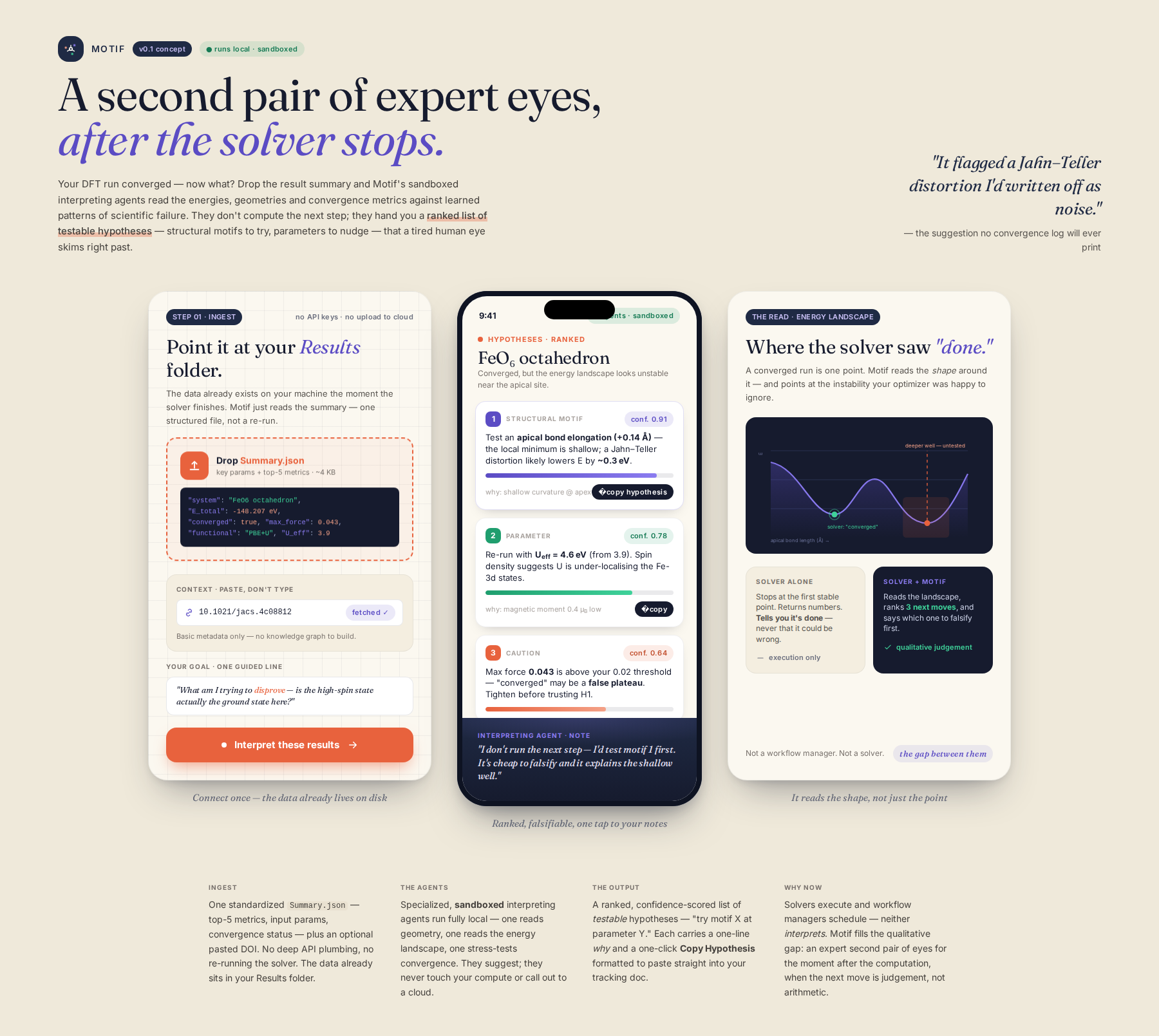
Process flow
Who it's for
Computational chemists and materials scientists needing to guide complex, multi-step research beyond standard optimization routines.
Why they need it
Existing simulation tools (e.g., Gaussian, VASP, SciPy optimization wrappers) are excellent at executing defined mathematical procedures (like gradient descent) but fail when the required next step involves qualitative, non-algorithmic insight—such as suggesting a symmetry break or a novel reaction intermediate based on complex energy profiles.
What it is
A containerized system where specialized, sandboxed AI 'interpreting agents' analyze the raw output (energies, geometries, convergence metrics) from established scientific solvers. These agents do not run the simulation, but rather suggest the next set of parameters or structural modifications for the human expert to test.
How it works
The user runs an initial simulation using a standard solver (e.g., DFT). The system captures the raw output data. The AI agents analyze this data against learned patterns of scientific failure/success. Instead of calculating the next step, the agents output a ranked list of hypotheses for the expert: 'Try testing structural motif X at parameter Y, as the energy landscape suggests instability here.'
Differentiation
Existing solutions are either pure execution engines (like standard solvers) or general workflow managers (like Snakemake). This system fills the gap of 'AI-driven, qualitative hypothesis generation from raw simulation data.' It acts as an intelligent 'second pair of expert eyes' post-computation, rather than an automated computation layer.
Implementation sketch
- Narrow the scope: Focus exclusively on one domain (e.g., transition state searching in molecular dynamics).
- Define the input/output contract: The system must reliably ingest standard output formats (e.g., XYZ coordinates + energy values) from a single, established solver API.
- Develop the core agent logic: Build a small, proof-of-concept agent (using RAG/prompting) whose sole task is to analyze a set of N data points and generate 3 distinct, plausible, actionable next-step hypotheses, citing the specific data points that triggered the suggestion.
First step: Select a public dataset of known chemical pathways and run it through a standard solver wrapper. Then, feed the raw output logs (e.g., 10 energy/geometry snapshots) into a local LLM prompt to force it to output 3 structured JSON hypotheses for the next step, validating the prompt engineering and data parsing pipeline.
Remaining risks
- The 'AI interpretation' becomes a 'black box' justification for poor science. If the LLM suggests a hypothesis based on spurious correlations in the raw data (e.g., correlating a minor noise spike with a major structural change), the expert user may trust the suggestion too much, leading to wasted, unscientific experimental cycles. — Implement a mandatory 'Confidence Scoring' mechanism for every hypothesis suggestion. This score must be derived from the density and consistency of the supporting data points, not just the number of points. Require the user to explicitly acknowledge the AI's confidence level before running the suggested test.
- The 'Input/Output Contract' is too brittle. Scientific solvers are notoriously sensitive to minor version changes, input file formats, or output logging variations. The entire system hinges on parsing unstructured, domain-specific text logs, which is an enormous, unquantifiable integration risk. — Do not build the parser layer first. Instead, mandate that the first iteration requires the user to manually pre-process and standardize the input data into a fixed, structured format (e.g., a specific JSON schema containing only coordinates and energies) before the AI agents can process it. This isolates the parsing risk to a manual, non-core dependency.
- The 'Novelty' defense collapses if the LLM simply parrots known scientific principles. If the generated hypotheses are merely 'try optimizing along the gradient' or 'check the next nearest stable structure,' the system is indistinguishable from advanced literature review tools or basic scientific software wrappers. — Constrain the agent's search space by forcing it to look for hypotheses that violate known, established chemical/physical rules within the context of the provided data. For example, suggest a structural change that forces a bond angle to deviate significantly from the ideal geometry, and then flag this deviation as the core hypothesis, forcing the expert to validate the physical possibility.
Watch for: A scenario where the system generates a highly plausible hypothesis, but the supporting data points are too sparse or too far apart in the simulation timeline to form a coherent narrative. This indicates the AI is hallucinating connections rather than interpreting physical evidence. Kill criterion: If the first concrete step (feeding raw logs into the LLM) results in the model generating hypotheses that are entirely uninterpretable or require domain knowledge beyond the scope of the prompt (i.e., the LLM is forced to 'guess' the underlying physics instead of just summarizing the data), the core premise of 'AI interpretation' fails.